• TalkBass has been independent since 1998. Add your voice.
    Create a free account to reply to discussions, view embedded media, and browse with fewer display ads.
    Join freeLog in
    Want zero display ads or expanded classifieds tools? Compare plans.

Cart before the horse...?

@rzamites

First, whatever you get, buy used. Pawn stores are a good source to keep an eye on. The best part of buying used is that you have the best chance of generally breaking even (+/-), if & when you decide to sell.

Next, find a comfortable to play Squier or MIM P-Bass and carefully remove the OEM pups and install your Geezer Butler pups. This will give you a bass that is at least somewhere in the same ballpark of what your custom made bass will be.

Then, take that bass and play it through various used offerings at pawn shops and or Craigslist/other ads, to find one that feels pleasing to you. The various suggestions of Fender Rumble offerings seem pretty spot on for a good starter rig. An Ampeg BA115 can also be pretty OK and often quite cheap. The B100R and B50R are fairly well regarded, for a little bit more.

Now, you've got a complete rig to practice up on and develop your skills to more accurately assess your custom built bass when you finally receive it, after swapping the P-Bass back to it's original pup. Of course, if you happen to decide that you enjoy that P-Bass enough to not want to part with it, another Geezer pup is only $120-ish!

Just My $.02 & Likely Worth Even Less?
Gene
 
  • Like
Reactions: rzamites
@rzamites

First, whatever you get, buy used. Pawn stores are a good source to keep an eye on. The best part of buying used is that you have the best chance of generally breaking even (+/-), if & when you decide to sell.

Next, find a comfortable to play Squier or MIM P-Bass and carefully remove the OEM pups and install your Geezer Butler pups. This will give you a bass that is at least somewhere in the same ballpark of what your custom made bass will be.

Then, take that bass and play it through various used offerings at pawn shops and or Craigslist/other ads, to find one that feels pleasing to you. The various suggestions of Fender Rumble offerings seem pretty spot on for a good starter rig. An Ampeg BA115 can also be pretty OK and often quite cheap. The B100R and B50R are fairly well regarded, for a little bit more.

Now, you've got a complete rig to practice up on and develop your skills to more accurately assess your custom built bass when you finally receive it, after swapping the P-Bass back to it's original pup. Of course, if you happen to decide that you enjoy that P-Bass enough to not want to part with it, another Geezer pup is only $120-ish!

Just My $.02 & Likely Worth Even Less?
Gene
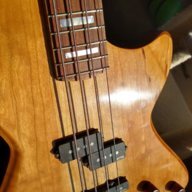
Exactly what I was doing at 2am - looking at used basses. There’s a few in my area that might be worth checking out, of course, I’ve considered buying a new Ibanez or Yamaha too - barring finding something local that I like.
 
  • Like
Reactions: Texican
Geez! From the tone of many replies here you’d think that the OP building his bass (having it built) is gonna give him cooties. The theme in this thread is that it can only go wrong. Feh! He’s involved in the build so the liklihood of a disastrous outcome is reduced. Doing what he’s doing will give him experience and insight that precious few of us have. From that standpoint alone I say, “Good on ya!”

The return-of-investment-on-resale argument gives me the willies because it says, first, that you haven’t carefully considered your purchase beforehand and, second, that you’re emphasizing a wrong reason for getting an instrument.

The topic of the thread began as getting an amp before getting the bass. It sure careened off to a cantankerous side issue. But that’s TB, isn’t it?
 
Last edited:
Geez! From the tone of many replies here you’d think that the OP building his bass (having it built) is gonna give him cooties. The theme in this thread is that it can only go wrong. Feh! He’s involved in the build so the liklihood of a disastrous outcome is reduced. Doing what he’s doing will give him experience and insight that precious few of us have. From that standpoint alone I say, “Good on ya!”

The return-of-investment-on-resale argument gives me the willies because it says, first, that you haven’t carefully considered your purchase beforehand and, second, that you’re emphasizing a wrong reason for getting an instrument.

The topic of the thread began as getting an amp before getting the bass. It sure careened off to a cantankerous side issue. But that’s TB, isn’t it?
Thanks for that post. I was starting to feel pressure (self-induced) to cancel the build and just buy a used bass and amp, and STFU until I had more experience. And for the record, I’m not opposed to buying a ‘beater’ bass and amp, but current social and public health circumstances curtail flexibility in trying out a bevy of them.

Cheers,

Rob
 
Geez! From the tone of many replies here you’d think that the OP building his bass (having it built) is gonna give him cooties. The theme in this thread is that it can only go wrong. Feh! He’s involved in the build so the liklihood of a disastrous outcome is reduced. Doing what he’s doing will give him experience and insight that precious few of us have. From that standpoint alone I say, “Good on ya!”

The return-of-investment-on-resale argument gives me the willies because it says, first, that you haven’t carefully considered your purchase beforehand and, second, that you’re emphasizing a wrong reason for getting an instrument.

The topic of the thread began as getting an amp before getting the bass. It sure careened off to a cantankerous side issue. But that’s TB, isn’t it?
The OP has clarified their situation a bit, so it makes a little more sense now. Initially it definitely came off as "new bass player, looking for an amp, already commissioned a custom build by an unknown builder". Nobody is gonna get cooties, but I think it's pretty solid advice(which some of us came by the VERY hard way) to let someone know the potential pitfalls. The biggest of which(in my mind) was that a new bassist might not even know what really works for them. It took me awhile to realize I have a preference for larger necks(especially front to back thickness.) Conventional wisdom would not indicate that would be the case, since I have average size hands and was already a guitarist, lots of evidence would suggest I'd likely prefer a thin jazz neck. And the OP mentioned later this was not a high dollar build, but initially folks thought he might be dropping alot of coin. Again, no cooties, but I'm of the opinion that if I can save a person from dropping $5k-10k on a custom build that if they decide is not their cup of tea that might get half that if they're luck, I will. Even custom jobs from well known builders often don't hold their value all that well.
 
Thanks for that post. I was starting to feel pressure (self-induced) to cancel the build and just buy a used bass and amp, and STFU until I had more experience. And for the record, I’m not opposed to buying a ‘beater’ bass and amp, but current social and public health circumstances curtail flexibility in trying out a bevy of them.

Cheers,

Rob

Nothing wrong in my book of getting a good professional bass to play first. Bass is what you play. It you buy a cheap instrument, or buy a used one with problems it may be discouraging. And you can get some adjustments or modifications done by the luthier after you purchase. A good bass will sound good with a headphone amp.

The amp and cabs can come later.

In the meantime you can use modeling to try out many head and cabinet combinations. Get a good low cost audio interface for your computer or iPhone/iPad. And try out some modelers. Some like IK and Brainworks (Plugin Alliance) are actually certified and endorsed by the original amp makers to sound the same as the hardware versions. The PC versions have free trials, some as long as two weeks with the Brainworks VSTs. If you find a software modeling amp you like with your new bass, then you can hunt down the hardware version. There are also several heads these days that have built in modeling. They are showing up in recording studios and stages everywhere these days.
Many pedals also are doing modeling.
Check out the cab impulse response threads as many pedals also do cabinet modeling.
 
  • Like
Reactions: rzamites
Nothing wrong in my book of getting a good professional bass to play first. Bass is what you play. It you buy a cheap instrument, or buy a used one with problems it may be discouraging. And you can get some adjustments or modifications done by the luthier after you purchase. A good bass will sound good with a headphone amp.

The amp and cabs can come later.

In the meantime you can use modeling to try out many head and cabinet combinations. Get a good low cost audio interface for your computer or iPhone/iPad. And try out some modelers. Some like IK and Brainworks (Plugin Alliance) are actually certified and endorsed by the original amp makers to sound the same as the hardware versions. The PC versions have free trials, some as long as two weeks with the Brainworks VSTs. If you find a software modeling amp you like with your new bass, then you can hunt down the hardware version. There are also several heads these days that have built in modeling. They are showing up in recording studios and stages everywhere these days.
Many pedals also are doing modeling.
Check out the cab impulse response threads as many pedals also do cabinet modeling.

Thanks for that feedback - I’ve actually got a Yamaha AG-6 Mixer that comes with modeling software, and works great with my iMac, although I’m not 100% positive that it comes with bass amps - I’ll check after work.

As an aside, I found an ‘as-is’ JP bass , sans nut, tuner and strings on GF’s website, it, plus a pre-slotted bass nut is about $65 - it’s tempting to buy that and slap my new tuners and Geezers in it and see how it goes:
[Invalid or Expired Link Removed]

Cheers,

Rob
 
I might think a "ready to play" unit like a Squier from a pawn shop could suit you better. My buddy picked up a Squier Affinity P-Bass, in pristine condition, for $80 at a pawn shop. All it needed was a truss rod adjust and some intonation setup (the strings were still like new) and it's the lightest P-Bass I've ever picked up. Plays well and doesn't even sound bad with the original pups!
Just Sayin'
Gene