• TalkBass has been independent since 1998. Add your voice.
    Create a free account to reply to discussions, view embedded media, and browse with fewer display ads.
    Join freeLog in
    Want zero display ads or expanded classifieds tools? Compare plans.

Double Bass carved bass bar.

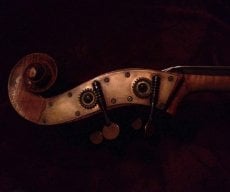
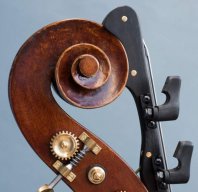
And some new german ones.

Heiner Windelband (Invalid Link Removed) makes tops with integrated bass bar. He told me the top will not sink on the bass bar side over time with these integrated bass bars. A lot of top jazz bassists go to him for (re-)setup and fingerboard planning when they visit Germany. For those going to BASS2012 in Copenhagen he will be there with his instruments. Really nice guy, you might like to talk to him about things like that.
 
Wrong side? Maybe the pic is flipped.
As far as the integral bass bar. I seem to recall hearing that they didn't work well and were often planed down and replaced with separate bars. This practice (if it truly existed?) seems to be contradicted by the fact that they are now being used in newly constructed basses from Germany as DoubleMIDI says.above.
 
Which probably means they are not familiar with it and go the route they know.
I don't want to say the integrated bass bar is better in any case, but it seems to make sense not to glue something in that could have been there naturally.
Even in Germany the traditional makers use glued in bass bars, but mostly because "it always has been this way and works for us". Heiner didn't like this purely traditional approach and experimented a lot on his own instruments before he used integrated bass bars for his topline basses.

The traditional method of glueing in a bass bar makes it easier to change it to a larger/thicker bass bar if needed. For the integrated bass bar you need to take off the top and only can make it smaller or remove it completely. This could be a reason why an integrated bass bar might (!) be a bit thicker than needed and sound may suffer from that. I really don't know if this is the case, but it seems to make some sense.
 
Why does it make more sense not to glue something in that could be in there naturally? As I understand it, integral bass bars were a matter of fast and cheap production -- fitting a seperate bass bar is hard work that takes time.

On top of that, having a seperate bass bar with the grain off-axis is supposed to offer greater strength and resistance to cracking.
 
This just off the top of my head so take some salt.
But the advantage of a separate, glued, bass bar might be that it is a piece of selected, straight-grained wood, possibly of a higher strength and density, while the integral bar is dependent for its grain, growth rings, knots, etc., on the variations of the top itself?
Just guessing :hmm:
 
Heiner told me that the top will be carved roughly by machines to his specifications and finished by hand. So not too much more work that way. The picture at the beginning seems to be a machine cut part to be worked out by a luthier.

Of course with a glued-in bassbar there are more options, some more than I first thought of, of course. So the luthier needs to have a lot of knowledge and experience to make a good top with an integrated bass bar. But I'm sure Heiner wouldn't use the integrated bass bar in his top line if it wouldn't sound better on his basses. And a lot of his customers like these basses with integrated bass bars.

There is always a way doing things badly, but this doesn't proof that anything made that way needs to be bad. This is what wanted to show. Maybe most or all of the basses with integrated bass bars in the US don't have the quality of Heiner's work.

If you ever have a gig in Germany visit him and try his instruments. Maybe you like them, maybe not, but even talking to him is very interesting and informative.
 
Seems not to be the kind of sinking I meant.

On my bass (and my luthier who built my instrument warned me that this will happen after some years) the top sunk a bit where the bass bridge foot resides on. So at the bass bar f-hole the inside edge is one or two millimeters lower than the outside edge (compared to the treble side). Mostly visible at the lower end of the f-hole, the top at the smallest distance has no height difference at the treble side but about three to four millimeters on the bass side.

Heiner told me this happens with a glued-in bass bar and will not with the integrated bass bar. (At least with his instruments.)

So the sinking I was refering to is more a local one on the inner side of the bass bar f-hole.
 
I dunno. I wouldn't want to carve in an integral bar. Looks like much more work than just graduating a plate and then fitting a conventional un-sprung bass bar.

I carved my top with an integral bass bar, since that is what the plan suggested, and I figured in the worst case, I can always plane it down and glue in a new one.

Carving in the bass bar was not really easy work, and during the process I constantly had this urge to get rid of it. I don't think it was necessarily done to save money.

George
 
I've worked on quite a few instruments with carved in bass bars, mostly in violins. In everything I've seen the workmanship was extremely rough with the top needing more careful graduation and the bass bar being very poorly executed. Regraduation and a new glued in bass bar has greatly improved the instrument every time. If I ever saw a carved in bass bar that looked like it was done well with some forethought and intention, and the instrument sounded reasonably good, I would leave it in, I think the idea has some merit. The biggest problem in my mind with a carved in bass bar is that is is associated with cheap, crappy work.