• TalkBass has been independent since 1998. Add your voice.
    Create a free account to reply to discussions, view embedded media, and browse with fewer display ads.
    Join freeLog in
    Want zero display ads or expanded classifieds tools? Compare plans.

Cheap bass neck (Kmise)

Just to share my experience with a cheap neck bought in eBay.

The neck brand is Kmise and cost me, including shipping and a partial refund (more on this later) a bit more than 25€. Wonderful price for a 21 frets Jazz Bass style neck.

I was looking to change my white japanese PB70 rosewood neck for a maple one, as all my P basses are rosewood. Although I wanted it finished as Dee Dee Ramone's one, finally I chose the yellowish vintage finish. My first option was a P neck (41mm nut width) with 20 frets, but as I didn't want to spend a lot of money in a Fender/AllParts/WD neck (few found in the EU and none for less than 250€.) I finished buying this Jazz Bass neck with 21 frets.

Pros:
* Dirty cheap
* Lacquer finish (satin) is smooth
* Frets are well placed, in height and smooth at the edges
* Trussrod works perfectly and neck is straight as an arrow
* Neck pocket had to be filed and sanded a bit. After this, it fitted as the original
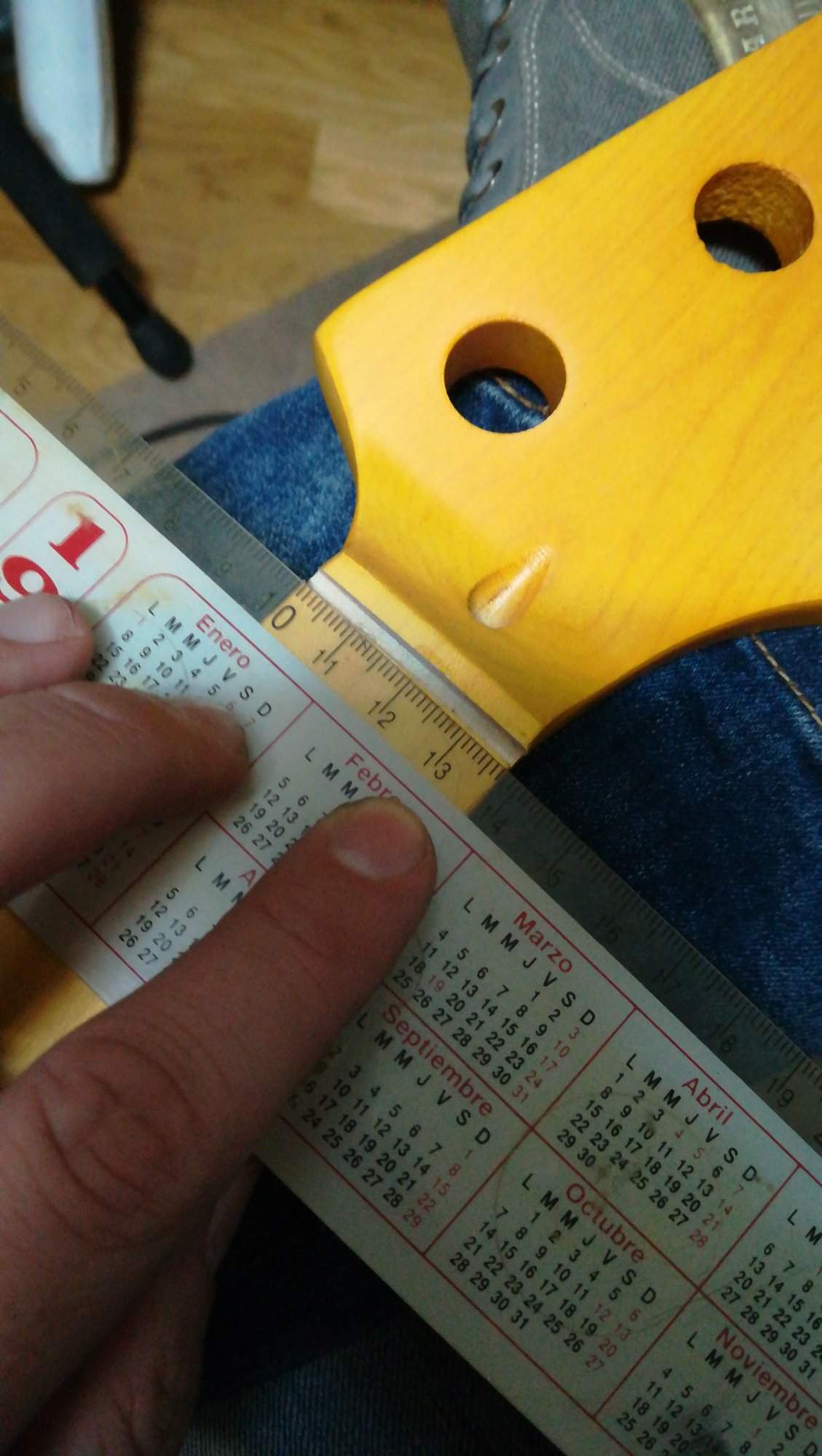
* Plastic nut well done and low height. Fits as a glove. 38,1mm width
* Fretboard/neck joint barely visible

Cons:
* Neck width at nut is barely 37mm, instead of the 38,1mm
* Standard sized machine tuners DO NOT FIT in headstock. Small plated (as found in the Highway One Precision) or lite tuners needed.

Before I bought the machine heads (Wilkinsons) I asked the seller if they'd fit. I got his OK but actually the tuners didn't fit. I got to swap them with the Highway One tuners. Due to this and the neck width at nut I got 10€ refund from the seller.

After all work done, I've found that the bridge is a bit offset to the right from factory, but so few millimeters it would not be worth of fixing it. The best part is that the original extra dark tone of this bass is gone.

All in all, it's a great neck for the money, far better finished than any Squier neck I've seen.
Very happy with it!

IMG-20171122-WA0006.jpeg
IMG-20171122-WA0004.jpeg
IMG-20171122-WA0018.jpeg
IMG-20171122-WA0020.jpeg
IMG-20171122-WA0008.jpeg
IMG_20171123_230443_new.jpg
IMG_20171126_233805.jpg
 
I'm wondering if anyone can see why this was not such a good deal. I don't want to come off as being overly critical, but from the photos alone I see a really inferior neck. Anyone else?
No it is not inferior. It is dirty cheap with all the subsequences like narrower nut, too small holes for tuners and etc. Also the moisture of the wood is unknown factor.
 
I got one laying around that I will put on a fernandes jazz body. it is a cheap neck, the finish seems like it'll come off but maybe I'm wrong.. Mine has the tuning peg holes drilled in such a way that some are smaller in diameter, but one of them is too wide that a 19 mm bushing is too loose. I can't comment on the truss rod as I haven't installed it yet (trying to fix the tuning peg situation first). The heel had to be rounded as OP mentioned. Frets seem fine so far but any possible problems will be obvious when it is installed if I ever do. I took a risk and paid $40 for it including shipping.

If anyone has unusued bushings that are over 19mm in diameter, hit me up please.
 
How 'bout:

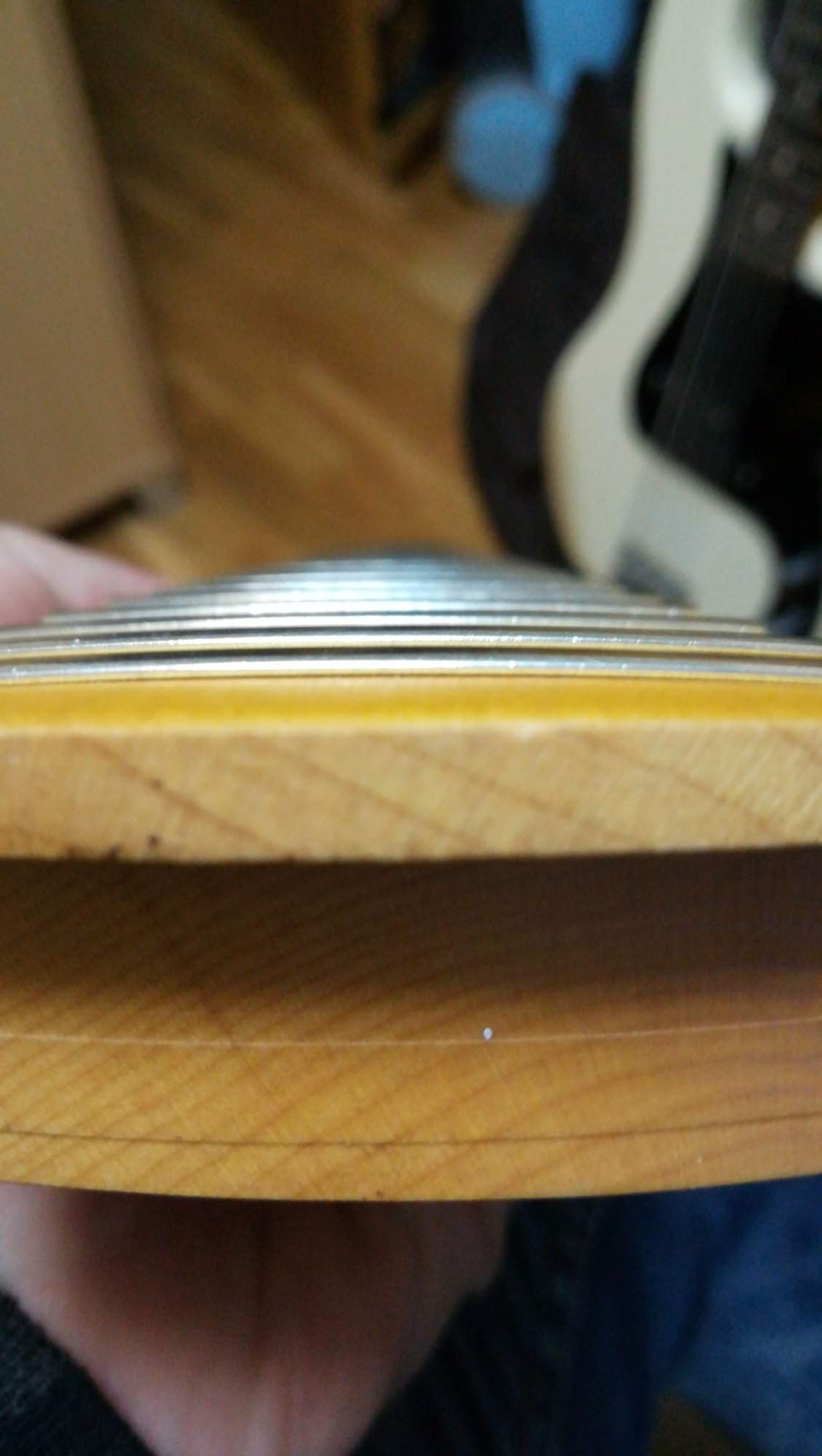
  • Grain. Just bad.
  • Grain choices between fingerboard and neck.
  • Lacquer chips at fret ends.
By the way, the bridge is probably located correctly. The neck is out of alignment.

The Fender decal on non-licensed neck misrepresents the product.
 
How 'bout:

  • Grain. Just bad.
  • Grain choices between fingerboard and neck.
  • Lacquer chips at fret ends.
By the way, the bridge is probably located correctly. The neck is out of alignment.

The Fender decal on non-licensed neck misrepresents the product.
Yah - you got it. The neck wood consists of wood cut too close to the centre of the log and has wide growth rigs on one side, closer on the other. Stability and rigidity are in question. That endgrain really looks bad . The wood in the fingerboard is also a poor choice for a fingerboard - really wide early-growth rings, indicating a fast growing tree. Not what you want for a fretboard. I would call it a neck-shaped object.

After all the most important component of the neck is the wood - it's the one thing you can't fix.
 
Can't it be coated in magic fiber-bondo-liciousness? That would make it stronger. Maybe pour some down in the truss rod channel, too!

It doesn't matter how nice the kitchen looks if the foundation won't hold the structure.
 
Awesome knowledge from all of you. Thanks so much for your comments. Really appreciated! :thumbsup:
The wood cut and grain you commented really knocked me out. It looked nice to me. 100% ignorance.

Let's hope at least it can serve me until I could find a truly decent neck. At least it's original extra-dark tone is gone.

Live and learn!
 
  • Like
Reactions: yodedude2
I wouldn't expect much for $40 (amazon price).
and for $40 it's very nice. Much nicer than other necks costing twice as much.

Nice, as in pretty? Maybe. But structurally it's an accident waiting to happen. Junk is junk no matter how pretty.

There was a sign that hung in my grandparents store. Another like it was in my dad's store. Same thing in my store. All three signs said the same thing:

No price is a bargain unless you get quality!
 
I wouldn't expect much for $40 (amazon price).
and for $40 it's very nice. Much nicer than other necks costing twice as much.
That is a lot to spend if it turns out to be something that is useless in short order. It may look OK now but I'd like to see what it looks like after it's been installed and under string tension and used for a year. My prediction is that there will be issues that will be costlier to address than the purchase price by a factor of 3x. Bargain?? Not in my books.

I don't mean to rain on anyone's parade, and I am not criticizing the OP. I just aspire to help folks make good decisions by pointing out what seems to be often overlooked.

Further to this I am going to post a thread in the Pro Bench sub-forum about sizing up neck quality. It may take a day or two for me to put it together and I will be inviting other Pros to comment. You will be able to find the discussion in a thread here:

Pro Bench
 
Last edited:
Except that it was described as being a great neck.

I said: "it's a great neck for the money, far better finished than any Squier neck I've seen."
Frankly, if the neck doesn't bow or breaks or any other terrible thing as long as I'm going to use it as a stopgap, for 25€ ($30), IMO, is more than good. After all, putting adjetives to things is a subjective thing (think in cars, ie). Sure I'm taking your advice and notes seriously in order to not to repeat same mistake and to check it until I could find a good one.

Again thanks for your input!
 
  • Like
Reactions: 3rdworlder
I said: "it's a great neck for the money, far better finished than any Squier neck I've seen."
Frankly, if the neck doesn't bow or breaks or any other terrible thing as long as I'm going to use it as a stopgap, for 25€ ($30), IMO, is more than good. After all, putting adjetives to things is a subjective thing (think in cars, ie). Sure I'm taking your advice and notes seriously in order to not to repeat same mistake and to check it until I could find a good one.

Again thanks for your input!
I guess my point was that it's not a great neck at any price.
 
  • Like
Reactions: RSBBass and Kikegg
The mission on this board is to help those who have less experience. Grain like this in a neck tends to have problems. That's not paranoia it's fact. It's not about value. It's not a good choice. At any price.

The finish on the neck is nice. But if the neck doesn't function for it's expected life (60+ years and counting) because of poor wood choice the finish just doesn't matter.

As far as ridiculous conversations go, if helping people understand wood and wire on a guitar board dedicated to repair is ridiculous, then this conversation is as ridiculous as it gets.
 
No one is getting rich selling quality replacement necks. To sell something that cheap, they have to be using wood that others wouldn't. Not all wood is the same. Simple as that.

I make baseball bats - suppliers generally see three different grades of blanks, based on grain and knots, etc.. I further grade what I get, including those issues and weight. I would imagine it's the same thing for neck maple, and these manufacturers are buying the lower grade wood.
 
Bass snobs always lose perspective when it comes to lower end gear. It happens every single time. A guy asks what bass he should buy for his 12 year old - and they recommend a $675 retail Fender Mustang...because...wait for it...everything else is crap. Never mind that it's likely to be nothing more than wall art that never gets paid. They look at everything through the eyes of what would be ideal for someone like them. Someone who has not already learned to play, but has made it a lifetime commitment.

Above, folks are talking about this neck as if it is going on a $12,000 Fodera and not a $199 Squier Affinity series (as an example). The question is not how does this neck compare to you genuine American Fender neck from 1962. The question is how does it compare to those made by Squier, Rogue and other bargain manufacturers. Will it make a good replacement for a beat up bass they found at the local pawn shop for under $150? Not will it work on a vintage collectors item.

Someone saying "it's junk at any price" would probably think anything less than professional grade is junk. Because for him, at his level of skill and commitment, it is. He's forgotten what it was like for this to be just a hobby and not a lifestyle/obsession. Or better yet, career if he's lucky.

You have to keep this stuff in perspective. The answer to every problem isn't to spend a months salary on gear. The real question is, is this neck appropriate for his application.