• TalkBass has been independent since 1998. Add your voice.
    Create a free account to reply to discussions, view embedded media, and browse with fewer display ads.
    Join freeLog in
    Want zero display ads or expanded classifieds tools? Compare plans.

Chinaberries ... a Build and a Half

Said "Hi!" in the "Who are you?" thread, but wanted to show a few pics of my first half-build and first scratch-build. To be fair, I did build a LP-ish guitar, but that was a kit, so except for a few customizations, glued the neck, rattle-canned a bit of clear lacquer, and assembled the parts. but encouraged by that, I wanted to "fix" my Hohner B2B to be more like my Steinberger Spirit 5-string bass that has a more traditional body than most "broomstick" Steinbergers.

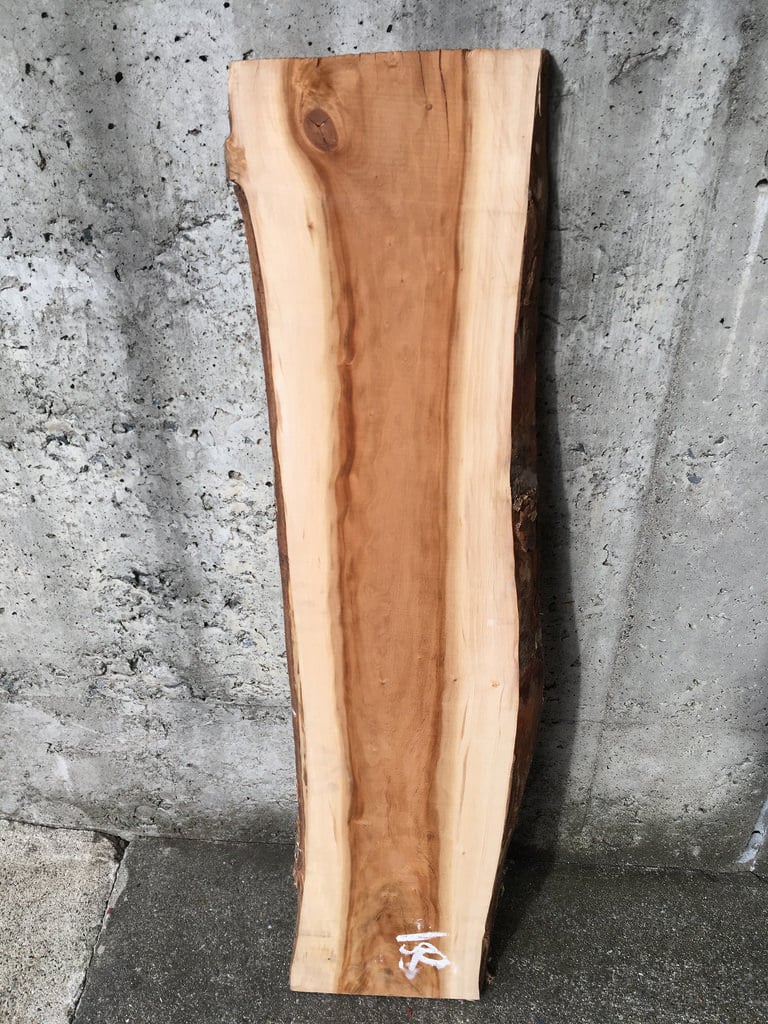
I won a cheap bid on a slab of Chinaberry (Sendan in Japanese, melia azedarach in scientific lingo) on Yahoo! JAPAN auction, probably because it had a huge knot right smack in the center. I was going to make a guitar with the knot where the pickup would be, but then got greedy ... why not two?! So I also bid on some lengths of Japanese Mountain Cherry, picking it up at a low bid because it was about half red heartwood, and half light sapwood ... and a few quirky ideas started percolating.

Here's the Chinaberry and one of the Cherry pieces:

23855304109_3b268b668c_b.jpg


30945748093_24c7b6af79_b.jpg
 
  • Like
Reactions: cazclocker
I decided on a Stingray type Bartolini pickup for the half-build. The Hohner had a nice maple bolt-on neck under a LOT of shiny black poly, so stripped it, reshaped it (slight "V"), finished with satin nitro, and made it a set-neck.

My workshop is the size of a very tight one-car garage ... which is what it was! In Japan, that is the epitome of luxury. I've been a carpenter/handyman all my life, but found quickly that building guitars requires a different set of tools! My first was a hand-me-down hobby drill press, then bought a nice router and a portable table for it. Since then I've added a small belt sander, and just the other day got a birthday present ... a tabletop 10" bandsaw that can resaw (slowly!) 175mm (7"). That will probably be it for a while, unless I can conjure up more square footage ... VERY precious!

Filled the grain with clear epoxy, then used a rattle-can clear lacquer. I wanted to finish the half-build before starting the scratch-build, so I could figure out what in the world I was doing! Probably took about two months to finish Chinaberry One, and gigged the following Sunday :thumbsup:.

BTW, you can see how I "incorporated the sapwood into a forearm contour ... like I said, getting two bodies out of that slab was really, really tight. I'll call it a "feature" ... anyone who remembers Windows 95 will know what that means! :laugh:.

31694913640_01960dbbbd_b.jpg


32069950165_784e4d4886_b.jpg


31431139943_3dc8eafbca_b.jpg


32431167185_0a4defd26a_b.jpg
 
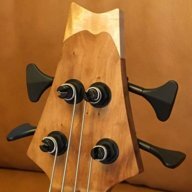
For Chinaberry Two, a real build, I wanted to use Japanese wood for the neck, but finding a suitable hardwood wasn't that easy. Most that I could find were great for carving, or making cool antique furniture/cabinetry, but a guitar neck, especially a bass guitar neck made folks wince. Almost all Japanese luthiers use foreign wood! The Japanese Mountain Cherry I found has a reputation of strength, but also movement. Fortunately, it was really seasoned, so I just used a router sled to plane it down little by little, giving time between to settle. Altogether spent about a month to get it to basic blank dimensions, each session showing less movement. The one piece neck was critical, as I'd gotten the idea for a Mt.Fuji headstock, loosely based on old Hokusai woodblock prints, specifically the "Red Fuji." That's where the almost-white sapwood comes in. In order to be real woodworking according to the Hakone Zaiku fashion, the "snowcap" had to solid wood, not an inlay.

Btw, Mt.Fuji is only about an hour away from my home, and I can see it from a nearby hill on a good day, especially in the winter. I've been here more than 40 years, and used to ride my motorcycle around the mountain all the time. Later, when I got into Kamikaze Downhill bicycle racing, I would carry my bicycle to the 8th station (approximately the snowcap on my headstock) and ride down to the 1st station at the base of the mountain. Yeah, this mountain has a place in my heart. And Hakone (the woodworking master's region) is just east of there, and I have been buying wooden toy, "Magic boxes," and even artwork since I was a pre-teen.​

Back to the guitar. I used the same sapwood for the fretboard, and heartwood for the fret markers. To strengthen the neck, I added carbon fiber rods.

It's getting late, so will post more later.

31641037641_77c7f31467_b.jpg


30915507644_889a3a10f1_b.jpg
 
Obviously not the same chinaberry from the US...that is so soft if you look at it too long itll take dents

Indeed, very hard stuff! Cutting it with a jigsaw was a chore. I've seen Chinaberry in Hawaii (my daughters live there) that is soft and not nearly as stripey. I found another larger slab a few weeks ago, again with a big knot in the middle, but equally hard, and even some flame ... hard to tell, but it's about 4-1/2 feet long and almost 3 feet wide. Enough for a full-size body on the left center, and the right side enough for a bass through-neck. Too bad the pith in the center curves so much, or I could get two bodies!

Those two interlopers are Chianti the Papillon and Beaujolais the Border Collie.

34628316406_3a0b7e7feb_b.jpg


34507884672_4e4a1fd7f8_b.jpg
 
  • Like
Reactions: goodkingzog
Forgot to add a few things about the Chinaberry One headless ...

Weight is 3,342g (7lb.6oz.) and nicely balanced. The controls cavity is really minimalist, and the maple cover is recessed and held on by one neodymium magnet. Tone report is that is sounds a lot like a MM Stingray, no surprise, but surprising that I get that on a passive system. I used an Emerson treble bleed on the volume, which really seems to help the tone knob be more useful.

32377212526_94e69191ff_b.jpg


32416674375_860cb72ce7_b.jpg


32295687051_2a05b4ab43_b.jpg
 
Back to the Chinaberry Two, here's the neck blank getting prepped in the router sled, and my primitive use of Windows Paint to figure out what works. I used FretFind2D ekips.org - FretFind2D to calculate a 30" scale. I guess the main reason for the short-scale was I just wanted to try one! The other was that I wanted total guitar length to be about the same as the headless ... our stage is kinda tight. ;)

31848197153_6fb4293151_b.jpg


32586170262_5d51dedb11_b.jpg


32659915155_4cac4afc5b_b.jpg


32699140886_24ea6a3ca3_b.jpg
 
  • Like
Reactions: mikewalker
Next was getting the whitish sapwood into shape for the fretboard. I did the same as the neck blank, and used hand planes and router sled to get it basically flat. Then I resawed by running a line on each side using my "table saw" ... which is just an old circular saw upside down in my shop table. Honestly, it's not very good for precision, but good enough for some rough cuts. The rest was done with a handsaw. I made four mostly sapwood fretboard blanks, one for this build, two for buddies, and one for a future build.

31971734094_96c1b892b0_b.jpg


32871306435_72582c6cbb_b.jpg


32871304385_5f5fab188b_b.jpg


32028549594_2102af8bef_b.jpg
 
  • Like
Reactions: rwkeating