• TalkBass has been independent since 1998. Add your voice.
    Create a free account to reply to discussions, view embedded media, and browse with fewer display ads.
    Join freeLog in
    Want zero display ads or expanded classifieds tools? Compare plans.

Chinese knock-off basses

To start, most countries respect the laws of other countries. Second of all, they are marketing and selling them here. Third, you are the one who said we should change our laws.

I don't think China has ever respected trademark and copyright laws of other countries. They are marketing them on a website in broken English, and they are selling them here. That part isn't lawful. I don't remember saying we need to change our laws. I do think China needs to change theirs.

 
Perhaps now, and I have no real philosophical disagreement with now. But if this principle had been rigorously applied across the decades, the landscape of music today would be quite different. Back in the day when a car's back seat was as large as a room in a Microtel (and softness of springs was a big deal), most neighborhoods (in my town at any rate) had a community center, every weekend most of those community centers held a sock hop: high school garage bands playing hits off top 40 am radio. Nobody paid licensing royalties to ASCAP, BMI, or SECUS. If they had to, nobody could have afforded it and there would have been no sock hops and no bands and a lot fewer pickers than are on the landscape now.
And ASCAP, BMI, and SECUS did not care; this "free music" was alright by them. They made their money off licensing fees paid by the nightclubs (and at the time I am speaking of, the Bossier Strip had a looooot of clubs).

Now, the licensing agencies have gotten predatory and are going after even the tiniest venues with a vengeance. The upshot of this is that nobody in my current area can afford to host live music -- not when they have to pay fees to ASCAP *AND* BMI *AND* SECUS. And the venues that did had to stop under threat of litigation from the licensing agencies. I know; I've spoken with the venue owners. No venues mean no bands; and no bands means no upcoming generations of pickers. Cui bono?

The old way was not perfect, but minimal harm was done. The present way is even less perfect and does much harm. There ought to be a media via that would satisfy the most important needs of all parties concerned.

To quote Luke Skywalker... Everything you just said is wrong. The Performing Rights Societies are not predatory. The blanket licenses for businesses that use music is based on maximum occupancy and how many different uses of music there are. If a business is small, the minimum yearly fee is less that $600. It also cannot be larger than $7,000, and that's for HUGE businesses. I worked for one of these organizations for over 10 years, and know all the fees. The "can't afford it" line is BS. If you REALLY can't afford it, how is your business even staying afloat?? The fees are quite fair, and justified, as businesses use other people's intellectual property for profit (play music... sell more beer. play music... people dance. play music... charge cover at the door). Some of that profit should be given to the songwriters that make said profits possible.
If a business is claiming they can't afford to host live music, they're feeding you BS, or they're very poor when it comes to running their businesses. They're projecting their own greed, or misunderstanding of the law on live bands. The Performing Rights Organizations are NOT the reason live bands aren't getting booked in certain venues. It's the venues.
Jukeboxes don't usually factor in because they are normally leased to businesses and have a Jukebox Licensing Organization number. They are exempt as the JLO already pays the Performing Rights Societies. Also, it's SESAC... not SECUS. A community center would also be exempt (non-profit), and private clubs are also exempt. Know your facts about performing rights, and intellectual property before believing what you hear from business owners. Contact the Better Business Bureau.
 
Well, we seem to have BS and rubbish in common. More than fifteen years ago an elderly couple I know who owned a used bookstore had to cease playing CDs THEY had bought on a CD player THEY had bought at a volume level that could barely be heard at the check-out counter, because some Performing Rights Societies' weasel claimed they were providing "free" entertainment to customers waaay at the back of the store -- a distance that could have been measured in many yards, not just feet. That IS predatory, but the couple did not have the resources to defend themselves in court, so they had to deprive themselves of music that they had purchased legally for their own use.

Agreed, large clubs and bars should be able to handle the fees, especially if the music is a principal component of earning their income. The instances I have in mind, and they are factual, are of coffee shops in towns with a population of 5,000 or thereabouts who are trying to provide music as a service to their communities rather than as a source of revenue. They. don't. sell. beer. And at most they had music only three times a month. So already you and I are talking apples and oranges.

While $600 for a license may not be burdensome for such small businesses, having to dole out $600+ annually to ASCAP and BMI and SESAC *is* prohibitive. And unless things have changed, maximum occupancy is based on how many people can jam themselves into a venue as if it were a storm shelter, not normal seating at full capacity. So the occupancy is inflated, which makes the licensing fee inflated. This is a problem created by a bad law made by Congress, but the PRSs seem perfectly willing to take advantage of it. That too is predatory.

I am not saying artists and writers should be denied the fruits of their labors, any more than you. I am saying there is a problem with things as they are and compromises should be made. Having a composite ASCAP/BMI/SESAC reduced fee for venues below a certain seating capacity or of a certain type would be one way. Adjusting seating capacities to "business as usual " numbers that reflect reality would be another. But I believe the present system creates inequities and invites abuse, and we ought to be able to find a better way. We have a problem; we ought to be able to find a solution.
 
  • Like
Reactions: Cliff Colton
It's a pleasure to read two well-put arguments which are diametrically opposed.
It's confusing to nod my agreement to both.

Personally I don't ultimately feel that the creator has the right of ownership regarding that which is created.
Twenty-four years of creating things I couldn't afford to own taught me that.
If there was a way that the composer could be paid once, at a price set by the market, to free the composition for all, I would support that.

In the Seventies, my mother was on a bus in Austria, where she heard a group of tourists from Malaysia singing a song written by my brother. Isn't that what music is about?

Or is it business ...?
 
  • Like
Reactions: JRA
My new Chinese bass arrived yesterday, a Sinfonie 24 Double bass from Hamburger Violin Design Manufaktur (Basic) 3/4. I don't suppose they designed or manufactured it, (the box said Made in China) and think it likely that most of my €2,000 will remain in Germany.
The finish seems very good, and the sound is fulsome. The soft case held the bow and bridge, and a small container with cloth attached (resin? polish? moustache wax?).

Although I was keen on a solid wood instrument, the climate here in southern Spain is sub-tropical so I am hoping that a decent plywood will hold together. Also whether the sound will mature with age. The varnish is fairly matt, so I'm wondering about polishing it.
There are extensive instructions, with some stern warnings, in German which I am slowly untangling, and in order to keep it out of the sun I need to move the furniture around in the music room and give it it's own dedicated corner.
I just hope it doesn't eat my ukulele.
 
I was given a Gibson knock off as a gift...it's a long story for another time.
It looks great hanging on my wall and impressive but unless questioned for more info I never say much about it.
That said, it's one of the crappiest guitars I've ever owned. Bad pick ups, loose wiring, grounding issues, intonation impossible to get and truss rod is janky. Every fret has fret sprout enough to leave your hand bloody after 5 mins. Lastly it's not a real hollow body. The inside is solid plywood except just under the 'F'' holes where it's hollow.
Again, it's a great wall hanger but don't let anyone touch it and hurt themselves.

Gibson.jpg
 
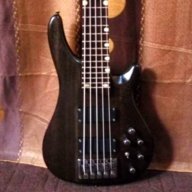
Got this ibanez bass copy... The wood work is superb buh had a poopy preamp I eventually changed... Overall, I think they are cheap and their wood work and quality is usually very ok on the ones that are a lil expensive. The electronics can be good if ure lucky.. Currently have a J&D and an ibanez copy which are quite good
 

Attachments

  • IMG-20180405-WA0001.jpg
    IMG-20180405-WA0001.jpg
    64.4 KB · Views: 26
  • IMG-20180404-WA0008.jpg
    IMG-20180404-WA0008.jpg
    61 KB · Views: 26
  • IMG_20180107_111645.jpg
    IMG_20180107_111645.jpg
    1 MB · Views: 16
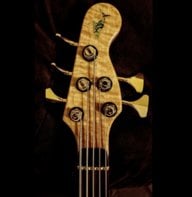
In my eyes it would be a little more acceptable if these copies were sold without any company logo on the headstock.

+1

I've seen some amazing stuff and some crap from China. And Mexico. And California. :laugh: But the logo thing is bad juju for me, personally.

I want a light-ish, , neck-thru, active 3 band, P/J, string-thru, unlined fretless 5er. But I don't have $5000 - $10,000 to have it made here. China is my only option. But I definitely don't want Fender or whatever on the headstock. If I ever get the balls to order it built.
 
+1

I've seen some amazing stuff and some crap from China. And Mexico. And California. :laugh: But the logo thing is bad juju for me, personally.

I want a light-ish, , neck-thru, active 3 band, P/J, string-thru, unlined fretless 5er. But I don't have $5000 - $10,000 to have it made here. China is my only option. But I definitely don't want Fender or whatever on the headstock. If I ever get the balls to order it built.

Gotta say folks. It's all about the financial agreements done with manufacturers.

The Spector Timbre (Spector's Acoustic / Elect Bass) is manufactured in China. But it is done per a legal agreement contract. And they have to meet the agreed specifications from Spector. And it is a great little acoustic bass with a killer preamp and pickup worthy of the Spector name. So they can make a killer bass. if a legal agreement is made.

But don't expect a Chinese bass guitar with a Fender or Gibson headstock inlay to be the same. It's likely just a ripoff.

[This invalid link has been removed]
 
mine are chinese brands, but i get your point and i think your assessment is valid. ;)

why is this a 'bad thing'? :)

my experience with the two instruments i own (chinese made, chinese branded) = the hardware/electronics was not crap, but rather: cheap, but functional. i elected to replace the hardware ("none more black"). i replaced the pu's on one of them in order to 'try out' a cheap american made set of PJ's. for both instruments: the cost of hardware/electronics replacement was, in fact, more than the instruments themselves. my net: two instruments, both better than they came, both cheaper than any not made in china. whats' not to like?

a lot of you are substituting emotionally-based, knee-jerk responses for critical thinking. your loss? :D


its not a bad thing. Just a few things u have to consider.
 
  • Like
Reactions: JRA
41CBA8C6-DDEF-4927-A549-2ED6583F554A.jpeg
I’m liking this one that is a Bongo.....at least that’s what it says on the headstock. I have no idea how a “real” EB Bongo 5er could go for $228 shipped though.....

There are a ton of very nice looking basses on AliExpress for Rondo Music/SX prices.

To buy or not to buy....that is the question....