• TalkBass has been independent since 1998. Add your voice.
    Create a free account to reply to discussions, view embedded media, and browse with fewer display ads.
    Join freeLog in
    Want zero display ads or expanded classifieds tools? Compare plans.

Double Bass Chromatic tuner for staying in tune during practice

kerrycares

Supporting Member
Jan 17, 2006
3,048
2,969
Michigan
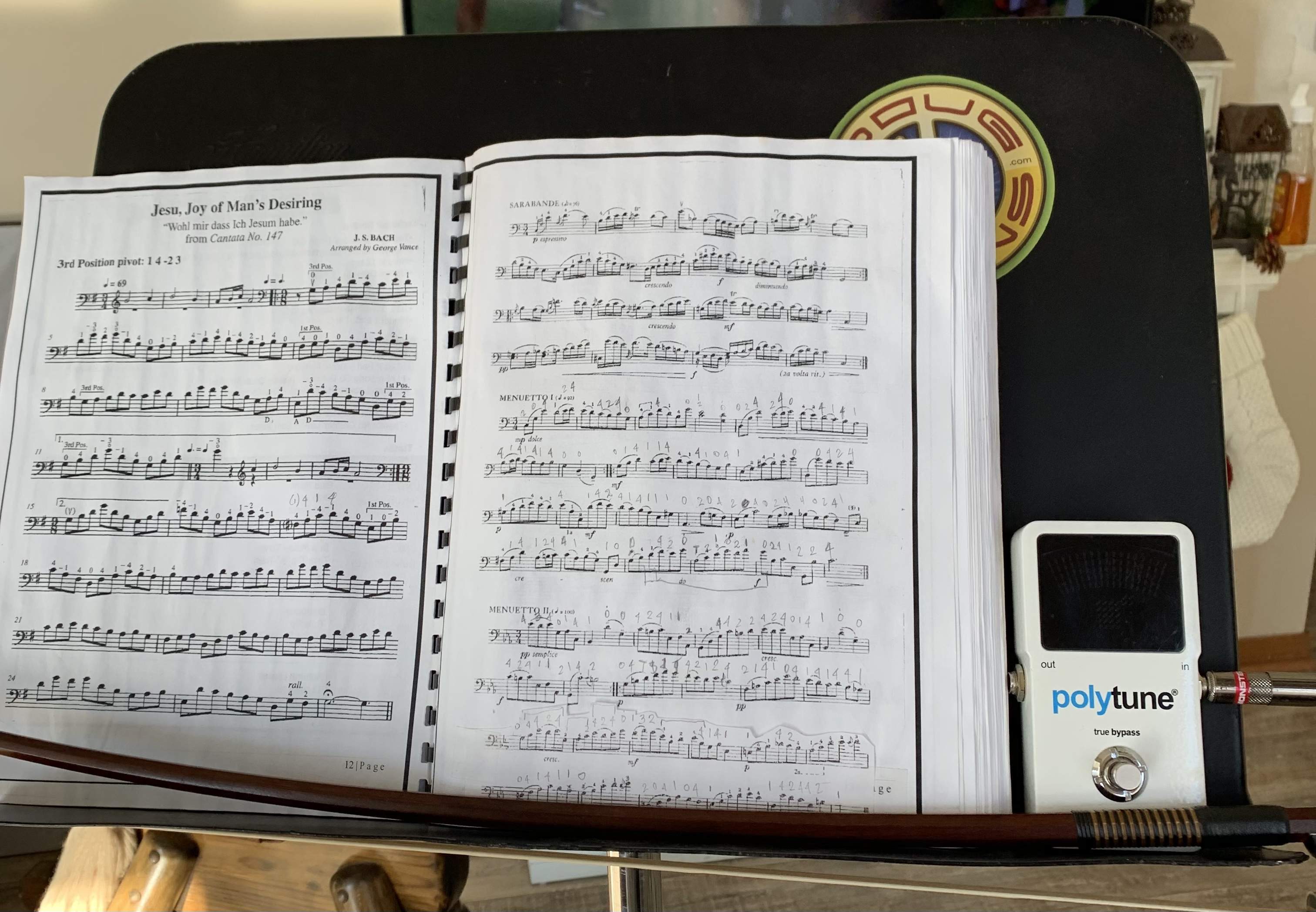
It just dawned on me to connect to my chromatic tuner during my practice to tighten up my in tune playing and develop better ear training.
I’d like to hear from others about how you use your chromatic tuners and/or stay in tune when you practice.
Thanks
7EDD2870-18BC-45B3-B325-206A65E18094.jpeg
 
Regarding the tuner, I have D'Addario & Snark clip-ons. I prefer the D'Ad. I mount it between the two legs of the bridge. Compared to the Snark, it is far less prone to resonating vibrations that make a buzzing sound. By having it on the bridge, the ergonomics are decent with my head looking downward. I'll mess around when doing scales with the tuner on (both arco & pizz.), but never have it on except when actually tuning during gigs. I can see the value of having the tuner on your music stand while reading your charts. Is it working well for you and do you find yourself flat or sharp more often?
 
Multitasking is the enemy of practicing the bass! I'd recommend scales with a drone BEFORE working on etudes or rep then turn it off. You need to trust yourself more than you check yourself.
An unconfident but in tune note will sound far worse that a note that is not dead on but is beautiful, strong, and full.

Check a note or phrase with a tuner is great, leaving it on while you try to work on something would be inadvisable.
 
I try to alternate playing with and without a drone. I seem to lock things in faster that way (as opposed to either never or always using a drone). Checking notes against open strings is also helpful. Looking at a tuner after every note is time consuming and distracting for me, but I will often leave one on and check the occasional note when I'm working on phrases that modulate keys.
 
I have used a chromatic pedal tuner with upright and fretless bass guitars. As noted above, unless you're playing something really slow, it's not really possible to check each and every note as you play, especially if you're sight reading. That said, what I have used a tuner for is spot checking my intonation. For example, when I'm playing something and I'm getting a sense that my intonation is slightly off, I will quickly check the tuner to see if what I'm hearing is as off as I think it is. It almost always is. Basically, it's a way to quantify (on a spot check basis) how far off your playing is to confirm what your ears are hearing, especially if you're on a new instrument or adjusting to a new scale length.
 
An important note: if you do engage in this method, DO NOT ADJUST. Note whether you are sharp or flat and try again making technical adjustments in direction you need.
Repeat until you are coming into the note correctly.
Also, ask yourself if you are hearing you are out of tune without the tuner. If you can hear it, then you don't need the tuner, you need to keep working on the line you are working on.
 
  • Like
Reactions: jj.833
There's an app called the Intunator that has some merit, and I use it for maybe 20 minutes a week. You put on phones and it hears the note you're playing and generates a perfectly in tune sound (supposedly - and tempered - it has no idea what key you're in) in the phones. You try to match your pitch to what you hear. It only works with slow practice and it's much better arco than pizz. For me, it sharpens my hearing a bit. I would never practice with a tuner, but I do like to spend some time with drones. The album "Cello Drones for Tuning and Improvisation" is my favorite and I also like an app called Tanpura Droid that is free and easily customizable. I tune it to a root and a -7th when I want to shed a chord or scale with an altered 5th.
 
  • Like
Reactions: Chris Fitzgerald
I will hold to the line that you should not let the tuner (or a drone) become a "crutch" that you rely heavily on. Better would be to work on internalising the structure of common scales and chords that you then apply to any given starting note with confidence. This could/should be part of your warm-up and could/should be quite intense and focused. Hear the two tetrachords (groups of four notes) very clearly in your mind, 1 2 3 4 (slight pause) 5 6 7 8. Each tetrachord has the same structure, Tone Tone 1/2 Tone (pause) Tone Tone 1/2 Tone. The tone interval between the tetrachords is not prominent. I would suggest starting with A Major 1 octave and, when you are happy, move to Bflat Major. The two forms of Flat scales each have distinctive tetrachords too.

Going on from here into two- and three-octave scales the intonation is kept on the rails by pausing on each octave note and repeating it as 1 in the next 1 2 3 4. I liken the process to creating a whole lot of small landings in an otherwise unbroken flight of stairs. I can go from one end of the fingerboard to the other with (almost?) total certainty, mentally aiming at notes like bull's eyes on a dart board.
 
TonalEnergy Tuner is recommended by David Moore, so I went with it.
It is an inexpensive app you can install on your phone or iPad.
https://www.tonalenergy.com/

There is something about the lowest notes on a bass that makes it very difficult to be in tune. I regularly play around on the violin and it is easier to be in tune than our basses.

The beauty of TE Tuner is you can see clearly where and how much you are off. You can play along with a drone. It does a lot more than only telling you how in tune you are. Check out the link.

Many say they don’t get the point of playing with a tuner. It’s recommended by David Moore, who kinda knows more than most of us here. Playing with a tuner is another practice tool to be better in tune when you play with people.

Top violin soloists do this kind of practice. It’s not meant to be used as a crutch, but a tool to improve.
 
Watching a tuner while attempting to practice sounds like a great way to stop listening and paying attention to your body. What about recording your practice and putting the tuner on as you listen back later? That way you could assess not just pitch accuracy but tone, time and interpretation too. Add posture and bow/hand/arm position if you video it.
 
Watching a tuner while attempting to practice sounds like a great way to stop listening and paying attention to your body. What about recording your practice and putting the tuner on as you listen back later? That way you could assess not just pitch accuracy but tone, time and interpretation too. Add posture and bow/hand/arm position if you video it.
The idea, for me, is tuner practice time is just that …purposeful time with your tuner. I’m good for about five or ten minutes with it. I won’t do it every day.

I will play a few minutes of long tones and spiccato every morning, even though I’ve played for decades. Maybe some tp stuff. There is a study that says people are good for about 20 minutes for a worthwhile constructive effort on a specific task to get best results. Then onto whatever orchestral pieces are coming up.

Any time you stop listening or zone out you just spent junk time. Yeah, watching a tuner while practicing for some will be a waste of time if they aren’t doing doing it purposely.

Recording yourself is the ultimate test of your playing. You certainly won’t need a tuner while listening back. You will also hear, loud and clear, your timing, tone or lack of it and basically what others hear when you play. Recording can be discouragingly brutal but honest. All imho.
 
Last edited:
  • Like
Reactions: Chris Fitzgerald
I have the Tonal Energy app on my iPhone and use it for tuning. I can see using it for long notes with a bow - it takes a bit of time for it to settle into a note. I don't use it for that, like others here, I prefer to just rely on my hearing.

There are plenty of great exercises you can do to improve intonation that don't rely on electronics. For me, It really comes down to training my ear. If I can hear it, I can correct it. I spent a good part of the covid lockdowns working with the Ottman's sight singing book. I'm a horrible singer but regardless, it helped me get pitches correct and really helped develop my hearing.

On the bass, one of my current favorite exercises is to play a scale starting anywhere around the first position E string (like, F or G maj) and going up two octaves - hold the final note and then play an open note and compare against the open note. When I first started this a few years ago, I found my self drifting over the two octaves. Now, I can do it and fairly consistently end up within a hair of the correct pitch.