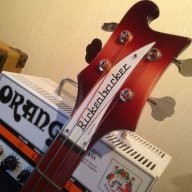
You can test it yourself, just get some big fishing sinkers, pound them flat, and double stick tape them to see if it has a noticeable effect before you spend any money on a custom job.

TalkBass has been independent since 1998. Add your voice.
Create a free account to reply to discussions, view embedded media, and browse with fewer display ads.
Join free Log in
Want zero display ads or expanded classifieds tools? Compare plans.

You can test it yourself, just get some big fishing sinkers, pound them flat, and double stick tape them to see if it has a noticeable effect before you spend any money on a custom job.

The other thing to try is lighter tuners. What we're trying to do here is change the resonant frequency of the neck to mitigate the dead zone. Yes, heavier weight will change the resonant frequency and damp vibrations, but using lighter tuners and making the neck stiffer by using a gauge heavier strings and tweaking the truss rod will also change the resonant frequency, raising it out of the dead zone. Another way is to put a small spacer or shim in the neck, again, not so much you noticeably changed the geometry of the neck at the bridge requiring a completely new setup, but just enough to "decouple" the neck from the body so they don't resonate together.
It's all about change. You have found the right combination of string tension, truss rod tension and other factors that work for you on your neck. Yes, sometimes lightening up everything, including the strings and truss rod, will work also. No two necks are alike, and so no single cure works all the time. It all has to be experimented with: strings, truss rod settings, tuners, extra weight here or there, tightness of neck screws, shims, even heavy or light bridges, to find the combination that eliminates, or at least lessens, the dead zone.That almost seems to be the opposite of what most say to try. At least as far as strings go, since I've never tried to change tuners, in my experience, lighter strings have worked best. I actually have a .45 G coming to replace my .49 because I've come to found that anything heavier than .45 makes the dead spot more obvious.
The other thing to try is lighter tuners. What we're trying to do here is change the resonant frequency of the neck to mitigate the dead zone. Yes, heavier weight will change the resonant frequency and damp vibrations, but using lighter tuners and making the neck stiffer by using a gauge heavier strings and tweaking the truss rod will also change the resonant frequency, raising it out of the dead zone. Another way is to put a small spacer or shim in the neck, again, not so much you noticeably changed the geometry of the neck at the bridge requiring a completely new setup, but just enough to "decouple" the neck from the body so they don't resonate together.
Before you go to the time and expense, you can see if it will work by going to a sports store, purchasing a roll of golfer's lead tape, and apply it one strip at a time incrementally to the back of the headstock to see if adding mass to the headstock helps. If it does, then you can decide exactly how much and either leave the tape or have a plate machined accordingly. And if not, you can peel the tape off and you are only out a few bucks for a roll of tape rather than the expense of a machinist and a part you won't use.Am in process of finding a local machine shop that can fabricate a metal plate for the rear of the headstock on both instruments.
As in Carvin Icon? Yes. Well. Is it a one-piece neck or the multi-piece option? If it is a one-piece, then I would go the other way: a little heavier strings, tighten the truss rod accordingly, and use HipShot UltraLite tuners, or even lighter if you can find them to try to raise the resonant frequency.With regard to inserting a spacer or shim in the neck, if you mean putting between it between body and neck at the bolt-on joint, I can't do it. The Icons are neck-through instruments.
Before you go to the time and expense, you can see if it will work by going to a sports store, purchasing a roll of golfer's lead tape, and apply it one strip at a time incrementally to the back of the headstock to see if adding mass to the headstock helps. If it does, then you can decide exactly how much and either leave the tape or have a plate machined accordingly. And if not, you can peel the tape off and you are only out a few bucks for a roll of tape rather than the expense of a machinist and a part you won't use.
Having enjoyed golfing until my hip gave out, I keep a roll of the lead tape for a variety of uses, from what it was designed for, golf clubs, to temporary patches on leaks on my brass instruments until I can get them to my tech, to weight experiments like this thread, and many others. If you have to peel it off, just remember to dispose of it environmentally correctly as it is lead.
As in Carvin Icon? Yes. Well. Is it a one-piece neck or the multi-piece option? If it is a one-piece, then I would go the other way: a little heavier strings, tighten the truss rod accordingly, and use HipShot UltraLite tuners, or even lighter if you can find them to try to raise the resonant frequency.
Hmm. 5-piece necks are not usually prone to dead spots, or at least they don't seem to be as severe as a one-piece neck. That is one reason many manufacturers either laminate the neck, or with G&L, saw it in two and re-glue it, to get a different stiffness or combine resonances to even them out. Have you asked Carvin directly about it? Their customer service folks are easy to contact and helpful.Yes, Carvin Icons. Each has a five-piece maple/walnut laminated neck-through.
Hmm. 5-piece necks are not usually prone to dead spots, or at least they don't seem to be as severe as a one-piece neck. That is one reason many manufacturers either laminate the neck, or with G&L, saw it in two and re-glue it, to get a different stiffness or combine resonances to even them out. Have you asked Carvin directly about it? Their customer service folks are easy to contact and helpful.




