• TalkBass has been independent since 1998. Add your voice.
    Create a free account to reply to discussions, view embedded media, and browse with fewer display ads.
    Join freeLog in
    Want zero display ads or expanded classifieds tools? Compare plans.

Class D Amps

It's just as powerful, but lacks the luster of mosfet. A watt is a watt.

They are notoriously clean. Til they get pushed too hard.
How do they lack the luster of MOSFETs when they use MOSFETs? All class D amps use MOSFETs by the way…
 
How do they lack the luster of MOSFETs when they use MOSFETs? All class D amps use MOSFETs by the way…
That's so interesting! Just last week I bought a 29 year old amp because I associated it with amps that I have used in the past that I thought of as MOSFET. To replace what it evidently a MOSFET amp. Terminology is fun!

I had no idea that amps I knew as class D (and there are still a couple Tripath hifi amps stored away here that I can't remember how they differ) used MOSFETs.

I appreciate being able to use more accurate words, so I dig this.

What would be a more accurate way to describe the difference between the amps that were initially marketed as MOSFET? Like the Hafler stuff, Hartke 3500 (?), maybe early Eden?

heh.. I just realized that without seeing this comment, I would have more highly valued a new amp that listed its type as "MOSFET", when in reality it sounds like they all could do so. And I probably would have been impressed with how it sounded juicier than a really similar amp that was called Class D.
 
I'm not much of a "gear head"

Is Class D a "step down" from Class A or Linear amps? Can somebody explain the difference in layman's terms?

I currently have an SVT 4 and looking to possibly get a new rig. I was looking at the GK Fusion 1200 and want to make sure that the "Class D" isn't a step down, like less powerful or anything... I would think 1200 watts is 1200 watts. But like I said, not a real gear head.

Thanks for any advice / explanations!
In my rather limited experience, I'm pretty confident with the opinion that the move to Class D is definitely not a step down. Even an 800 watt Class D could be powerful enough to give you what you want, but that depends on the particular head.

After I upgraded to better cabs a few years ago (pair of 2x10's), I got wanting something more manageable than my Traynor DB-800, which has a size and weight in the neighborhood of an SVT-4 Pro. The Class D head I picked up is a GK MB 500. I was worried about what I'd get with "only" 500 watts until I gigged with it once or twice and got enormous sound without needing to lean on the master volume or use any boost.

The more powerful GK Class D's would likely be right on par with the grunt that comes from an SVT-4, but it's tough to say what differences you'll see with your particular sound. My GK has a tone that's clear and clean, but I also have a Genz Benz Shuttle 6.0 that gives me a sound that's a little more warm and round. Neither of these have a preamp as flexible as the SVT-4 (the Shuttle only has a single preamp tube).
 
That's so interesting! Just last week I bought a 29 year old amp because I associated it with amps that I have used in the past that I thought of as MOSFET. To replace what it evidently a MOSFET amp. Terminology is fun!

I had no idea that amps I knew as class D (and there are still a couple Tripath hifi amps stored away here that I can't remember how they differ) used MOSFETs.

I appreciate being able to use more accurate words, so I dig this.

What would be a more accurate way to describe the difference between the amps that were initially marketed as MOSFET? Like the Hafler stuff, Hartke 3500 (?), maybe early Eden?

heh.. I just realized that without seeing this comment, I would have more highly valued a new amp that listed its type as "MOSFET", when in reality it sounds like they all could do so. And I probably would have been impressed with how it sounded juicier than a really similar amp that was called Class D.
The devices are the same but the circuit topologies are different.

Without knowing this, saying that the reason an amp sounds a particular way because it has MOSFETs might be believable from a marketing perspective.

That’s some of what we are seeing in this thread.
 
I'll try to ask a better question.

Is there a commonality among those amps that were among the first to be marketed as MOSFET? I tend to prefer something about their sound that I think of as more harmonically rich and colored, and I would associate with transformers and higher even-order harmonic distortion.
 
  • Like
Reactions: LiptonJigglers
I've used class D bass amps for a long time. There are huge differences between brands in how they sound. To my ear, some sound sterile, some sound brittle, some sound tight, some sound warm. Yes, warm. As many people have commented above, how well a class D amp lets you get the sound in your head depends on how it was designed.

I've owned an EA, several GK, an Aggie, a TC (for a backup in my stage bag), and every one of the 800 watt Mesa Subways. In addition, I've been backlined into a Trace Elf and a Darkglass. For me the Mesa TT-800 nails it; that amp will do whatever I ask it to. My best advice is to check into the entire Subway line. Each of them has a different personality, but they all sound really good.
 
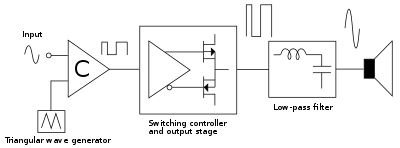
Class D amps are digital in the sense that the penultimate output stage comprises on/off (ie. 1/0) switching, but of varying duration rather than quantised to a clock signal like in a computer and so-on; the final output is a low-pass filter which converts this to an analogue signal.
400px-Pwm_amp.svg.png


You have to be wary regarding stated output in Watts and read between the lines: is it RMS, "music power", or some other measure?
The important thing to note is that 2x Watts is not twice as loud; because of the way our ears work and the logarithmic nature, it's actually around 10x watts = twice as loud (ie. 1000W = 2x 100W).
However, Watts do not equate directly to sound volumes, since an amplifier doesn't produce any sound on its own.
You need speakers for that and their efficiency plus the cabinet design are a big factor in how loud things are.

One thing about class-D amps is that they are more efficient than A, B, A/B and so they don't waste so much energy as heat, which means they don't need so big heatsinks to dissipate the waste, which means they can be made smaller.
 
I'm not much of a "gear head"

Is Class D a "step down" from Class A or Linear amps? Can somebody explain the difference in layman's terms?

I currently have an SVT 4 and looking to possibly get a new rig. I was looking at the GK Fusion 1200 and want to make sure that the "Class D" isn't a step down, like less powerful or anything... I would think 1200 watts is 1200 watts. But like I said, not a real gear head.

Thanks for any advice / explanations!
Some will tell you that only Class AB should ever be used and a Solid State is unworthy. Some 'don't like' the sound of a Class D. Some can't handle anything different. Ds are more efficient, smaller and lighter. I'm thankful for mine, whenever I lift it. They do, however, have a fan. Some 'don't like' a fan in a head, because they can hear when the playing stops.
 
  • Like
Reactions: _Obra_
A perfect amplifier would be one that takes your input signal, makes it louder, and drives a speaker with it, drawing only as much power from the wall socket as it puts out. Class D amplifiers are the closest we have to that goal - especially the power requirement part. As they don't waste much power, they don't need much cooling - that's why they can be small and light. Other classes of amplifiers are far more wasteful - they make a lot of heat, which needs to be removed, to avoid them cooking themselves. A lot of folks around here are very concerned that they get as much power from their amp as possible. If you extend that to the wall socket - you want to pull as much power as possible from the wall, then you definitely don't want to waste any - a class D amp is your friend in that goal.
 
I'll try to ask a better question.

Is there a commonality among those amps that were among the first to be marketed as MOSFET? I tend to prefer something about their sound that I think of as more harmonically rich and colored, and I would associate with transformers and higher even-order harmonic distortion.
MOSFET isn't a marketing term, it's a physical component that the amp either has or doesn't have.

There are a lot of different MOSFETs. They have different characteristics. I have a headphone amp that allows me to roll MOSFETs, just like other audio nerds might roll tubes in a tube amp, except MOSFETs are considerably cheaper than tubes -- most were under $3 (since I was buying individually; they were often under a buck in volume at the time), the most expensive one cost (at the time) less than $30. That was an interesting experience. Most sounded pretty similar, and trying to distinguish between them is probably easier with appropriate bench equipment than with ears. One made the sound very detailed but also harsh. I was happiest with the chip that struck a nice (to me) balance between detailed and lush.
 
Almost all pro touring amps for major concert tours have been class D for years. They are lighter and more power efficient while sounding just as good as previous class AB designs. The result is less cost associated with hauling them and less effort for setting them up.

Translated to our world, they sound just as good, are a lot easier to haul around, and won’t break your back at the gig.

I just played an outdoor gig with a 4-lb amp rated at 800 watts. I never got the volume knob past 9:00 and it was probably too loud. I’ll never go back.
 
I got to this thread late, so not much I can add, except that a lot of people don't seem to separate the 'tone' notion from the amp type, and they should, even the old Hiwatt valve amps were based on trying to get as much CLEAN power as possible.

If anyone is saying they prefer the 'tone' of an amp, it's almost certainly not the power stage of the amp that they're hearing!

The main difference between class D and any other earlier class is that earlier ones subdivide voltage, and class D subdivides time. Either way, they do it as linearly as possible, trying to avoid any 'tone'. Dividing time equally is easy and accurate, hence the high linearity and clean output.

The switching action in Class D is extremely fast, to get the main parts small and light in weight. There is a payoff though, LOTS of emitted radio frequency interference. This can be (and IS) filtered, but how well may depend on what you're willing to pay for because excellent high power passive filtering is expensive.

Using precisely made speaker cables with twisted pair wiring is wise, it helps reduce emissions further. Most cables with rounded sheath profiles probably do this already, just avoid the 'zip wire' types with straight parallel form.

Once you settle on this, you can add all the tone you want with preamp, pedals, way you play, whatever..

Small all-in-one devices (like Trace Elliott ELF) are basically a Class D output preceded by a preamp. That preamp may well be all-digital, an impulse response or other type of software model, but this is NOT the 'Class D' bit. It's much easier to understand Class D if this division of labour is not blurred.
 
  • Like
Reactions: HolmeBass
Listen to the amps in as close to a real-world setting as possible. Trust your ears. Don't worry about amp topology. Go with what sounds best to you.

This is the answer. The factors I use to determine if an amp is for me are as follows... in this order.

1) Tone - Does us sound good?
2) Reliability/reputation of the company - Do they make "good stuff" and stand behind it?
3) Form factor - Do I like how it looks? Features? Controls layout? Weight? Wattage/volume?
4) Budget - Does it cost less than a used car? It doesn't have to be cheap. But I'm not paying four grand for an amp.

The Mesa TT800 answered all of those questions with a resounding "Yes" for me. Find what answers all of those questions with a big fat "Yes" for you. Note that amp topology is NOT on the list.

My main amp is the TT, a "class D". But I also own, and really like, a MOSFET amp (Mesa Walkabout), a modern tube amp (Ashdown LB30), and a vintage tube amp (highly modified 70s Fender PA100). I have no idea what "class" any of those are. Perhaps they're like me and have no class. ;)
 
Is there a commonality among those amps that were among the first to be marketed as MOSFET? I tend to prefer something about their sound that I think of as more harmonically rich and colored, and I would associate with transformers and higher even-order harmonic distortion.
Circling back to your question a moment... around the time the home audio industry was transitioning from fully discrete construction (in which every transistor, resistor, diode, etc. were separate) to products designed around integrated circuits, conventional wisdom among the punditry was that discrete amps were smoother and integrated amps sounded harsher.

There was actually something to it at the time, because this change in production (which made audio equipment much cheaper to manufacture, as well as smaller and more efficient) happened around the same time as the advent of digital audio, smaller and more powerful speakers, portable audio, cassette audio, and the rise of electronic pop music which didn't sound right on big lush ol' Harman-Kardon receivers.

But it wasn't inherent to the technology, it was a function of the equipment designs adapting to consumer interest. People who wanted big lush audio to listen to their Mel Tormé albums on were disappointed when they wanted to upgrade, but the audio industry was more interested in catering to the listening habits of younger people, and shaped the tone of their new products accordingly.
 
I'll try to ask a better question.

Is there a commonality among those amps that were among the first to be marketed as MOSFET? I tend to prefer something about their sound that I think of as more harmonically rich and colored, and I would associate with transformers and higher even-order harmonic distortion.

WARNING: Not Class D. :) I'm going to try answering this as I find it, not link it with class D amps in any way.

MOSFET's use a 'channel', with Drain on one end, Source on the other, and the Gate applies a charge to pinch off the channel to the point where electrons won't flow through it. It's much closer to the action of the Plate electrode between Anode and Cathode in a valve. It allowed a closer approach to valve circuit topology than bipolar transistors did. Circuits could be much simpler while getting a cleaner output than many bipolar designs.

They are not the same as valves though, it's unlikely they'd sound like overdriven valves, though any nonlinearities in saturation may affect high level output sound in the case where gate charges opened, rather than closed, the channel (look up 'depletion' vs 'enhancement' mode MOSFET's for info on that detail..) It might be like a soft clipping effect.

I have no idea if MOSFET's in a linear circuit with feedback could produce valve-like harmonic byproducts, but if it's down to the topology rather than the semiconductor behaviour, then maybe it could.

Just bear in mind that you may not be hearing what you think. If placebo effect did not work, marketing probably wouldn't work nearly as well as it does.

I developed techniques in phase modulation synthesis that can sound like tape and valve saturation, but have nothing at all to do with the same mechanics. Ears will hear, and the brain will fill in the gaps and then the mind may believe whatever it hears. If it were not so, the synthesiser would never have been invented. :)

The easiest way to eliminate possible illusions is blind tests, 'ABX' comparison listening tests. It's amazing how those reveal that we often can't tell the difference in sound as well as we think we can.

Ok, ONE link to the Class D amps: It is fast and easy to go between channel fully open, and channel fully pinched off, so instead of dividing voltage in systems that use feedback to control the linearity, the MOSFET is purely used as a switch, dividing time. For this reason, the notion of tone is void, it not quantitative, the QUALITY that we call tone does not exist in the output stage of Class D, unless the timing itself is distorted.

EDIT:
MOSFET's are used as switches because they can be considered like voltage controlled resistances, some of them have resistances that vary from megohms to well below an ohm, so unlike the 0.6V drop across a bipolar junction, a MOSFET is extremely efficient as a switch. They are chosen for this, not for tone.
 
Last edited: