• TalkBass has been independent since 1998. Add your voice.
    Create a free account to reply to discussions, view embedded media, and browse with fewer display ads.
    Join freeLog in
    Want zero display ads or expanded classifieds tools? Compare plans.

Class D Amps

It's 23 years since I stopped using tube amps, and 23 years since I had an amp failure.

It's 15 years since I started using D class amps.

Last weekend I used my SS amp and D class amp. The only difference was the extra 21lbs in the SS.

At this point, playing through my Aguilar amps, I have never sounded better. How they do it is of no interest to me. I just go for the best sounding amp I can find.
 
I'll try to ask a better question.

Is there a commonality among those amps that were among the first to be marketed as MOSFET? I tend to prefer something about their sound that I think of as more harmonically rich and colored, and I would associate with transformers and higher even-order harmonic distortion.
Many, like Eden, SWR, and Hartke had class A pre-amps and class A/B power amps. (@agedhorse let me now if there was actually more variety among the pre-amps). Many of these amps were also called “hybrid” because a tube would be used in the pre-amp section.

So there are amp classes (A, B, A/B, D, H, and others) and there are output devices used to do the amplification, two very common ones being either tubes or MOSFETs. The class A/B power amps usually had large power transformers that could act as current reservoirs. I think the sound of the various amps had more to do with specific implementation details, then output devices, and the amp class has the least discernible “sound” of all.

So my opinion is that like a lot of stuff in music, it’s not what you do (the amp class), it’s how you do it (myriad design decisions made during implementation).

This is a good primer on amp classes, specifically geared towards power amps: Power amplifier classes - Wikipedia
 
I'm not much of a "gear head"

Is Class D a "step down" from Class A or Linear amps? Can somebody explain the difference in layman's terms?

I currently have an SVT 4 and looking to possibly get a new rig. I was looking at the GK Fusion 1200 and want to make sure that the "Class D" isn't a step down, like less powerful or anything... I would think 1200 watts is 1200 watts. But like I said, not a real gear head.

Thanks for any advice / explanations!

You will find the preamps in those are voiced very different. If you can, take your bass and cab to a shop and try one out. Maybe even take your whole amp to be able to A/B them.

As many others have mentioned, power amp topology is not as important as the execution of that design. Well designed and produced Class D amps sound fantastic.
 
I'll try to ask a better question.

Is there a commonality among those amps that were among the first to be marketed as MOSFET? I tend to prefer something about their sound that I think of as more harmonically rich and colored, and I would associate with transformers and higher even-order harmonic distortion.

Not necessarily, unless the circuit itself is designed to do that (and presuming that “tubes and transformers” are really responsible for even order harmonics)

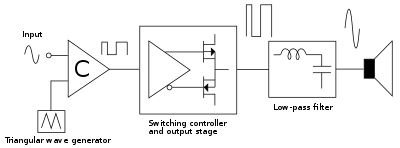
Class D amps are digital in the sense that the penultimate output stage comprises on/off (ie. 1/0) switching, but of varying duration rather than quantised to a clock signal like in a computer and so-on; the final output is a low-pass filter which converts this to an analogue signal.
400px-Pwm_amp.svg.png


You have to be wary regarding stated output in Watts and read between the lines: is it RMS, "music power", or some other measure?
The important thing to note is that 2x Watts is not twice as loud; because of the way our ears work and the logarithmic nature, it's actually around 10x watts = twice as loud (ie. 1000W = 2x 100W).
However, Watts do not equate directly to sound volumes, since an amplifier doesn't produce any sound on its own.
You need speakers for that and their efficiency plus the cabinet design are a big factor in how loud things are.

One thing about class-D amps is that they are more efficient than A, B, A/B and so they don't waste so much energy as heat, which means they don't need so big heatsinks to dissipate the waste, which means they can be made smaller.

Not really, class D is PWM which is really a non-linear analog signal. It’s a gray area between analog and what is generally considered digital.

Some will tell you that only Class AB should ever be used and a Solid State is unworthy. Some 'don't like' the sound of a Class D. Some can't handle anything different. Ds are more efficient, smaller and lighter. I'm thankful for mine, whenever I lift it. They do, however, have a fan. Some 'don't like' a fan in a head, because they can hear when the playing stops.

Some have fans, some do not. It depends on the design and the intent of the amp.

I got to this thread late, so not much I can add, except that a lot of people don't seem to separate the 'tone' notion from the amp type, and they should, even the old Hiwatt valve amps were based on trying to get as much CLEAN power as possible.

If anyone is saying they prefer the 'tone' of an amp, it's almost certainly not the power stage of the amp that they're hearing!

The main difference between class D and any other earlier class is that earlier ones subdivide voltage, and class D subdivides time. Either way, they do it as linearly as possible, trying to avoid any 'tone'. Dividing time equally is easy and accurate, hence the high linearity and clean output.

The switching action in Class D is extremely fast, to get the main parts small and light in weight. There is a payoff though, LOTS of emitted radio frequency interference. This can be (and IS) filtered, but how well may depend on what you're willing to pay for because excellent high power passive filtering is expensive.

Using precisely made speaker cables with twisted pair wiring is wise, it helps reduce emissions further. Most cables with rounded sheath profiles probably do this already, just avoid the 'zip wire' types with straight parallel form.

Once you settle on this, you can add all the tone you want with preamp, pedals, way you play, whatever..

Small all-in-one devices (like Trace Elliott ELF) are basically a Class D output preceded by a preamp. That preamp may well be all-digital, an impulse response or other type of software model, but this is NOT the 'Class D' bit. It's much easier to understand Class D if this division of labour is not blurred.

They CAN emit lots of RF if not well designed. Of course, if they emit a lot of RF, they won’t pass EMC/EMI testing and certification.

Many, like Eden, SWR, and Hartke had class A pre-amps and class A/B power amps. (@agedhorse let me now if there was actually more variety among the pre-amps). Many of these amps were also called “hybrid” because a tube would be used in the pre-amp section.

So there are amp classes (A, B, A/B, D, H, and others) and there are output devices used to do the amplification, two very common ones being either tubes or MOSFETs. The class A/B power amps usually had large power transformers that could act as current reservoirs. I think the sound of the various amps had more to do with specific implementation details, then output devices, and the amp class has the least discernible “sound” of all.

So my opinion is that like a lot of stuff in music, it’s not what you do (the amp class), it’s how you do it (myriad design decisions made during implementation).

This is a good primer on amp classes, specifically geared towards power amps: Power amplifier classes - Wikipedia

Most very early solid state and tube preamps were class A, most later solid state preamps were/are class AB.

Power amp devices are either tube, bipolar transistor or MOSFET transistor.
 
They do, however, have a fan. Some 'don't like' a fan in a head, because they can hear when the playing stops.
Fans are not exclusive or unique to class D amps: my Traynor YBA-3 had a fan as does the ancient Traynor Beta 800 power amp that I still have or the Hartke HA3500 I played through in the 90s. None of these are class D. The latter two also had massive heatsinks to go with the fan.

Class D amps do probably tend towards higher RPM fans due to their more compact enclosures (and lack of heatsinks) which is probably why they notice. You can get quiet, high RPM fans, but they cost more so this will be reflected in the price point of the class D amp in particular.
 
I'm not much of a "gear head"

Is Class D a "step down" from Class A or Linear amps? Can somebody explain the difference in layman's terms?

I currently have an SVT 4 and looking to possibly get a new rig. I was looking at the GK Fusion 1200 and want to make sure that the "Class D" isn't a step down, like less powerful or anything... I would think 1200 watts is 1200 watts. But like I said, not a real gear head.

Thanks for any advice / explanations!

Good Class D amps are good. Bad Class D amps are bad. An extremely wide range of Class D amps from bad to good are readily available new and used.
 
They CAN emit lots of RF if not well designed. Of course, if they emit a lot of RF, they won’t pass EMC/EMI testing and certification.

Which is a very good reason not to build them from raw modules.. I decided on an IMG Stageline STA-400D because that way it's certified. And much cheaper for me. :) They did the hard work...

Even so, they can't specify what we do with cabling. They could advise but the manual doesn't even do that, which is why I mentioned using round profile sheathed cable with a twisted pair. It really does help limit the spread of RF a lot, compared to the giant 'bell wire' stuff. It is also more flexible, puts less stress on connectors, so it's a nice easy fix for several ills.
 
Fans are not exclusive or unique to class D amps: my Traynor YBA-3 had a fan as does the ancient Traynor Beta 800 power amp that I still have or the Hartke HA3500 I played through in the 90s. None of these are class D. The latter two also had massive heatsinks to go with the fan.

Class D amps do probably tend towards higher RPM fans due to their more compact enclosures (and lack of heatsinks) which is probably why they notice. You can get quiet, high RPM fans, but they cost more so this will be reflected in the price point of the class D amp in particular.
It depends very much on the overall design how the fan is used as well.
 
  • Like
Reactions: DJ Bebop and InkCow
I'm not much of a "gear head"

Is Class D a "step down" from Class A or Linear amps? Can somebody explain the difference in layman's terms?

I currently have an SVT 4 and looking to possibly get a new rig. I was looking at the GK Fusion 1200 and want to make sure that the "Class D" isn't a step down, like less powerful or anything... I would think 1200 watts is 1200 watts. But like I said, not a real gear head.

Thanks for any advice / explanations!

When the "Class D revolution" first started, I think they were generally a step down from the old school lead sled amp heads. Now ... not so much. They've come a long way, IMHO. I have a GK MB500 that is every bit as good, if not better than the GK 800RB that it replaced. I had a GK 800RB for many years and it served me well. I used to play with a drummer who worked for Drums Unlimited who are/were one of the premier backline providers in the MD/DC/VA area and he told me that the GK 800RB was their far and away most requested bass head so that says a lot for it. My GK MB500 has the same preamp section and a very similar sound, but has more bottom end and power than its predecessor. In addition (though I've never personally tried one), there seems to be a whole lotta rabid fans of the Mesa Boogie Class D heads.
 
Last edited:
WARNING: Not Class D. :) I'm going to try answering this as I find it, not link it with class D amps in any way.

MOSFET's use a 'channel', with Drain on one end, Source on the other, and the Gate applies a charge to pinch off the channel to the point where electrons won't flow through it. It's much closer to the action of the Plate electrode between Anode and Cathode in a valve. It allowed a closer approach to valve circuit topology than bipolar transistors did. Circuits could be much simpler while getting a cleaner output than many bipolar designs.

They are not the same as valves though, it's unlikely they'd sound like overdriven valves, though any nonlinearities in saturation may affect high level output sound in the case where gate charges opened, rather than closed, the channel (look up 'depletion' vs 'enhancement' mode MOSFET's for info on that detail..) It might be like a soft clipping effect.

I have no idea if MOSFET's in a linear circuit with feedback could produce valve-like harmonic byproducts, but if it's down to the topology rather than the semiconductor behaviour, then maybe it could.

Just bear in mind that you may not be hearing what you think. If placebo effect did not work, marketing probably wouldn't work nearly as well as it does.

I developed techniques in phase modulation synthesis that can sound like tape and valve saturation, but have nothing at all to do with the same mechanics. Ears will hear, and the brain will fill in the gaps and then the mind may believe whatever it hears. If it were not so, the synthesiser would never have been invented. :)

The easiest way to eliminate possible illusions is blind tests, 'ABX' comparison listening tests. It's amazing how those reveal that we often can't tell the difference in sound as well as we think we can.

Ok, ONE link to the Class D amps: It is fast and easy to go between channel fully open, and channel fully pinched off, so instead of dividing voltage in systems that use feedback to control the linearity, the MOSFET is purely used as a switch, dividing time. For this reason, the notion of tone is void, it not quantitative, the QUALITY that we call tone does not exist in the output stage of Class D, unless the timing itself is distorted.
EDIT:
MOSFET's are used as switches because they can be considered like voltage controlled resistances, some of them have resistances that vary from megohms to well below an ohm, so unlike the 0.6V drop across a bipolar junction, a MOSFET is extremely efficient as a switch. They are chosen for this, not for tone.[/QUOTE]

Thanks for the nice contribution to this subject. I have no issues with any of the points you raised, but all I wanted to say was that even though MOSFETs may still be widely used, I haven't heard their use in any modern design that delivers the clarity and dynamics that the original Hitachi-made MOSFETs did. Of course, you could ask that if these devices were so good and widely used, why did Hitachi discontinue them? I don't know the answer to that question, but I think it was either because they weren't as profitable as other things they were making or they saw the opportunity to make more money from something else. I can tell you that when Hitachi announced their discontinuance, they forced a lot of manufacturers to redesign their products.
 
Last edited:
  • Like
Reactions: Old Garage-Bander
Class D amps are better than linear. D stands for dimensions. They have 3. That's why they don't sound flat.
I think you’re referring to class TD amps (i.e. Three Dimensions).

Class TD was preceded by another continuously modulated rail design, BASH.
I thought BASH is a reference to what the tube acolytes do to class D amps. ;)

(Disclaimer: This response should be filed under Musical Misinformation, and is in no way intended to be taken seriously or appear knowledgeable in any way. Yeah, like there’s any chance of that.)
 
Have you tried anything new?

The reason I ask is, those observations you posted sound dated, in comparison to current offerings.

:)
Yes. Yes I have. It just seems like a common ground.

Of course, a perception is a very personal thing. One's perception/opinion is never law. It changes from man to man
 
Regarding MOSFETs, and Hitachi specifically, is that one major difference is how overcurrent protection is accomplished.

Ime, it’s both the design and execution that dominates the performance metrics.
 
  • Like
Reactions: Gizmot and DJ Bebop
I've found the majority of the class D to be loud, clean and sterile, with no personality.

If I designed one of those majority amps, I'd consider this a compliment.
Power amps aren't typically designed to color a signal. If it happens by how it's driven, that's another matter.
Likewise the voicing of an instrument amp is done ahead of the power output stage regardless of class.
 
This is the answer. The factors I use to determine if an amp is for me are as follows... in this order.

1) Tone - Does us sound good?
2) Reliability/reputation of the company - Do they make "good stuff" and stand behind it?
3) Form factor - Do I like how it looks? Features? Controls layout? Weight? Wattage/volume?
4) Budget - Does it cost less than a used car? It doesn't have to be cheap. But I'm not paying four grand for an amp.

The Mesa TT800 answered all of those questions with a resounding "Yes" for me. Find what answers all of those questions with a big fat "Yes" for you. Note that amp topology is NOT on the list.

My main amp is the TT, a "class D". But I also own, and really like, a MOSFET amp (Mesa Walkabout), a modern tube amp (Ashdown LB30), and a vintage tube amp (highly modified 70s Fender PA100). I have no idea what "class" any of those are. Perhaps they're like me and have no class. ;)
If the TT had the 4 band eq I'd be all over it. But I've never kept any 3-band amp or pedal very long so I shy away from it.
 
  • Like
Reactions: two fingers
Yes. Yes I have. It just seems like a common ground.

Of course, a perception is a very personal thing. One's perception/opinion is never law. It changes from man to man
I get it :thumbsup:

I don't care for the level of distortion other people like to use, in my signal chain when I play. Yet I like to hear other people use it all the time.

I've always gone for a clean powerful sound. I did go against my usual nature and tried a Mesa Subway amp, the WD 800, looking for a little different character as I (wrongly) figured, it's a class D amp and even though it has a tube in the front end, most of the ones i'd tried at that point either didn't do anything or they sounded like a jar of bees. None of that from the WD. I can get a clean sound, a tube sound, a powerful sound, a deep sound, a new sound, a vintage sound, and all points in-between.

Of course, IMHO, each to their own, YMMV, this is not a step, close cover before striking.

:)