
Enjoy the benefits of a premium membership!
Upgrade Account
-
TalkBass has been independent since 1998. Add your voice.
Create a free account to reply to discussions, view embedded media, and browse with fewer display ads.
Join free Log in
Want zero display ads or expanded classifieds tools? Compare plans.
You are using an out of date browser. It may not display this or other websites correctly.
You should upgrade or use an alternative browser.
You should upgrade or use an alternative browser.
Classical bass guitar
- Thread starter Hallic
- Start date
More options
Who Replied?
It took a little searching but I found it.You gonna re-post the link?
https://www.talkbass.com/threads/acoustic-bass-guitars-with-serious-mojo.1046398/
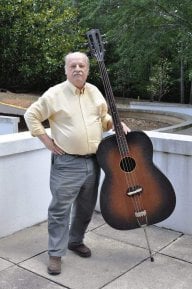
As pictured on post #7 of this very thread, it's a 4-string version of a classical contrabass guitar. In its original Niibori concept the instrument has six strings, but since most adopters outside the guitar ensemble format will just use it as a bass, builders like Aria and Esteve must have decided to offer the 4-string configuration as an option.
1979 Acoustic EKO B.A/6 purchased ABG - Anyone familiar with it?
^ "Se puede construir con 6 o 4 cuerdas"
#7
^ "It can be made with 6 strings or 4 strings."
Contrabass
^ "4 String and 6 String models (...) 4 cuerdas y 6 cuerdas. (...) nut is 48mm for the 4-string model but 52mm for the 6 string model."
The "Productos Relacionados" section at the first Esteve link is interesting. The PSCB model, also offered in 4 or 6 strings, has a marginally longer scale than the PS75, at 30.5" vs. the 29.5" of the latter; the "PS70" or "Bajo" is the Niibori "bass guitar" (700mm scale, B-b tuning) that I rambled about in past posts.
[In practice, the critical element in including the 4-string version under the term seems to be the classical guitar shape, construction and type of strings, rather than the number/tuning (and narrow spacing) of the strings themselves. Sure, one could argue that's just a short-scale, eight-shaped classical-body ABG. Much like the contrabass vs. contra guitar argument, it's a matter of seeing how many English speakers adopt a specific term for the specific object. Hey, this thread might contribute in tipping the scales either way, someday. Japanese and Spanish, or at least MI manufacturers based in the respective countries, seem to have chosen.]
The real monster is the instrument you have, Contra. Speaking of which, I forgot to link to its older dreadnought cousin, the EKO BA.6 that @Tom Robitaille acquired last year. From all indications, also a one-off. Scale length is shorter, at 34".
1979 Acoustic EKO B.A/6 purchased ABG - Anyone familiar with it?
Oh, wow, cool, thanks for posting that thread and for explaining the difference between all of the different models. I am certainly confused about the whole thing.
Yes, mine is a monster. Every day, I try to move the rock a little bit, but I believe that I will hire a teacher just to work with me on the contra guitar. I look at it as a different instrument than the classical guitar, with its own challenges. I'm just starting to figure out how to get a loud, focused sound out of the instrument. It's going to take me a while to gain some proficiency on the thing.

I found out a little bit more regarding the use of the contrabass in Fado bands. There is a film available for rent in Apple's iTunes called "Fados" by Carlos Saura, and there is a nine minute scene in it that shows the use of a Esteve P75 contrabass, and a little bit of a solo, after the 5:00 mark:
How I wish the video had subtitles! Maybe the one on iTunes does.
The luthier who told me about this video said this is a song fight between Fado singers.
How I wish the video had subtitles! Maybe the one on iTunes does.
The luthier who told me about this video said this is a song fight between Fado singers.
Ok, mine is smaller than this one:
What is this thing? Who made it?
What is this thing? Who made it?

Ok, mine is smaller than this one:
What is this thing? Who made it?
That video pops up every few months in ABG threads here.

That video pops up every few months in ABG threads here.
LOL.
So, I don't want to play mine like a lap guitar, that's sort of what he is doing, or like a cello or an upright double bass, but more like a regular classical guitar. Still, it not easy to figure out how to hold the monster. I've tried small and large Dynarette pillows with my feet flat on the floor, but using a foot stool on its lowest setting seems to work better.
Holding the thing between my legs feels kind of like giving birth to a Volkswagen Beatle. ;-) I need more hip joint flexibility. I could try holding it on my right leg but the guitar is much more unstable there than on the left leg. I wonder if I could prop it up on a low stool.
Any suggestions would be appreciated. I need to angle it back a bit to see the neck. I also need the neck pointed up, but not too much. A strap is out of the question.
Holding the thing between my legs feels kind of like giving birth to a Volkswagen Beatle.
Hilarious description!

I think I will call these Bassical Guitars.
Clever.

I have been trying to find a stand which would hold the contra guitar so that it doesn't have to be held on my legs, and would hold the guitar to the right side of my right leg, so I didn't have to feel like I was giving birth when I was holding the thing between my legs.
I started with this idea, from my luthier, it is a Tripodium from the 1800s, used by Aguado:
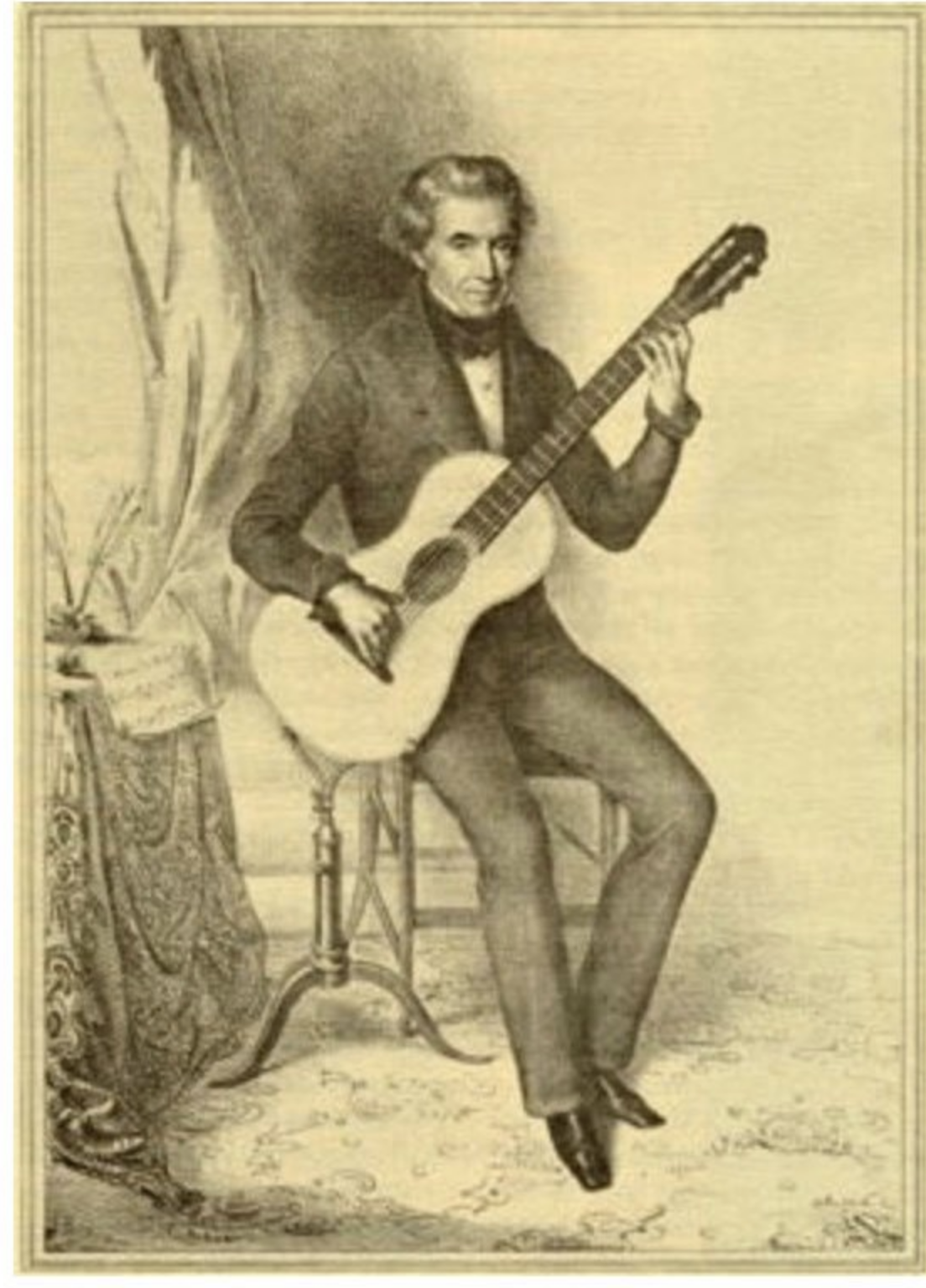
and even though a luthier has built a modern copy:
Tripodium
I don't think this is the way to go because it requires drilling holes in the guitar.
So, I have found Viking Performance Stands:
Invalid Link Removed
The guy who builds them says that he will work from the tracing of a guitar and build a custom head. I don't want clamps, as those could damage the soundboard. I just need longer supports on the back since the guitar will be tilted backwards during play. I think I also need some kind of lip on the front of the head, and one at the bottom of the guitar. I can't see ever leaving the guitar on this stand and walking away, I just want it for playing.
I need to find out how low the stand can go because I will be playing it while sitting down.
I think the Viking will be strong enough, as it says it weighs 13 pounds.
The Viking stand does shift the guitar to the other side of the stand from the Tripodium, so perhaps I need to play with the stand between my legs, I don't know.
Anyway, all thoughts and suggestions welcome.
If you think I have it bad, what about this guy, playing a theorbo here:

I started with this idea, from my luthier, it is a Tripodium from the 1800s, used by Aguado:
and even though a luthier has built a modern copy:
Tripodium
I don't think this is the way to go because it requires drilling holes in the guitar.
So, I have found Viking Performance Stands:
Invalid Link Removed
The guy who builds them says that he will work from the tracing of a guitar and build a custom head. I don't want clamps, as those could damage the soundboard. I just need longer supports on the back since the guitar will be tilted backwards during play. I think I also need some kind of lip on the front of the head, and one at the bottom of the guitar. I can't see ever leaving the guitar on this stand and walking away, I just want it for playing.
I need to find out how low the stand can go because I will be playing it while sitting down.
I think the Viking will be strong enough, as it says it weighs 13 pounds.
The Viking stand does shift the guitar to the other side of the stand from the Tripodium, so perhaps I need to play with the stand between my legs, I don't know.
Anyway, all thoughts and suggestions welcome.
If you think I have it bad, what about this guy, playing a theorbo here:
Gotta get me one of them there Theorbo things!
Gotta get me one of them there Theorbo things!
You gotta! My music teacher said he saw a theorbo player get on a bus once. He saw this huge instrument case, and he heard, "Excuse me, Excuse me, Excuse me".
So, my teacher talked to the guy. He said that New Yorkers would not tolerate his theorbo during rush hour, he got roughed up quite a bit and pushed around. I thought double bass players had trouble.
Here is an interesting Wikipedia article on the Mandora, or Gallichon, a bass instrument with a string length of 72cm or greater, that is similar to a theorbo. There are very few of these instruments in existence and someone told me that Bach inherited two of them at one point. I guess Bach had trouble playing them as there is not a lot of music for them. They were mainly used for basso continuo.
Mandora - Wikipedia
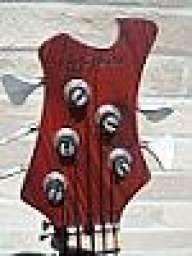
Sorry to resurrect an old thread but this seemed like the best place to put information about my new guitar. I have just received a contra guitar, a guitar that has six strings and is tuned exactly the same as a classical guitar, but one octave lower. This guitar is often called a contrabass guitar, but that's not accurate, as the guitar is not one octave below a bass, but one octave below a classical guitar.
I play classical guitar so this is convenient, as I can read treble clef and play it the same on this guitar as on my regular classical guitar and it will sound one octave lower. Still, the stretches in first position are huge, I'm trying to get my head around them. Any tips would be greatly appreciated! I'm feeling a bit overwhelmed at the moment, haha!
This guitar has a scale length of 90cm, 900mm, while a standard classical guitar has a scale length of 650mm.
Surprisingly, Hannabach sells strings off the shelf for this guitar!
Invalid Link Removed
Who in the world is buying them and where do they live? ;-) I have never seen another 900mm contra guitar.
Anyway, here are some pictures of it, and a couple of videos by a pro after that:
View attachment 3088722
View attachment 3088721
View attachment 3088723
Here is the same guitar being played by Peter Constant, a very talented guitarist who studied with Ben Verdery, chair of the guitar department at Yale. Peter is part of Z.o.o. Duo, a guitar duo/orchestra that uses a wonderful mix of different scale guitars on their recordings. You can find them on YouTube.
and
I'm not sure I'll every be able to play it like Peter does, but maybe with enough practice, I can make some music with this monster. For now, I'm hoping to play some simple bass lines in an ensemble, say a trio or a quartet. Wish me luck.
I think I've seen this guitar on Delcamp
As a bass player and classical guitar player I would love to try it!!

I saw this thread last night and since then I'm thinking about that if I'd ever need classical bass. I have an acoustic bass but thought about the genres I've been playing and I think I wouldn't need any... It's more like a flamingo guitar companion when it comes to what you play on it and the sound it creates...
I think I've seen this guitar on Delcamp
As a bass player and classical guitar player I would love to try it!!
Ha, I have been discovered. ;-) It would be great to get your opinion of the contra guitar as a bass player but, unfortunately, we're kind of a long way from each other. I think it takes some effort to get good on this instrument, check back after a year of lessons. ;-)
What bass do you play? Do you only play the acoustic bass?
You know, I'm totally cheating, as I can just read and play treble clef on this guitar because it is tuned exactly the same as a classical guitar.
I saw this thread last night and since then I'm thinking about that if I'd ever need classical bass. I have an acoustic bass but thought about the genres I've been playing and I think I wouldn't need any... It's more like a flamenco guitar companion when it comes to what you play on it and the sound it creates...
I also thought about repertoire. The thing that swung me was the enthusiasm I found in people willing to arrange music for the instrument, plus the existence of a classical guitar orchestra. I want to concentrate more on ensemble playing. The contra guitar is unique instrument for ensemble playing and I think it can fit in well in a group.
We have that governments broadcast foundation in Turkey. (Think it's like BBC or Deutsche Welle). They have many orchestras for our traditional music shows on tv. They kinda keep the old compositions based on original forms but with impoving tech there are more needs in musical way. We have "baglama" for our folk music like Americans have their folk guitar.
You can see here
During that time, these traditonal music orchestras had bass guitar for sub tones. But there are lots of "commas" in Turkish traditional music and it was hard to get those commas with a western instrument.
In the end they invented "bass baglama" which not only giving those "commas" needed but also has tones very close to original baglama instrument.
You can see here
There are also some more experimentations by luthiers
So in my opinion, like the bass baglama, classical bass guitar or contra bass is also for a specific genre of music and its own arrangements. I've been thinking that it can be used for pop music.
For example, Turkish pop music is too much inspired by flamenco. Used the same chords and almost the same style.
You can see an example here
So maybe bassists who are playing this kind of mainstream music genres influenced by classical guitar forms can use contra bass. That would be the most perfect and interesting thing instead of just playing their electric basses all the time...
You can see here
During that time, these traditonal music orchestras had bass guitar for sub tones. But there are lots of "commas" in Turkish traditional music and it was hard to get those commas with a western instrument.
In the end they invented "bass baglama" which not only giving those "commas" needed but also has tones very close to original baglama instrument.
You can see here
There are also some more experimentations by luthiers
So in my opinion, like the bass baglama, classical bass guitar or contra bass is also for a specific genre of music and its own arrangements. I've been thinking that it can be used for pop music.
For example, Turkish pop music is too much inspired by flamenco. Used the same chords and almost the same style.
You can see an example here
So maybe bassists who are playing this kind of mainstream music genres influenced by classical guitar forms can use contra bass. That would be the most perfect and interesting thing instead of just playing their electric basses all the time...
Last edited:

So, I don't want to play mine like a lap guitar, that's sort of what he is doing, or like a cello or an upright double bass, but more like a regular classical guitar. Still, it not easy to figure out how to hold the monster. I've tried small and large Dynarette pillows with my feet flat on the floor, but using a foot stool on its lowest setting seems to work better.
Holding the thing between my legs feels kind of like giving birth to a Volkswagen Beatle. ;-) I need more hip joint flexibility. I could try holding it on my right leg but the guitar is much more unstable there than on the left leg. I wonder if I could prop it up on a low stool.
Any suggestions would be appreciated. I need to angle it back a bit to see the neck. I also need the neck pointed up, but not too much. A strap is out of the question.
Have you looked at Ergoplay or something similar? They can attach pretty much anywhere on the side of the instrument with suction cups. Lots of adjustment for height and angle with the Troester model, and you can even use one in conjunction with a footstool for extra range and control. Might be helpful if the natural "waist" of the instrument puts it in an awkward location for such a long scale.
Have you looked at Ergoplay or something similar? They can attach pretty much anywhere on the side of the instrument with suction cups. Lots of adjustment for height and angle with the Troester model, and you can even use one in conjunction with a footstool for extra range and control. Might be helpful if the natural "waist" of the instrument puts it in an awkward location for such a long scale.
I think the guitar is too heavy for any of those kind of supports. I don't want the entire weight of the thing concentrated on a small support. It weighs twelve pounds. I have used the Sage Works/Barnett support, and I have both the large and small Dynarette pillows, but I'm not really happy with them.
The real trouble is that the guitar's body is so big that it forces me too spread my legs very wide. I don't want that strain on my hip joints and so I think moving the guitar to my right so that I can close my legs is the way to go. Now, if I could just find the right kind of stand.
Yesterday, I played the guitar while seated on my bed to try out that position. My right arm gets pushed too high when playing this way but it was good to have most of the weight supported by the bed. There aren't many frets on the body, so it's ok to get closer to first position. If I had a stand that held the guitar maybe 6 inches lower than the bed, neck up and body pointed back a little, I think I'd be ok. The bed is 24" off of the ground.
We have that governments broadcast foundation in Turkey. (Think it's like BBC or Deutsche Welle). They have many orchestras for our traditional music shows on tv. They kinda keep the old compositions based on original forms but with impoving tech there are more needs in musical way. We have "baglama" for our folk music like Americans have their folk guitar.
You can see here
During that time, these traditonal music orchestras had bass guitar for sub tones. But there are lots of "commas" in Turkish traditional music and it was hard to get those commas with a western instrument.
In the end they invented "bass baglama" which not only giving those "commas" needed but also has tones very close to original baglama instrument.
You can see here
There are also some more experimentations by luthiers
So in my opinion, like the bass baglama, classical bass guitar or contra bass is also for a specific genre of music and its own arrangements. I've been thinking that it can be used for pop music.
For example, Turkish pop music is too much inspired by flamenco. Used the same chords and almost the same style.
You can see an example here
So maybe bassists who are playing this kind of mainstream music genres influenced by classical guitar forms can use contra bass. That would be the most perfect and interesting thing instead of just playing their electric basses all the time...
Thanks for this introduction to Turkish music and the use of the bass guitar in it. Are you playing a baglama now? I think it is interesting to combine an acoustic bass with acoustic guitars. In the classical guitar world. most people play solo, so you don't get to hear the low bass notes that a contra guitar can produce.


