• TalkBass has been independent since 1998. Add your voice.
    Create a free account to reply to discussions, view embedded media, and browse with fewer display ads.
    Join freeLog in
    Want zero display ads or expanded classifieds tools? Compare plans.

Classical bass guitar

Yes, Baden Powell's father named him after the founder of the Boy Scouts.

Green Bar Bill would have been far worse.

Anyway, after my friend played the contra guitar, he realized that he had been thinking of the instrument as a large classical guitar instead of as a bass. So, a lot of the notes he wrote sound better when moved up an octave and are not played on open strings. The open strings can be played to great effect, but not when overused.

I'd be tempted to tune the second and first strings to C and F, respectively.

During rehearsal, we found that if I drove the guitar hard with the side of my thumbnail, closer to the bridge, that I could really push out a lot of sound. and that it was more focused. So, to answer your question, I don't think I need a lighter touch on the contra guitar, I think I need a heavier touch to make it come alive. I think this makes sense because I have to move a much longer string than on a regular sized classical guitar and that takes energy.

True, one would have to put more energy into the contra string due to the increased stiffness of the string at the fixed point of the bridge (less string elasticity) and the larger plate under contra's bridge...particularly with the increased mass of the low E-string. Then again, I don't know how many pounds of linear tension are present in the contra strings.

And, oh, I heard from the luthier, and this guitar became available when the guy who ordered it could not pay for it, as I guessed, so the same old story.

It certainly seems to have found a good home.
 
  • Like
Reactions: ContraGuitar

In the video at 4:40, that's a Stoll contra guitar/bass?, made in Germany. It comes in 4,5, and 6 string configurations.

Invalid Link Removed

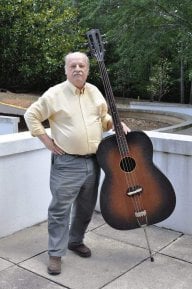
The scale length is 86.4 cm, so a little shorter than my 90cm behemoth. You can see two people holding the six string guitar in the pictures below the main product picture, one with a neck strap, and one on a stool. I'll be in intensive care if I try to play mine on a neck strap.

Does Stoll sell their own strings or do you have to custom order them? I don't remember seeing 86.4cm strings for sale anywhere.

The Stoll is listed as weighing about 6 1/2 pounds. My contra guitar weighs 12 pounds! I can't begin to describe how solidly constructed it is, the back is triple lined, the sides are double lined, and the top is a spruce/cedar double top! The back and sides feel absolutely inert, while the top vibrates freely when you speak two or three feet away from the guitar.
 
Last edited:
  • Like
Reactions: bholder
Green Bar Bill would have been far worse.


I'd be tempted to tune the second and first strings to C and F, respectively.


True, one would have to put more energy into the contra string due to the increased stiffness of the string at the fixed point of the bridge (less string elasticity) and the larger plate under contra's bridge...particularly with the increased mass of the low E-string. Then again, I don't know how many pounds of linear tension are present in the contra strings.


It certainly seems to have found a good home.

Haha, Green Bar Bill.

I'm not sure about tuning up at the moment, I have enough problems playing anything on the thing in standard tuning. My friend wants me to play the melody of the Baden Powell piece on the repeat, and I said, I don't think that's my job!

A composer at the Mannes Guitar Seminar this summer commented that he was listening to classical guitar in the car and thought, I wish to god we had some other bass notes besides D and E. So, he wrote a bunch of pieces with the lowest string tuned to C#. They were interesting.

Thanks for the kind words about the instrument finding a good home! I'm trying to put the guitar to good use. A music professor friend who lives three blocks away from me, conveniently, is excited about arranging some music for the contra guitar. I think he has a Vivaldi piece in mind. There is also a guitar orchestra in town and I have exchanged email with the conductor. They may have some parts for me next year.

Anyway, the contra guitar now has some wheels:

IMG_5647.JPG


Yes, I will use more than one bungie cord to wheel it down the street.

I want to put some padding in the case and under it to give the guitar some protection from bumps.

Any ideas?
 
Look at this stretch from G natural on the 6 string to E natural on the 5th string. I have pretty big hands but that's not easy for me. Will I get more flexible if I keep stretching like this? I planted E and stretched back for G. I curled my middle fingers for the photo so you could see the stretch better.

Going back to a 650mm scale guitar is like playing a toy after trying to play this thing.

IMG_8645.JPG
 
Mine (...) was built by Jose Mota of Rhode Island and intended to be used for fado.
Funny you mention fado, as I keep reading that the contrabass is used in fado but I have yet to see one like this being played in video of a fado group on YouTube. Do you have any links?
(...) The only other six string option was the Esteve P75, which is a 750mm instrument
Not that I know anything whatsoever about fado, but...what I've seen in looking for info about MY bass is that the fado bassists seem to be playing whatever they can get, from Guilds to electrics to uprights.
Very much à propos, here's a fresh contribution by member @CARLOS VALINHAS:
you can listen a FADO ensemble with a Esteve Contrabass...

Another example...
 
  • Like
Reactions: bholder
Ha, I don't know anything about fado either, except that it is sung in Portuguese, and is so sad, that you don't need to understand the words to break down in tears.

Very much à propos, here's a fresh contribution by member @CARLOS VALINHAS:
Beautiful, but so very sad. :crying::crying::crying::crying::crying::crying:

Seriously cool stuff - I have a little round 12 string guitar with the odd tuners like the one in the video - anyone know what it's called?
 
This is going to almost sound smartass, but...it's called a Portuguese guitar. Really.
Portuguese guitar - Wikipedia
Haha! You know, that's probably what it was sold as, too, but I thought it simply meant "guitar from Portugal" rather than the name of the instrument type! :woot::roflmao::thumbsup:
ac_1_b.JPG
2d_1_b.JPG

(I've restored it and restrung it since those seller pics, came out beautifully, need to get new pics)
 
  • Like
Reactions: HaphAsSard
Beautiful, but so very sad. :crying::crying::crying::crying::crying::crying:

Seriously cool stuff - I have a little round 12 string guitar with the odd tuners like the one in the video - anyone know what it's called?
The English Wiki entry for the thing is titled, drumroll, Portuguese guitar (guitarra portuguesa in the original).
[Pre-posting EDIT: @mikeoso beat me to it!]
Since I've spent quite a lot of bandwidth on nomenclature in this thread, I might as well give my most humble recommendation about this instrument, which is to leave at least "guitarra" untranslated: it should leave no doubt about which Lusitan plucked cordophone you're referring to precisely. [As you've attested, ]"Portuguese guitar" is a little ambiguous, and the further fact that Portugal has an unusually rich tradition of guitar-like instruments, both urban and rural (most of which are known as violas - as is the Spanish guitar by the way) would only add to the confusion.

While not without local antecedents, the guitarra owes a number of details to the mid-18th century importing of the so-called "English guit(t)ar", particularly its use of Preston tuners. Another similar instrument sporting them and which too derives from the guittar, both directly and via some influence from the Portuguese guitarra, is the early 20th century Hamburger Waldzither, originally designed by German luthier C. H. Böhm.

ATLAS of Plucked Instruments - Europe West
ATLAS of Plucked Instruments - cittern
 
Last edited:
  • Like
Reactions: bholder
The English Wiki entry for the thing is titled, drumroll, Portuguese guitar (guitarra portuguesa in the original).
[Pre-posting EDIT: @mikeoso beat me to it!]
Since I've spent quite a lot of bandwidth on nomenclature in this thread, I might as well give my most humble recommendation about this instrument, which is to leave at least "guitarra" untranslated: it should leave no doubt about which Lusitan plucked cordophone you're referring to precisely. [As you've attested, ]"Portuguese guitar" is a little ambiguous, and the further fact that Portugal has an unusually rich tradition of guitar-like instruments, both urban and rural (most of which are known as violas - as is the Spanish guitar by the way) would only add to the confusion.

While not without local antecedents, the guitarra owes a number of details to the mid-18th century importing of the so-called "English guit(t)ar", particularly its use of Preston tuners. Another similar instrument sporting them and which too derives from the guittar, both directly and via some influence from the Portuguese guitarra, is the early 20th century Hamburger Waldzither, originally designed by German luthier C. H. Böhm.

ATLAS of Plucked Instruments - Europe West
ATLAS of Plucked Instruments - cittern
And yes, the "waldzithers" are also on my GAS radar. ;)
 
  • Like
Reactions: HaphAsSard
Isn't the bass a four string bass and not a contra guitar?
As pictured on post #7 of this very thread, it's a 4-string version of a classical contrabass guitar. In its original Niibori concept the instrument has six strings, but since most adopters outside the guitar ensemble format will just use it as a bass, builders like Aria and Esteve must have decided to offer the 4-string configuration as an option.
1979 Acoustic EKO B.A/6 purchased ABG - Anyone familiar with it?
^ "Se puede construir con 6 o 4 cuerdas"
#7
^ "It can be made with 6 strings or 4 strings."
Contrabass
^ "4 String and 6 String models (...) 4 cuerdas y 6 cuerdas. (...) nut is 48mm for the 4-string model but 52mm for the 6 string model."
The "Productos Relacionados" section at the first Esteve link is interesting. The PSCB model, also offered in 4 or 6 strings, has a marginally longer scale than the PS75, at 30.5" vs. the 29.5" of the latter; the "PS70" or "Bajo" is the Niibori "bass guitar" (700mm scale, B-b tuning) that I rambled about in past posts.
[In practice, the critical element in including the 4-string version under the term seems to be the classical guitar shape, construction and type of strings, rather than the number/tuning (and narrow spacing) of the strings themselves. Sure, one could argue that's just a short-scale, eight-shaped classical-body ABG. Much like the contrabass vs. contra guitar argument, it's a matter of seeing how many English speakers adopt a specific term for the specific object. Hey, this thread might contribute in tipping the scales either way, someday. Japanese and Spanish, or at least MI manufacturers based in the respective countries, seem to have chosen.]


The real monster is the instrument you have, Contra. Speaking of which, I forgot to link to its older dreadnought cousin, the EKO BA.6 that @Tom Robitaille acquired last year. From all indications, also a one-off. Scale length is shorter, at 34".
1979 Acoustic EKO B.A/6 purchased ABG - Anyone familiar with it?
 
Last edited:

Latest posts