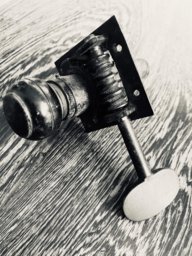
"the question was: what I cannot see from the pics, and what I do not know, is if their brace-like cleats have the grain running purely length-wise. While the 'cleats' are placed at 90° with the top grain, if the 'cleat' grain runs at an angle, so that the angle between the 'cleat' grain & the top grain is substantially less than 90°, it would be much less of an issue. Is that so?"
My answer is still yes; I believe that would be so, if that is what they did.
 "Compressional sound velocity in CF is much higher than in wood, which leads to the rays following different paths becoming out of phase, and this effect is strongest for higher frequencies. Hence LPF."
The compressional sound velocity is not significant in this application; the CF is being proposed as a cleat repair material, not a fabrication material. But it is not at all irrelevant to discuss the use of carbon fibre
cloth that Fdeck raised; woven CF cloth composite is used for its stiffness and impact strength, not for its flexibility. So if stiffness is being increased, as I said before, i believe the effect - if detectable - would be more akin to a HPF (high pass filter, if we
must use these electronics terminologies) Stiffness is proportional to frequency; the stiffer the element, the higher the natural frequencies of that element. In my experience if you are after increased low frequency response, you make the salient element more flexible. I understand that the inverse is Ortsom's opinion without warranty, but both science and empirical experience does not bear this out as a fact.
The use of epoxy in bass repair has its place, but there are some applications where I believe it should never be used; for example, in most cases, crack repair.
I have seen how the Thomas Martin workshop work is done; i have had basses restored by them in my workshop. And I have explained my personal beliefs on cleating in some depth, while accepting that there are many schools of thought. Make whatever inference you like. So with regard to their workshop methods, perhaps, as Ortsom wrote "Why is for him to answer"




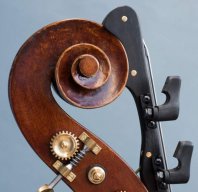

 )
)