Background
In years past I owned two Class D bass amplifiers: a ca. 1993 Walter Woods amp and a 2007 Acoustic Image Focus 1 Series III. It’s been a long time, but I remember really digging the Walter Woods amp. Though I still own the Acoustic Image amp, the last I played it regularly was over three years ago. In its day it was good, but the state of Class D advanced a lot since then. Even Acoustic Image’s own newer amps are much better than their older ones, I have heard. The Focus 1 Series III sounded pretty good to me, but it hissed a little and felt somewhat distant to play.
Also in the past I owned various Class AB or Class H amps: a big Carver for a biamped rig in the 80s, who knows what else, and currently a QSC PLX1104 and PLX1804. The PLX1804 is a recent arrival, meant to replace the PLX1104. The PLX1804 is Class H (or AB/H, as QSC describes it sometimes) to the PLX1104 being Class AB. At a given perceived volume they sound the same to me.
I won’t mention my past or present tube amps, since the comparison of their sonics is not relevant in my consideration of types of solid state amps.
Premise
Among solid state bass amps, the sound of high quality Class AB is my current standard. But reading players’ accounts of the latest crop of Class D bass amps, I felt it was time for me to try at least one, to give Class D another chance. (That plus I am a gear ho. Discriminating, but a ho nonetheless.)
Selection
My first attempt was an Eich Amplification T-900. That didn’t go well due to a very bad deal with the sole US dealer (you have been warned). I never even played it before returning it. My second try was a Glockenklang Blue Rock. That went perfectly; dealer, deal, amp and all (thank you, Luthier's Access Group!)
Inquiry
“At a given perceived volume they sound the same to me.”
That was a key part of my interest. How close could I come to being able to say that when comparing the QSC PLX1804 and the Glockenklang Blue Rock?
Today I did a first test to enable that comparison.
Harness
[Invalid or Expired Link Removed]
Prep
First I warmed up all the electronics well. Then I chose a moderate, but spirited output volume on the Blue Rock.
The MAS-112 is quite sensitive. It doesn’t need much power to sing or to hit hard, and at 600 watts it was well outmatched by both amps. So at the chosen volume there was lots of headroom. Lots, I said.
Switching the input and output connections over to the PLX1804, then I matched its output volume to the Blue Rock’s as best I could, which after a couple of turns was pretty darn close.
Considering that the Blue Rock features a logarithmic output volume pot (smooth, linear-sounding transition — it doesn’t “come on the cam”, and full output is at about 3 or 4 o’clock), note that I set its output volume at just above 9 o’clock. To match that, I set the one PLX1804 channel's volume at five clicks up from shut, by chance also just above 9 o’clock.
Comparison
Next was the listening test proper. Playing with a variety of instrument sounds (pickup selection, tone pot setting, playing style, etc.), I stepped through several musical motifs, alternating between the two amps as often as time permitted.
That turned out to be a fairly long test. It was enough to let me feel confident that after all the variations, I understood each amplifier’s characteristic sound.
Conclusion
Did they sound the same? If not, how did they differ?
Allowing for weighting by primacy (first impression) and recency (latest impressions), I heard the following comparatively. The differences were subtle, but distinctive:
My guess is that this would be the same for most experienced players: after a while, they would not hear the difference unless they were either 1. really trying to or 2. were so strongly attached to the Class AB sound that they couldn’t help but hear the difference.
Though with only these two examples my preference still is for the sound of Class AB, after this test I accept that Class D has arrived; that when it is artfully integrated into an excellent design well implemented, it can sound basically as good as any other solid state power amp type (which point knowledgeable forum members often make here on TalkBass).
Afterword
In itself, especially with its own preamp and all, the Glockenklang Blue Rock is a fantastic bass amp and a beautiful-sounding instrument. As I wrote to the dealer after playing it for the first time,
“There is far to go before I learn all its pathways and features, but my intuition is that the Blue Rock is the Class D, all-solid state integrated bass amp I was waiting for. Barring a massive qualitative improvement in bass amplification in the near future, I should be happy with this amp for years to come, and not feel that I am missing out. It is a sweet spot device. Clearly its design pursues no extremes, and is based in a commitment to usefulness and quality rather. I even like the Blue Rock’s size and weight, but that could be my age talking.”
In years past I owned two Class D bass amplifiers: a ca. 1993 Walter Woods amp and a 2007 Acoustic Image Focus 1 Series III. It’s been a long time, but I remember really digging the Walter Woods amp. Though I still own the Acoustic Image amp, the last I played it regularly was over three years ago. In its day it was good, but the state of Class D advanced a lot since then. Even Acoustic Image’s own newer amps are much better than their older ones, I have heard. The Focus 1 Series III sounded pretty good to me, but it hissed a little and felt somewhat distant to play.
Also in the past I owned various Class AB or Class H amps: a big Carver for a biamped rig in the 80s, who knows what else, and currently a QSC PLX1104 and PLX1804. The PLX1804 is a recent arrival, meant to replace the PLX1104. The PLX1804 is Class H (or AB/H, as QSC describes it sometimes) to the PLX1104 being Class AB. At a given perceived volume they sound the same to me.
I won’t mention my past or present tube amps, since the comparison of their sonics is not relevant in my consideration of types of solid state amps.
Premise
Among solid state bass amps, the sound of high quality Class AB is my current standard. But reading players’ accounts of the latest crop of Class D bass amps, I felt it was time for me to try at least one, to give Class D another chance. (That plus I am a gear ho. Discriminating, but a ho nonetheless.)
Selection
My first attempt was an Eich Amplification T-900. That didn’t go well due to a very bad deal with the sole US dealer (you have been warned). I never even played it before returning it. My second try was a Glockenklang Blue Rock. That went perfectly; dealer, deal, amp and all (thank you, Luthier's Access Group!)
Inquiry
“At a given perceived volume they sound the same to me.”
That was a key part of my interest. How close could I come to being able to say that when comparing the QSC PLX1804 and the Glockenklang Blue Rock?
Today I did a first test to enable that comparison.
Harness
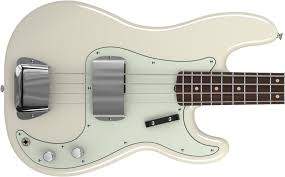
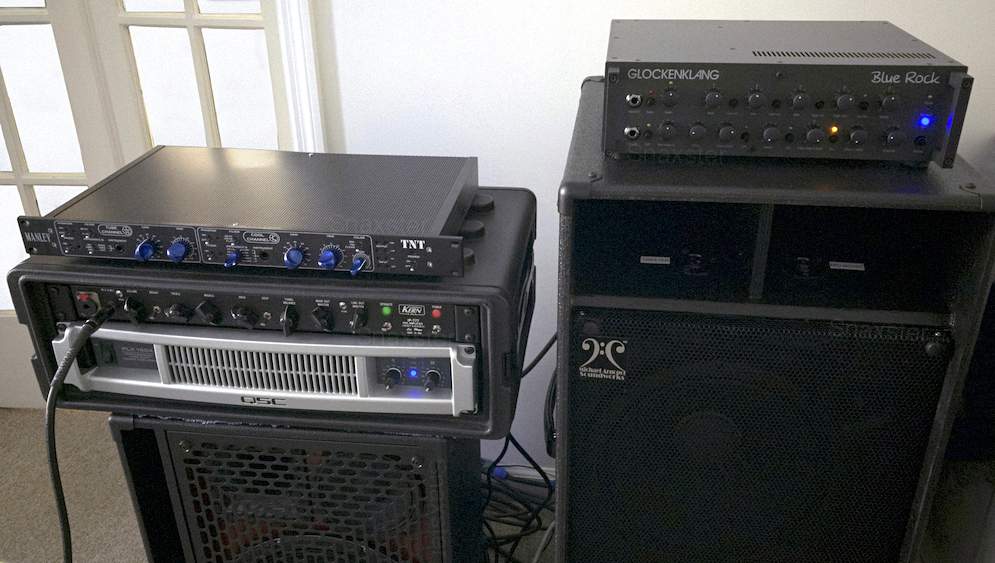
- 1973 Fender Precision Bass as P/J, ash and maple
- Kern IP-777 preamp, set clean and pretty flat, line out
- [sfx] micro-Thumpinator HPF
- QSC PLX1804, line in
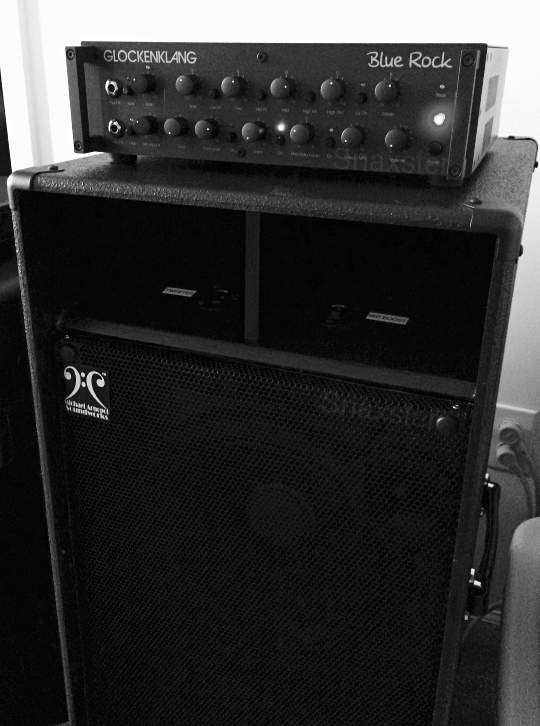
- Glockenklang Blue Rock, return in, loop input volume maxed
- MA Soundworks MAS-112, Eminence woofer, 4 ohm, set flat
[Invalid or Expired Link Removed]
- Power amp type: Class AB/H
- Output power: 1k Hz, 0.1% THD (EIA), 900 watts 4 ohms per channel
- Freq response: 20 - 20k Hz, ±0.5 dB
- Distortion: SMPTE-IM 0.02%
- Signal/noise: unweighted, 20 - 20k Hz -106 dB
- Power amp type: Class D
- Output power: 1000 watts 4 ohms
- Freq response: 20Hz to 20KHz, -1 dB
- Distortion: unspecified
- Signal/noise: unspecified
Prep
First I warmed up all the electronics well. Then I chose a moderate, but spirited output volume on the Blue Rock.
The MAS-112 is quite sensitive. It doesn’t need much power to sing or to hit hard, and at 600 watts it was well outmatched by both amps. So at the chosen volume there was lots of headroom. Lots, I said.
Switching the input and output connections over to the PLX1804, then I matched its output volume to the Blue Rock’s as best I could, which after a couple of turns was pretty darn close.
Considering that the Blue Rock features a logarithmic output volume pot (smooth, linear-sounding transition — it doesn’t “come on the cam”, and full output is at about 3 or 4 o’clock), note that I set its output volume at just above 9 o’clock. To match that, I set the one PLX1804 channel's volume at five clicks up from shut, by chance also just above 9 o’clock.
Comparison
Next was the listening test proper. Playing with a variety of instrument sounds (pickup selection, tone pot setting, playing style, etc.), I stepped through several musical motifs, alternating between the two amps as often as time permitted.
That turned out to be a fairly long test. It was enough to let me feel confident that after all the variations, I understood each amplifier’s characteristic sound.
Conclusion
Did they sound the same? If not, how did they differ?
Allowing for weighting by primacy (first impression) and recency (latest impressions), I heard the following comparatively. The differences were subtle, but distinctive:
- the PLX1804 sounded thick, planted, even
- the Blue Rock sounded bright, spatial, edgy
- the PLX1804 felt neither introvert nor extrovert, warmly presenting what it was given
- the Blue Rock felt a bit extrovert, eager to present its power and beauty
- both the PLX1804 and the Blue Rock
- seemed to have endless headroom for conveying clean, clear bass frequencies
- were in their responsiveness to playing inputs immediate and tactile
- presented great clarity across strings and in harmonic content.
My guess is that this would be the same for most experienced players: after a while, they would not hear the difference unless they were either 1. really trying to or 2. were so strongly attached to the Class AB sound that they couldn’t help but hear the difference.
Though with only these two examples my preference still is for the sound of Class AB, after this test I accept that Class D has arrived; that when it is artfully integrated into an excellent design well implemented, it can sound basically as good as any other solid state power amp type (which point knowledgeable forum members often make here on TalkBass).
Afterword
In itself, especially with its own preamp and all, the Glockenklang Blue Rock is a fantastic bass amp and a beautiful-sounding instrument. As I wrote to the dealer after playing it for the first time,
“There is far to go before I learn all its pathways and features, but my intuition is that the Blue Rock is the Class D, all-solid state integrated bass amp I was waiting for. Barring a massive qualitative improvement in bass amplification in the near future, I should be happy with this amp for years to come, and not feel that I am missing out. It is a sweet spot device. Clearly its design pursues no extremes, and is based in a commitment to usefulness and quality rather. I even like the Blue Rock’s size and weight, but that could be my age talking.”
Last edited: