
Enjoy the benefits of a premium membership!
Upgrade Account
-
TalkBass has been independent since 1998. Add your voice.
Create a free account to reply to discussions, view embedded media, and browse with fewer display ads.
Join free Log in
Want zero display ads or expanded classifieds tools? Compare plans.
You are using an out of date browser. It may not display this or other websites correctly.
You should upgrade or use an alternative browser.
You should upgrade or use an alternative browser.
Composite vs. maple neck
- Thread starter Wawawa
- Start date
More options
Who Replied?A composite neck seems to deliver a more focused sound, no dead spots, very consistant on every position on the neck. The sound of maple seems to be a bit more dynamic, singing and with the possible disadvantages of wood you have to take into account. FWIW off course, I'm no expert, just the owner of a Modulus and a Benavente that fit the desciption.


Agree with Mule's description of composite necks. Personally, I like that. But I'd add that there are hybrids such as Modulus' Genesis necks (all the tension is born by graphite, but the graphite is encased in a maple or other wood, including a wood fretboard). This is not the same as graphite reinforcement (which, to my ears, produces closer to a wood neck sound). Genesis necks produce a blend of both characters: No dead spots, somewhat more massive bass, closer to a "singing" tone than just graphite. Not to everyone's taste, but an alternative not everyone knows about. Modulus makes P and J replacement necks (though they are way backordered and a bit hard to find through dealers).

Just as The Mule stated above, composite tends to provide a consistent tonal volume across the fretboard, with each note having just as much vibrance as the last.
From my experience, certain manufacturers such as Modulus, and Moses tend to make composite necks that are made simply for the busy touring musician, in that the necks are made for stability and not for tonal purposes. Having owned a Quantum, I can tell you firsthand that it is built like a tank, but the tone was anemic and thin. It was... utilitarian, really.
Now... manufacturers such as Zon... their necks, coupled with their phenowood boards, and overall craftsmanship... absolutely sing. I don't know how they do it, but once you play a Zon, you'll see what all the noise is about.
From my experience, certain manufacturers such as Modulus, and Moses tend to make composite necks that are made simply for the busy touring musician, in that the necks are made for stability and not for tonal purposes. Having owned a Quantum, I can tell you firsthand that it is built like a tank, but the tone was anemic and thin. It was... utilitarian, really.
Now... manufacturers such as Zon... their necks, coupled with their phenowood boards, and overall craftsmanship... absolutely sing. I don't know how they do it, but once you play a Zon, you'll see what all the noise is about.
In the case of graphite, I'd say "more focused" means a more equal delivery of each harmonic of the note you play. They intonate very well so that you can always and more easily (than with other basses) hear the note that's being played. If anything, they may tend to be a little lacking in mids (the Genesis neck is not, but I think that may have to do with the maple content in its construction). Also, as Marcus pointed out, not all graphite necks are the same. I prefer the Genesis over the straight-up graphite Modulus necks because it delivers a more complex tone. To my ears, Zon necks and Status necks are more complex than the Modulus Quantums and Fleas as well.

I have a Modulus Genesis VJ fretless that also has a Chechen board. It is very warm and can mwahh till the cows come home. Additionally, it has the benefit of zero deadspots and complete eveness across the board.
I also have a Q5 with Graphite neck and Chechen board, and I love its sound. I don't find it to be thin at all, just very focused and even. In fact, I love soloing that bass because it sounds very sweet to me.
On the other hand, my wood neck basses do have more color (i.e. more harmonics) and I like that sound as well. If you want a wood neck that has minimal if any deadspots, I would highly recommend a Sadowsky. My new P-Bass is VERY even and has a very strong fundamental compared to my other wood neck basses. There is only one spot on the entire neck that has a slightly faster decay on the 6th fret of the G string (C#), and this is really barely noticeable.
I also have a Q5 with Graphite neck and Chechen board, and I love its sound. I don't find it to be thin at all, just very focused and even. In fact, I love soloing that bass because it sounds very sweet to me.
On the other hand, my wood neck basses do have more color (i.e. more harmonics) and I like that sound as well. If you want a wood neck that has minimal if any deadspots, I would highly recommend a Sadowsky. My new P-Bass is VERY even and has a very strong fundamental compared to my other wood neck basses. There is only one spot on the entire neck that has a slightly faster decay on the 6th fret of the G string (C#), and this is really barely noticeable.

I've split the difference with my last 2 basses.
My fretless 6 has an Acrylized birdseye maple board coupled with a quartersawn maple neck... sounds like maple with a little extra clarity.
My Fretted 7 Bee has an Acrylized birdseye neck coupled with an Acrylized wenge board... sounds like maple & wenge with a bit more extra clarity.
 The Acrylized process is taking the wood into a vaccuum and impregnating it with Acrylic resin
My fretless 6 has an Acrylized birdseye maple board coupled with a quartersawn maple neck... sounds like maple with a little extra clarity.
My Fretted 7 Bee has an Acrylized birdseye neck coupled with an Acrylized wenge board... sounds like maple & wenge with a bit more extra clarity.
The Acrylized process is taking the wood into a vaccuum and impregnating it with Acrylic resinJames Hart said:I've split the difference with my last 2 basses.
My fretless 6 has an Acrylized birdseye maple board coupled with a quartersawn maple neck... sounds like maple with a little extra clarity.
My Fretted 7 Bee has an Acrylized birdseye neck coupled with an Acrylized wenge board... sounds like maple & wenge with a bit more extra clarity.
And this makes the neck much stronger...right? and what about the feel?
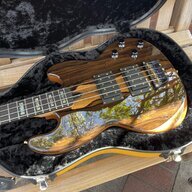
I like the Zon's a lot so composite is not a problem for me, if it's done right... you're not going to get the same sound, but then maybe that is the tone you're looking for.. Plus composite necks have other advantages like their lower maintenance, and more consistent in terms of quality. I still prefer wood, but I could see myself owning a Zon someday.

Human Bass said:And this makes the neck much stronger...right? and what about the feel?
much stronger and slightly heavier. I love the feel of it... Very silky. The killer thing is it's already finished (my Bee's wood was dyed my choice of color during the process). Using Tripoli Compound and a soft buffing wheel you can take it from a mate finish through to a super gloss.


