

Enjoy the benefits of a premium membership!
Upgrade Account
-
TalkBass has been independent since 1998. Add your voice.
Create a free account to reply to discussions, view embedded media, and browse with fewer display ads.
Join free Log in
Want zero display ads or expanded classifieds tools? Compare plans.
You are using an out of date browser. It may not display this or other websites correctly.
You should upgrade or use an alternative browser.
You should upgrade or use an alternative browser.
Confusing phase and timing when we say that different size speakers together is bad?
- Thread starter Vinnie Boombatz
- Start date
More options
Who Replied?
All speakers respond at the same speed regardless of size.
I would also argue that rather than being unimportant, phasing issues are the bane of my existence as a bass player. Nothing I hate worse than hearing some notes and not others.
And further, time alignment is constant for any position, whereas phase is unpredictable. Time alignment everywhere is impossible.
It's not just whole notes that can vanish. The harmonic texture gets wrecked. My own mixed cabs sound fine, but biamped they take on a whole new level of clarity, not enough to warrant dragging all the PA stuff though. I keep my eyes out for another Trace 1518.

I am watching a video of Alice in Chains live at the Maquinaria Festival in 2011 and they have a set up guaranteed to cause phase issues. Both the guitar and bass players have one row of speaker cabinets on the stage and then another row of cabinets set above and several feet behind the bottom row. The frequency with half a wavelength of that offset difference and its octaves will be lost on the stage. It appears that the speakers are about 1.5m apart in depth and that would be F# if so. Luckily, they all use IEMs and hopefully most of what they hear comes from them.

Even if your phase differences with the cabs isn't 180 degrees on some notes, even partially out of phase can cause some notes to be louder and softer than others. And a softer note is a missing note as far as I'm concerned.
that's not "phase", that's polarity, a different thing....the problem I have is when people say that it's due to PHASING issues.
...
Phase would have to do with the way the cabinets were wired, and if one was wired opposite of the other you were using, THAT would cause phasing issues.
out-of-polarity speakers are useless with each other, and don't happen unless somebody made a big mistake.
polarity is about backwards wiring, phase is about shifts in time and distance, and things like the sound a port makes in relation to the speaker driving it.
again, it's not that a 2x10 on a 1x15 is bad, it's just that given the choice, two 2x10s or two 1x15s are probably better.
To illustrate what happens when you put e.g. a 15"woofer and an 8" fullrange driver in one cab without crossover.
Blue= 15"
Green= 8"
Black= summed response
As you can see, the summed frequency-response has a severe dip around 2khz. This is because of the different frequency/phase responses of both drivers.
In picture two you see the phaseresponse(degrees y-axis, frequency x-axis) of both drivers. As you can see the phase between these two drivers already starts to shift at 400hz and is very severe around 2khz.
Hope this explains a bit why using different drivers causes phase issues. To make it even more complicated, using multiple of the same drivers in a cab causes phase issues outside the main listening angle....(mostly in the mid/high frequencies, depends on the distance between the drivers, can't explain it all here...)
Blue= 15"
Green= 8"
Black= summed response
As you can see, the summed frequency-response has a severe dip around 2khz. This is because of the different frequency/phase responses of both drivers.
In picture two you see the phaseresponse(degrees y-axis, frequency x-axis) of both drivers. As you can see the phase between these two drivers already starts to shift at 400hz and is very severe around 2khz.
Hope this explains a bit why using different drivers causes phase issues. To make it even more complicated, using multiple of the same drivers in a cab causes phase issues outside the main listening angle....(mostly in the mid/high frequencies, depends on the distance between the drivers, can't explain it all here...)
Attachments



Maybe you're referring to comb filtering?
The term "comb filtering" is not a term of art in physics. Whenever you see it used you should consider the related statements are probably dumbed down from the explicit truth - perhaps with good reason taking into account the audience - but perhaps not; the term is often used to present concepts that just flat wrong. Interference patterns are generally a lot more complex than a comb shape - and such generally aren't considered filters.
See Arjank's post above for an example of both constructive and destructive interference arising from phase anomalies between dissimilar drivers broadcasting in the same frequency range. Constructive and destructive interference are actual terms of art in physics. Note that the phenomena doesn't look anything like a comb, and consider that the described device isn't a filter [that term implies intent].
==
phase is intrinsically an issue of time
http://en.wikipedia.org/wiki/Phase_(waves)
===
swapping the red and black wires to you cab changes the "polarity" - don't use the term "phase" to describe this, they aren't the same thing
===
Perfect phase coherence in a multi-driver system is a non-trivial challenge - it takes a smart choice of drivers and xover settings and even perhaps swapping the polarity of one or more driver [see what I did there?], and/or perhaps physical displacement of one ore more drivers setting it back from the speaker baffle, and/or perhaps setting small time delays to the signal feeding one or more drivers. Then you must set the listener's head [note the use of the singular] in C-clamps so he doesn't move from the listening position you adjusted everything for... but it does yield astonishing clarity as mentioned above - admit it or I tighten the C-clamp.

===
Jimmy sez:
...phasing issues are the bane of my existence as a bass player.
Physics sez: Give up on the idea of 8 drivers with 4 grossly different path lengths to your ears a few feet away with an intervening reflective floor surface adding 8 more virtual sources with 4 additional gross path lengths Jimmy!


that's not "phase", that's polarity, a different thing.
out-of-polarity speakers are useless with each other, and don't happen unless somebody made a big mistake.
polarity is about backwards wiring, phase is about shifts in time and distance, and things like the sound a port makes in relation to the speaker driving it.
There is a relation - a phase difference (two sources being out of phase) means there's any amount of phase misalignment that isn't a multiple of 360° (because any signal equally phase-shifted by 360° is that same signal). Backwards wiring will instantly produce a 180° misalignment, because rotating phase by 180° degrees is equal to flipping the current direction, that is, flipping polarity.
The term "comb filtering" is not a term of art in physics. Whenever you see it used you should consider the related statements are probably dumbed down from the explicit truth - perhaps with good reason taking into account the audience - but perhaps not; the term is often used to present concepts that just flat wrong. Interference patterns are generally a lot more complex than a comb shape - and such generally aren't considered filters.
The term "comb filtering" is a term in the area of signal processing and analysis, which is relevant here. It's not the only thing happening due to the mixing of the sound coming from different speakers, but it's a component or a good first-order approximation.

To illustrate what happens when you put e.g. a 15"woofer and an 8" fullrange driver in one cab without crossover.
Blue= 15"
Green= 8"
Black= summed response
As you can see, the summed frequency-response has a severe dip around 2khz. This is because of the different frequency/phase responses of both drivers.
In picture two you see the phaseresponse(degrees y-axis, frequency x-axis) of both drivers. As you can see the phase between these two drivers already starts to shift at 400hz and is very severe around 2khz.
Hope this explains a bit why using different drivers causes phase issues. To make it even more complicated, using multiple of the same drivers in a cab causes phase issues outside the main listening angle....(mostly in the mid/high frequencies, depends on the distance between the drivers, can't explain it all here...)
I was talking about different size drivers in different cabs, not the same cab.
I was talking about different size drivers in different cabs, not the same cab.
If the drivers are in the same plane it doesn't matter.
The simulation just shows two drivers in the same cab, but with each their own chamber.
Using different drivers in different cabs and place them somewhere randomly across the stage may give (to some) a nice spatial sound (due to lots of phase shifting throughout a broad frequency range), but it is far from creating an accurate and dynamic sound.....
If the drivers are in the same plane it doesn't matter.
The simulation just shows two drivers in the same cab, but with each their own chamber.
Using different drivers in different cabs and place them somewhere randomly across the stage may give (to some) a nice spatial sound (due to lots of phase shifting throughout a broad frequency range), but it is far from creating an accurate and dynamic sound.....
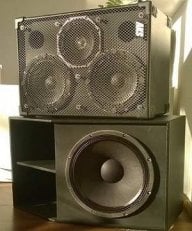
again, i was talking about two different size cabs, on top of each other, in the same rig. not concerned with every single possible scenario here, with different drivers in one cab, or one cab in one spot and another cab somewhere else. just one cab stacked on the other, in the same place.
again, i was talking about two different size cabs, on top of each other, in the same rig. not concerned with every single possible scenario here, with different drivers in one cab, or one cab in one spot and another cab somewhere else. just one cab stacked on the other, in the same place.
The simulation actually shows an 8" cab stacked on top of a a 15" cab both running at full range.
Allthough I wrote in my earlier post that they are in the same cab this doesn't make a difference here.
If they are stacked or in the same cab, they are still in the same plane.
The simulation actually shows an 8" cab stacked on top of a a 15" cab both running at full range.
Allthough I wrote in my earlier post that they are in the same cab this doesn't make a difference here.
If they are stacked or in the same cab, they are still in the same plane.
who uses 8's and 15's?! How about a more realistic comparison of something like a 2x10 and a 1x15.
who uses 8's and 15's?! How about a more realistic comparison of something like a 2x10 and a 1x15.
The simulation was just for the sake of showing what might happen when you mix drivers.
Allthough I can simulate a "210" and a "115", it would not make any sense. There are so many 210's and 115's with different frequency/phase-reponses that it makes as much sense as showing you what happens between a 15 and an 8.
If I simulate it again, but then with a different 8" driver, the outcome will be different.
You're missing a key point. Each speaker has a characteristic phase response across its frequency operating range. The music is always misphased with itself but it doesn't bother our hearing of it, we hear the sum of harmonics as if in phase.
But combining misphased outputs of incompatible cabs gives bumps and hollows in the sum.
Is a single speaker is used, the phase response is almost a moot point (but only if multiple path lengths are eliminated- something that's impossible in a non-anechoic acoustical environment). As soon as a second driver is used, issues occur and these are most noticeable when the listener or measurement mic is closer to one of them because of phase cancellations. The effect is called 'comb filtering' because the response now looks a bit like a hair comb, with deep dips and high peaks that look nothing like a normal response plot. This happens when two speakers and cabinets are as identical as possible. It's also the reason crossovers are necessary when different sizes of drivers are used- it's a bad thing when they produce the same frequencies. As soon as one of them isn't producing the same frequencies at the same amplitude as the other, the effects diminish and this is the reason for companies like Gallien-Krueger building amps capable of bi-amping.
The term "comb filtering" is not a term of art in physics. Whenever you see it used you should consider the related statements are probably dumbed down from the explicit truth - perhaps with good reason taking into account the audience - but perhaps not; the term is often used to present concepts that just flat wrong. Interference patterns are generally a lot more complex than a comb shape - and such generally aren't considered filters.
See Arjank's post above for an example of both constructive and destructive interference arising from phase anomalies between dissimilar drivers broadcasting in the same frequency range. Constructive and destructive interference are actual terms of art in physics. Note that the phenomena doesn't look anything like a comb, and consider that the described device isn't a filter [that term implies intent].
==
phase is intrinsically an issue of time
http://en.wikipedia.org/wiki/Phase_(waves)
===
swapping the red and black wires to you cab changes the "polarity" - don't use the term "phase" to describe this, they aren't the same thing
===
Perfect phase coherence in a multi-driver system is a non-trivial challenge - it takes a smart choice of drivers and xover settings and even perhaps swapping the polarity of one or more driver [see what I did there?], and/or perhaps physical displacement of one ore more drivers setting it back from the speaker baffle, and/or perhaps setting small time delays to the signal feeding one or more drivers. Then you must set the listener's head [note the use of the singular] in C-clamps so he doesn't move from the listening position you adjusted everything for... but it does yield astonishing clarity as mentioned above - admit it or I tighten the C-clamp.
===
Jimmy sez:
Physics sez: Give up on the idea of 8 drivers with 4 grossly different path lengths to your ears a few feet away with an intervening reflective floor surface adding 8 more virtual sources with 4 additional gross path lengths Jimmy!
'Comb filter' may be dumbed down, but it gives people a good way to visualize the effect. If someone hasn't studied physics, constructive/destructive interference will be unknown terms, so there's not much benefit from using them unless someone just wants to keep the terminology consistent. If that's true, a glossary would be of huge benefit and it should be stickied at the top.
Re: your comment about multiple drivers, tell that to Bose.

(BTW- he IS a physicist)
I have to argue that the interference isn't a filter. If it affects the response just by being there, it has acted as a filter and it really doesn't matter if that filter is acoustical, electrical or mechanical. It may not have removed any part of the response from either, but the composite output has been changed.
FWIW, I have measured in-room speaker response many times and I have seen what is referred to as 'comb-filtering' when the path length between two speakers was different or reflections caused this. It's very easy to see when the path differences are increased/decreased and/or reflections are minimized.
The comb-effect is e.g. typical for a 410 cabinet, on-axis it all seems ok, but off-axis these cabs are a mess....Ever wonder why I use a coaxial mid/high driver for my 210?
Also, most argue that a regular 410 or 210 has better sensitivity then my cab with coaxial driver. That might be true on-axis but off-axis the coaxial driver wins hand down, giving me a better power response
Also, most argue that a regular 410 or 210 has better sensitivity then my cab with coaxial driver. That might be true on-axis but off-axis the coaxial driver wins hand down, giving me a better power response
Re: your comment about multiple drivers, tell that to Bose.
(BTW- he IS a physicist)
He is?
901, worst piece of c... ever.

Point to add is that the difference in phase response can be as great between different enclosures with the same speaker size as with mismatched speaker sizes. The conversation when focused upon mixing driver sizes alone is a bit myopic. Truth is that mixing anything except identical cabinets introduces a potential response issue. That includes running a loud stage volume and also running through the FOH. Beyond that, you start to add distance induced issues which are equally impactful and totally unrelated to response. It is also possible to find different enclosures with unmatched drivers that have nearly identical phase response, and yes sometimes that is a deliberate point of design (and more likely to occur as such than by random chance).
Bottom line is that there are a large pool of variables that can cause phase reinforcement or negation. You would think that mismatched drivers are a huge part of the equation. I'm not in agreement to the extent that the idea has reached disproportionate levels due to the extent to which it has been debated.
By point of comparison, I use a setup with multiple preamps and start my signal at a Radial JD7. This box splits my input signal to the different preamps. A feature of this setup is there is a button that allows me to switch the polarity of an output by 180 degrees in the event something downstream is also wired in reverse polarity. However, as you would expect there is nothing downstream as such, and therefore when you push the button on one preamp but not the other(s) you experience true phase cancellation. It is dramatic. The summed outputs become almost completely inaudible. I use this as a baseline for what phase cancellation sounds like. This cancellation is constant and does not ebb and flow in any mysterious way.
When mixing drivers the phase reinforcement or negation will also be constant. The difference is that it will occur at specific frequencies and not at others. A simple test therefore is to play each note on the bass at a consistent velocity and listen. If you hear a dramatic (truly dramatic) difference at certain notes, then turn off one cabinet and try again. If the differences remain then it's not a phase issue. If the differences disappear than you have an issue.
However, most of the anecdotes players give talking about this phenomenon sound to me a lot like simply getting lost in the mix or dealing with other variables in the environment.
The main point is to judge with your ears once you are armed with an understanding of what the potential issue are. We mix a lot of signals all along the way to make our sounds. Clean and dirty, neck and bridge, stage and FOH, etc. It's better to know about phase response than to ignore it. It's also good to understand that there are a million other little things that are equally impactful.
Bottom line is that there are a large pool of variables that can cause phase reinforcement or negation. You would think that mismatched drivers are a huge part of the equation. I'm not in agreement to the extent that the idea has reached disproportionate levels due to the extent to which it has been debated.
By point of comparison, I use a setup with multiple preamps and start my signal at a Radial JD7. This box splits my input signal to the different preamps. A feature of this setup is there is a button that allows me to switch the polarity of an output by 180 degrees in the event something downstream is also wired in reverse polarity. However, as you would expect there is nothing downstream as such, and therefore when you push the button on one preamp but not the other(s) you experience true phase cancellation. It is dramatic. The summed outputs become almost completely inaudible. I use this as a baseline for what phase cancellation sounds like. This cancellation is constant and does not ebb and flow in any mysterious way.
When mixing drivers the phase reinforcement or negation will also be constant. The difference is that it will occur at specific frequencies and not at others. A simple test therefore is to play each note on the bass at a consistent velocity and listen. If you hear a dramatic (truly dramatic) difference at certain notes, then turn off one cabinet and try again. If the differences remain then it's not a phase issue. If the differences disappear than you have an issue.
However, most of the anecdotes players give talking about this phenomenon sound to me a lot like simply getting lost in the mix or dealing with other variables in the environment.
The main point is to judge with your ears once you are armed with an understanding of what the potential issue are. We mix a lot of signals all along the way to make our sounds. Clean and dirty, neck and bridge, stage and FOH, etc. It's better to know about phase response than to ignore it. It's also good to understand that there are a million other little things that are equally impactful.
Latest posts
-

-
 Curious what the percentage of bass players use rounds vs flats is.
- Latest: 5StringBlues
-

-
