
Enjoy the benefits of a premium membership!
Upgrade Account
-
TalkBass has been independent since 1998. Add your voice.
Create a free account to reply to discussions, view embedded media, and browse with fewer display ads.
Join free Log in
Want zero display ads or expanded classifieds tools? Compare plans.
You are using an out of date browser. It may not display this or other websites correctly.
You should upgrade or use an alternative browser.
You should upgrade or use an alternative browser.
Confusing phase and timing when we say that different size speakers together is bad?
- Thread starter Vinnie Boombatz
- Start date
More options
Who Replied?
that's not "phase", that's polarity, a different thing.
out-of-polarity speakers are useless with each other, and don't happen unless somebody made a big mistake.
polarity is about backwards wiring, phase is about shifts in time and distance, and things like the sound a port makes in relation to the speaker driving it.
+1. You can be out of phase by a micro second, it doesn't have to be a complete 180. Otherwise, this little box would not work:
[Invalid or Expired Link Removed]
It's the same effect you have when combining a microphone with a DI signal. One signal is delayed by a micro-second compared to the other. This creates a cancellation effect at certain frequencies and not at others. Like what comb-filtering sounds like to a person up close to a cabinet, but as you back away the problem goes away because you ear gets more equidistant to both sources, while when you stand closer to the amplifier, one speaker is farther away and another is closer. The closer speaker will be louder, but the one farther away is in a different phase/time from your ear. This is because sound moves at a fixed speed.
This is also what I like my fearful 15/6/1. All of the frequencies are coming out of one speaker, so I do not have the problem of hearing myself differently from 1ft away and 5ft above the speaker, where I normally stand. The fearful is much more even because there is no phase relationship between drivers at different distances from my ear. But this problem is accentuated when standing closer to a 210 but goes away as you back away from the 210.
Technically Comb Filtering is a phase relationship change brought on by a change in location of hearing. Reversing a speaker's + and - is also a phase relationship change. The problem is the phase between multiple sources of sound producing the same thing at the same time in relation to the listener. There also exists a problem that un-like speakers do not reliably couple, so adding two different speakers will not always produce 3db louder.
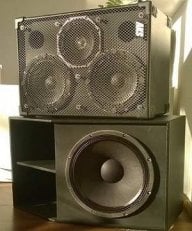
To be honest, I never noticed anything wrong with my 410 + 115 setup until I came here
Forget what you read in this thread...
If you're happy with your rig and it totally works for you then there's no reason for you to think there's something wrong with your setup

Like what comb-filtering sounds like to a person up close to a cabinet, but as you back away the problem goes away because you ear gets more equidistant to both sources
Not so, that the comb-effect gets less apparent is because there's more indirect sound(reflections from walls etc) entering your ear. The comb-effect itself stays.

When looking at frequency and phase charts, it is important to consider what frequencies are actually generated by a bass. [Invalid or Expired Link Removed] lists them. The low B is about 30 and the low E is 41. For the E, being lazy and rounding down, its corresponding harmonics would be :
F 40
1 80
2 120
3 160
4 200
The third octave of E and its harmonics would be :
F 320
1 640
2 960
3 1280
4 1600
5 1920
This thread has some frequency spectrum waterfall plots that show the harmonic characteristics produced by various basses.
What the list says is the third octave of E, which is just above the fretboard's limit on most four and five string basses, is 320Hz and its fifth harmonic is 1920 Hz. This gives an idea of what frequencies a bass is going to produce and the plots in the thread give you an idea of the strengths of those frequencies.
F 40
1 80
2 120
3 160
4 200
The third octave of E and its harmonics would be :
F 320
1 640
2 960
3 1280
4 1600
5 1920
This thread has some frequency spectrum waterfall plots that show the harmonic characteristics produced by various basses.
What the list says is the third octave of E, which is just above the fretboard's limit on most four and five string basses, is 320Hz and its fifth harmonic is 1920 Hz. This gives an idea of what frequencies a bass is going to produce and the plots in the thread give you an idea of the strengths of those frequencies.
Not so, that the comb-effect gets less apparent is because there's more indirect sound(reflections from walls etc) entering your ear. The comb-effect itself stays.
What you said is tru with midrange comb filtering, correct. BUT:There is a more dramatic difference standing closer to one speaker at LOW FREQUENCIES because one speaker is farther away from the ear. It's the same problem that you have with two subs on sticks on each side of the stage, only directly in-between the subwoofers do they couple and sound louder. Anywhere else you need to hear the reflections to make up the canceled notes.
With low frequencies, we can actually move the direction the wave travels by using multiple drivers and time allignment changes. You can have a subwoofer array you cannot hear behind the speaker and have it couple in front, making the subwoofer system inaudible on stage, or behind the concert. But you cannot acomplish this trick with mids.

Jesus Christ. I just asked about two flipping cabs one on top of the other combining 10's and a 15 and the thread has apparently gone to involving subs, full-blown outdoor PA's, etc. I'm going to go practice my bass now and taking a break from this thread. I will say, and there is nobody out there that can disprove this...practicing will make me sound much better...even if I have mismatched cabs!
Jesus Christ. I just asked about two flipping cabs one on top of the other combining 10's and a 15 and the thread has apparently gone to involving subs, full-blown outdoor PA's, etc. I'm going to go practice my bass now and taking a break from this thread. I will say, and there is nobody out there that can disprove this...practicing will make me sound much better...even if I have mismatched cabs!
Deity aside; the same theories apply to everything that produces sound from a moving diaphragm/speaker. You are correct, practice will make you sound better.
I loved my 15/410 rig in the day, but I bi-amped the 15 under 400hz sending 400hz and up to the 410 so I could hear myself closer to the speaker better. Never understood why until I dived into phase and built a directional subwoofer array.
But let me say this again: You are correct, practice will make you sound better.
When looking at frequency and phase charts, it is important to consider what frequencies are actually generated by a bass. [Invalid or Expired Link Removed] lists them. The low B is about 30 and the low E is 41. For the E, being lazy and rounding down, its corresponding harmonics would be :
F 40
1 80
2 160
3 320
4 640
5 1280
6 2560
This thread has some frequency spectrum waterfall plots that show the harmonic characteristics produced by various basses. This information should give an idea of what frequencies a bass actually produces and at what relative strengths.
Why is that important?
IMO to faithfully reproduce all tones(notes) from a bassguitar(or whatever instrument) with equal spl, the speakersystem should be quite linear (read, no sudden phase jumps) throughout a broad frequencyrange.
I don' t see the value of these " bass guitar waterfall plots" when designing a basscab. Each bass guitar has it's own individual " waterfall" footprint, which is also very depended on the guy who plays that bass......
The only thing that is informative about those plots (easily done with a spectrum-analyzer) is that most energie is centered around the 2e harmonic.
Deity aside; the same theories apply to everything that produces sound from a moving diaphragm/speaker. You are correct, practice will make you sound better.
I loved my 15/410 rig in the day, but I bi-amped the 15 under 400hz sending 400hz and up to the 410 so I could hear myself closer to the speaker better. Never understood why until I dived into phase and built a directional subwoofer array.
But let me say this again: You are correct, practice will make you sound better.
zzzzzzz....
zzzzzzz....
Wow.. Yay. ZZZZZZZZZZZZZZZZZZZZZZZz!!!!!!!! Glad I wasted my time here too, apparently the OP is going to troll everybody now. Goodbye..

Maybe you're referring to comb filtering? Search for Bill Fitzmaurice and comb filtering. Lots of posts on the topic.
I think this is it. ^ ^ ^ ^
I explains why, by themselves, my Eden 210XLT and my SWR 210 sound great (imo), but i use them together and it sounds like crap. No matter which head I use.
Some notes are boomy, some notes are gone,, and the whole thing just sounds muddy and weird.
Ive read some success stories about TB peeps mixing speaker cab / driver sizes (without the use of a crossover), but ive yet to hear a mixed set of cabs sound good in the real world.
Saw some poor guy a couple of weeks ago at a local club with a 210 or 212 sitting atop a 115. I could tell he was a decent player, but the sound? What a mess. I felt compelled to say something to him, but didnt want to come off as being a know-it-all, so i just kept my mouth shut.

It's the same problem that you have with two subs on sticks on each side of the stage, only directly in-between the subwoofers do they couple and sound louder. Anywhere else you need to hear the reflections to make up the canceled notes.
Thats because of the larger wavelenght.
Next time, when you have such a system on stage, run e.g. 60hz through that system and walk from one side to the other. You'll hear that at some spot the tone almost disappears and at other spots it gets louder. This is not only because of having two (active)low frequency sources but also because of reflections(passive low frequency sources) that project the waves from the sub back into the room(which are in phase on the spot where it is loud and out of phase on the spot where the tone almost disappears). Standing waves (room modes) can also be nasty.

Stick with it, then.To be honest, I never noticed anything wrong with my 410 + 115 setup until I came here
So what am I supposed to do with that Heritage SVT rig I have coming in a month?Physics sez: Give up on the idea of 8 drivers with 4 grossly different path lengths to your ears a few feet away with an intervening reflective floor surface adding 8 more virtual sources with 4 additional gross path lengths Jimmy!

But seriously, I know the 810 beams, but I don't ever recall having a phasing problem with it. For sure, the fEarful is built with more regard to physics, but I cannot get the sound of the 810 out of my head. It does everything I want in a bass cab. That said, I used my B-15 stack this weekend...only one point source with two 115's vertically stacked...and I've also used the SVT with two 210av's vertically stacked...so sometimes you can be proud of me

Naa... I know you love you some 8x10 - hell I used one for years.
But some of your drop out / drop-in problems are probably related to that relationship.
Do you have fewer of these problems with the B-15?
But some of your drop out / drop-in problems are probably related to that relationship.
Do you have fewer of these problems with the B-15?
When looking at frequency and phase charts, it is important to consider what frequencies are actually generated by a bass. [Invalid or Expired Link Removed] lists them. The low B is about 30 and the low E is 41. For the E, being lazy and rounding down, its corresponding harmonics would be :
F 40
1 80
2 160
3 320
4 640
5 1280
6 2560
Those frequencies are all harmonics of 40 Hz but each successive harmonic is not twice the frequency of the preceding one. The list of the first six harmonics of 40 Hz is actually:
1 40
2 80
3 120
4 160
5 200
6 240
The 1st harmonic is the fundamental, f, and the nth harmonic is simply n*f. You have them listed as (2^n)*f which leaves out most of them. For example 2560 Hz is the 64th harmonic of 40 Hz, not the 6th harmonic.
Ken
I've really never noticed it on either the B-15 cabs or the 810. The only thing I notice is that there's one venue I play where I have to put whatever rig I use as close to the wall as possible so I don't get boundary cancellations. Otherwise I'm fine with it.Naa... I know you love you some 8x10 - hell I used one for years.
But some of your drop out / drop-in problems are probably related to that relationship.
Do you have fewer of these problems with the B-15?
Those frequencies are all harmonics of 40 Hz but each successive harmonic is not twice the frequency of the preceding one. The list of the first six harmonics of 40 Hz is actually:
1 40
2 80
3 120
4 160
5 200
6 240
The 1st harmonic is the fundamental, f, and the nth harmonic is simply n*f. You have them listed as (2^n)*f which leaves out most of them. For example 2560 Hz is the 64th harmonic of 40 Hz, not the 6th harmonic.
Ken
Thanks Ken ! I was confusing octaves and harmonics. I have corrected my original post.
like they say, "the truth will set you free, but first it will piss you off"Jesus Christ. I just asked about two flipping cabs one on top of the other combining 10's and a 15...


