I never said that all Gibsons have neck dive. All I said was neck dive is a design flaw

Enjoy the benefits of a premium membership!
Upgrade Account
-
TalkBass has been independent since 1998. Add your voice.
Create a free account to reply to discussions, view embedded media, and browse with fewer display ads.
Join free Log in
Want zero display ads or expanded classifieds tools? Compare plans.
You are using an out of date browser. It may not display this or other websites correctly.
You should upgrade or use an alternative browser.
You should upgrade or use an alternative browser.
Controversial Opinion: Gibson Basses Questionable Design Choices
- Thread starter peteygrizz
- Start date
More options
Who Replied?I have a 30.5" bass that I built with a chambered body that weighs a svelte 5 pounds nine ounces and shows NO neck dive. That is because I took the time to make sure that it balances nicely with either a strap on or in a sitting position. It's not that hard to get it right.

I never said that all Gibsons have neck dive. All I said was neck dive is a design flaw
But you made sure to ask which ones didn't exhibit neck dive...wording it as "Such as ?" after my remark that there are Gibson basses with zero neck dive if I remember correctly...
I have a 30.5" bass that I built with a chambered body that weighs a svelte 5 pounds nine ounces and shows NO neck dive. That is because I took the time to make sure that it balances nicely with either a strap on or in a sitting position. It's not that hard to get it right.
Fair enough. You also have the advantage of utilizing 60+ years of the entire industry experience - something that Gibson didn't have when they designed their early models - at your disposal. Not to mention that you don't have to deal with the consumer base filled with traditionalists who scream "heresy" every single time you leave the beaten path. Fender, Gibson and Rickenbacker most certainly face that problem, and it's a very real one. How many replicas of *your* bass - as great of an instrument as it may be - would sell with one of those three logos on its headstock ?

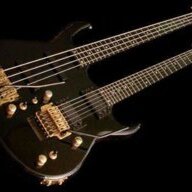
i had a gibson grabber bass with the movable pickup. hated it. the pickup wouldn't stay in position. would move while you played. fat neck. gibson makes great guitars but i'm a fender man forever.So I was thinking about why Gibson Basses are so rarely used and why I have never felt a connection to any Gibson bass I have ever played and it hit me:
Gibson's approach to basses is to simply make a larger guitar. There is no consideration of it being its own instrument with its own needs. They simply make a larger version of their guitars, take two strings off, and call it a bass.
Now I understand there are many guys who like their Thunderbirds, and I'm not trying to poopie in anyone's cereal, I'm just pointing out that while Fender designed the P and Jazz basses from the ground up as unique instruments, Gibson simply made a Les Paul bass, an SG bass, a Firebird bass... Why couldn't they have a designer work with some working bassists and design a bass that wasn't just an upscaled guitar. They build some of the finest guitars ever made, why can't they make great basses as well?

I feel that way about Fenders basses. Never appealed to me and I think they´re quite overpriced. Gibson basses has a more natural and smooth feel to them and they sound more pristine. Not for everybody.
I have an EB-OL and a fretless EMB-4. I´ve also got a p-bass copy made in GDR that plays well (it fulfills all my needs for p-basses.)
I have an EB-OL and a fretless EMB-4. I´ve also got a p-bass copy made in GDR that plays well (it fulfills all my needs for p-basses.)
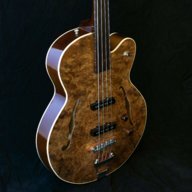
But that's the point of the Les Paul bass, IMHO. Sure, they took the Les Paul body style, but they also spent time figuring out how big the body needed to be to get the sound it gets, which pickups would sound best, how to get weight relief, etc., etc.That's cool that you enjoy your Les Paul bass. My point was not really to imply that there was anything wrong with their basses, just that they never designed any basses from the ground up.
Oh, and it's bogus to say that Fenders were designed and built from the ground up considering the original P-bass designs stole extensively from Leo's Telecaster. Later on in its development in the 1950s, Leo went with the Stratocaster body shape for the P-bass. Split coils? Not until 1957, the same year the Strat headstock became the standard for the P-bass as well. Seems more like evolution through feedback than intentional design.

^^ The Strat inherited its shape from the Precision. And its proportions are slightly different. Put a Strat body shape on a bass and it'll look wrong.
And yes, the P borrowed extensively form the Tele's construction methods, but the parts and design are completely different.
And yes, the P borrowed extensively form the Tele's construction methods, but the parts and design are completely different.
^^ The Strat inherited its shape from the Precision. And its proportions are slightly different. Put a Strat body shape on a bass and it'll look wrong.
And yes, the P borrowed extensively form the Tele's construction methods, but the parts and design are completely different.
"The first of these revisions appeared with the 1954/55 model year, in which the Precision borrowed body and forearm contours from the Stratocaster that made it much more comfortable to play. Also new were a smaller single-ply white pickguard, steel bridge saddles in place of pressed fiber saddles, serial numbers on the bridge instead of the neck plate, and a handsome two-color sunburst finish (like the Stratocaster)." Invalid Link Removed
The "body and forearm contours" are the belly cut and armrest. The body shape of the Strat was derived from the original Precision."The first of these revisions appeared with the 1954/55 model year, in which the Precision borrowed body and forearm contours from the Stratocaster that made it much more comfortable to play. Also new were a smaller single-ply white pickguard, steel bridge saddles in place of pressed fiber saddles, serial numbers on the bridge instead of the neck plate, and a handsome two-color sunburst finish (like the Stratocaster)." Invalid Link Removed
The "body and forearm contours" are the belly cut and armrest. The body shape of the Strat was derived from the original Precision.
Feel free to take that quibble up with Fender. The quote is from their article.
"The first commercial unit of the Precision Bass was produced in October 1951. It had a “slab” (non-contoured) ash body with two “horns” (as opposed to the Telecaster’s one; this provided greater balance and was subsequently adapted for the Stratocaster)...."Not a quibble, just a precision (no pun intended).
So the "horns" were carried over to the Strat, but the contours came from the Strat to the P-bass because the P-bass originally had the Tele slab body.
Pretty much what I said."The first commercial unit of the Precision Bass was produced in October 1951. It had a “slab” (non-contoured) ash body with two “horns” (as opposed to the Telecaster’s one; this provided greater balance and was subsequently adapted for the Stratocaster)...."
So the "horns" were carried over to the Strat, but the contours came from the Strat to the P-bass because the P-bass originally had the Tele slab body.
View attachment 3703086

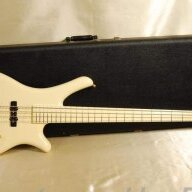
Sorry Dude I own a 58 it is Nothing like the Earlier P bass Body Which is More like a Tele Bass body !The original P Bass and the 1957-and-later P Bass have the same body shape. Contours were added in 1954, same year the Strat was introduced.
He's talking about the body shape (the outline), not the contours.Sorry Dude I own a 58 it is Nothing like the Earlier P bass Body Which is More like a Tele Bass body !
Edit: Sorry, can't find a decent pic.
Attachments

Sorry Dude I own a 58 it is Nothing like the Earlier P bass Body Which is More like a Tele Bass body !
Seriously, are you sight-impaired? The body outlines are the same. The contours were added in 1954. We're talking about the body, not the pickup, the pickguard shape or anything else.

Just browsing in relation to this topic, I will throw in my recent discovery that Gibson had an EB released in 2014(? or about there) that looks NOTHING like the EB's of the past. it doesn't even appear to share the same pedigree in design or features. Furthermore, I find it very attractive and desire to pick one up to try it ... but I can't because it appears they don't make it anymore?
If I have a complaint about Gibson, it's not their designs, it's their marketing and product offering. What a mess.
If I have a complaint about Gibson, it's not their designs, it's their marketing and product offering. What a mess.
that's the beauty of having so many choices but for some reason you don't see that many gibson basses even in big music stores or on stage.I feel that way about Fenders basses. Never appealed to me and I think they´re quite overpriced. Gibson basses has a more natural and smooth feel to them and they sound more pristine. Not for everybody.
I have an EB-OL and a fretless EMB-4. I´ve also got a p-bass copy made in GDR that plays well (it fulfills all my needs for p-basses.)

I wouldn’t use the words “Gibson Bass” and “design” in the same sentence.


