
No doubt the original Fender bass is an outsized tele, but in the overall arc of the Fender bass that design was discarded rather quickly for a somewhat radical revamp into a slab with a top horn then from that to a rounded and contoured variation which is pretty much what is still produced today. Any differences between current production and the first contoured P body would be more keeping up with evolving production methods than refinement of any specific aspect of the design in response to user concerns or complaints.Well thats not really true at all, you could make the argument that the P bass in many ways was a large Telecaster(similar neck, pickup, and bridge design) and the Jazz bass is IMO almost completely a large Jazzmaster. To say any of the fender bass designs were "from the ground up" is not accurate

Enjoy the benefits of a premium membership!
Upgrade Account
-
TalkBass has been independent since 1998. Add your voice.
Create a free account to reply to discussions, view embedded media, and browse with fewer display ads.
Join free Log in
Want zero display ads or expanded classifieds tools? Compare plans.
You are using an out of date browser. It may not display this or other websites correctly.
You should upgrade or use an alternative browser.
You should upgrade or use an alternative browser.
Controversial Opinion: Gibson Basses Questionable Design Choices
- Thread starter peteygrizz
- Start date
More options
Who Replied?

....And by then Gibson had already lost interest in the “fat bottom girls” (i.e. the Ripper, Grabber, and G3) and had moved on to the short lived Victory series which were soon to be followed by the RDs.
really? I vividly remember the RD coming out way before the Victory... *never had an RD but did enjoy the shoulder-crushing heft of a Victory for a while


I don't know anyone at Gibson, and I'm hesitant to apply some broad-brush "group-think" bad-intent to their design and marketing decisions... heck, they probably have had multiple people making those decisions over the years.
But the fact that Gibson bass fans seem to always passionately bring up the short-lived Victory, the Ripper-Grabber-G3's and the RD's... models that were not around long, probably due to lack of sales... must make them scratch their heads in bewilderment. "Nobody wanted them enough to continue producing them THEN... why are they considered our BEST basses ever...now?" And the new re-tools of some of them are uninspiring, like an expensive copy.
At least, it shows a disconnect from the "pulse" of the bass marketplace. Whoever is making these product/design/marketing decisions don't understand it, or they just don't care. One or the other.
But the fact that Gibson bass fans seem to always passionately bring up the short-lived Victory, the Ripper-Grabber-G3's and the RD's... models that were not around long, probably due to lack of sales... must make them scratch their heads in bewilderment. "Nobody wanted them enough to continue producing them THEN... why are they considered our BEST basses ever...now?" And the new re-tools of some of them are uninspiring, like an expensive copy.
At least, it shows a disconnect from the "pulse" of the bass marketplace. Whoever is making these product/design/marketing decisions don't understand it, or they just don't care. One or the other.
D
I have no particular opinion, pro or con, about Gibson in general, but I'm genuinely fascinated by this comment. Can you expand a bit on this, and mention any well-known bands that you feel are actually defined by the Gibson bass sound?
I guess Cream would be the obvious answer.
Several thoughts:
MOST all of the major manufacturers make electric basses in similar shapes to their guitars. There are a number who have 'standalone' bass designs (Ibanez comes to mind among them), but they are a minority.
Not a lot of manufacturers are as successful in electric guitars equal to their electric bass business.
And a lot of this is now made even more murky in this era of online sales, and internet access to small builders who would have been minor, regional players back in the old days.
Gibson (and it has to be era corrected over the years due to the various owners over that time; they've now had three or four owners in my lifetime) rightly thought to get into the electric bass business as an adjunct to their guitar business. And they made questionable decisions in their electric guitars as well: They really thought SG's would replace Les Pauls for the bulk of the 1960's.
The original EB, the 335-style EB's, and to me as well the SG-shaped EB's were 'of their time'; scale lengths kept changing, the 'mudbucker' pickup certainly delivered that flatwound thump tone in spades, and electric bass was still a new instrument in the 50's into the 60's, and importantly, completely different choices vs. Fender-style basses. Gibson took a lot of pride in that theirs weren't some screw-together bass, but properly built instruments. And they're hardly alone in their bass shapes echoing familiar guitar shapes.
The Thunderbirds were the first real adoption of a real two-pickup, solid body, 34" scale that was a success. And the only of those three 'designer' shapes that worked in a practical sense: Alembic once built Entwistle a full 34"-scale Flying V-shaped axe, and it was almost as tall as an upright, and an Explorer shape could be just as long. T-Birds expectedly suffered from that long-scale with a big peghead and four Schallers trying to home in on Mother Earth with that short upper shoulder.
The Ripper (concurrently with the similar Grabber and G3) was to me the closest they came to a Gen-U-Wine original bass design that worked in a Fender world and was a viable alternative, between the body/neck design and Bill Lawrence's pickup/tone network design. With that reissue from several years back, I'd have kept those electronics and added Ultralights and the HipShot Gibson replacement bridge and left well enough alone. That axe would have easily grown to five-string no problem.
Which brings me to the point (…...finally...…), that Gibson has some worthy axes, but a reissued updated Ripper and a rationalized Victory bass (update to Barts, slim the body depth to save weight, and cleverly reduce the peghead a little and fit UltraLites) would have been far better in terms of genuinely competing in the real bass world; for me, their assortment of the SG/EB's, crash-diving T-Birds, the 'THAT's a Gibson' recent bolt-on EB's, and other oddballs to me guarantees that they'll keep mining a narrow market instead of having a lineup that could still be obviously Gibson and compete head-to-head with anyone out there.
But then, that's one curmudgeon's opinion, surely different than others.
MOST all of the major manufacturers make electric basses in similar shapes to their guitars. There are a number who have 'standalone' bass designs (Ibanez comes to mind among them), but they are a minority.
Not a lot of manufacturers are as successful in electric guitars equal to their electric bass business.
And a lot of this is now made even more murky in this era of online sales, and internet access to small builders who would have been minor, regional players back in the old days.
Gibson (and it has to be era corrected over the years due to the various owners over that time; they've now had three or four owners in my lifetime) rightly thought to get into the electric bass business as an adjunct to their guitar business. And they made questionable decisions in their electric guitars as well: They really thought SG's would replace Les Pauls for the bulk of the 1960's.
The original EB, the 335-style EB's, and to me as well the SG-shaped EB's were 'of their time'; scale lengths kept changing, the 'mudbucker' pickup certainly delivered that flatwound thump tone in spades, and electric bass was still a new instrument in the 50's into the 60's, and importantly, completely different choices vs. Fender-style basses. Gibson took a lot of pride in that theirs weren't some screw-together bass, but properly built instruments. And they're hardly alone in their bass shapes echoing familiar guitar shapes.
The Thunderbirds were the first real adoption of a real two-pickup, solid body, 34" scale that was a success. And the only of those three 'designer' shapes that worked in a practical sense: Alembic once built Entwistle a full 34"-scale Flying V-shaped axe, and it was almost as tall as an upright, and an Explorer shape could be just as long. T-Birds expectedly suffered from that long-scale with a big peghead and four Schallers trying to home in on Mother Earth with that short upper shoulder.
The Ripper (concurrently with the similar Grabber and G3) was to me the closest they came to a Gen-U-Wine original bass design that worked in a Fender world and was a viable alternative, between the body/neck design and Bill Lawrence's pickup/tone network design. With that reissue from several years back, I'd have kept those electronics and added Ultralights and the HipShot Gibson replacement bridge and left well enough alone. That axe would have easily grown to five-string no problem.
Which brings me to the point (…...finally...…), that Gibson has some worthy axes, but a reissued updated Ripper and a rationalized Victory bass (update to Barts, slim the body depth to save weight, and cleverly reduce the peghead a little and fit UltraLites) would have been far better in terms of genuinely competing in the real bass world; for me, their assortment of the SG/EB's, crash-diving T-Birds, the 'THAT's a Gibson' recent bolt-on EB's, and other oddballs to me guarantees that they'll keep mining a narrow market instead of having a lineup that could still be obviously Gibson and compete head-to-head with anyone out there.
But then, that's one curmudgeon's opinion, surely different than others.

I know im among the minority, I really like gibsons. Granted gibsons gig is 6 string guitars. I think the two issues bass players have with gibsons is 1, hey this doesn't sound like a fender. 2, EQing the gibson bass, its a completely different bass than you have played before. The correct strings and proper Eq setting is where you find the joy of the gibson bass! It takes some time and effort but when you hit that sweet spot, you know it! Most bassist play a gibson for 5 minutes, say this thing sucks and walk away?


really? I vividly remember the RD coming out way before the Victory... *never had an RD but did enjoy the shoulder-crushing heft of a Victory for a while
You are correct. The RD series came out in 1978. The Victory series in 1981.
Despite having a shorter run than the Victory series, I seem to misremember seeing the RDs around far longer and in more places than the Victories. (A 42 year span between then and now can do that to you sometimes.
 ) Maybe the Victory hit me as “here and gone” so fast because the Victory series got next to no publicity from Gibson after the initial rollout. Of the four pro level stores I hung out in back then that were authorized Gibson dealers, only one had a Victory. And it was a Standard. A pretty red one. Gibson was at the place with the Victory and that solid body classical guitar they were big on that year. The Gibson guy had little to say about the bass. He was there to demo the guitar and did a whole presentation on it.
 After a few months of looking at it I decided to buy it. But by the time I scraped up the cash it was gone. So it goes.
FWIW despite being heavy I never found the Victory basses to be that heavy. And at 5’10” and 175 lbs I’m not that big a guy. I've played and gigged JBs built in the 70s that were heavier. But then again, I was a lot younger back then too…so that might (just might mind you!) have something to do with it.

I did *not* know that BOO was recorded with an EB-3! I always thought it was a P bass, but could never capture that tone myself. Thanks for sharing this!Doesn't look like a 34" to me...
Speaking of people putting Gibson basses to good use on legendary recordings...
View attachment 3689242
Bob Daisley Interview: Gibson basses
I don't know anyone at Gibson, and I'm hesitant to apply some broad-brush "group-think" bad-intent to their design and marketing decisions... heck, they probably have had multiple people making those decisions over the years.
There have been several Gibson people who publicly have said Gibson was never really into producing electric basses. A few went so far as to say Gibson didn’t want to do basses at all. It was a corporate culture thing that they were “a guitar company.” Occasionally somebody would champion a bass and actually manage to get one into production. But it would never get much commitment or an advertising budget from the marketing people. And the minute it seemed it wasn’t going to be a smash hit, Gibson would let it just die on the vine. Much like Fender did with their Dimension series basses.
At least, it shows a disconnect from the "pulse" of the bass marketplace. Whoever is making these product/design/marketing decisions don't understand it, or they just don't care. One or the other.
Sure looks like.
Look at the huge push they put on their newest little LP Jr. bass. (Yeah right!) Lot of interest from bass players. Decent sound, a different sound, inexpensive for a set neck, and (IMO) not at all bad looking. Good reviews on the channels and blogs. And shorties seem to even be the “in” thing right now.
And what’s Gibson done?
The usual: announce it - say ”Here ya go!” - and walk away. (How many have you seen in stores?)
I’ll probably end up getting one when Sweetwater puts them out on the clearance rack in another six months. I tried one. Belongs to a buddy. It’s a nice little bass.
Last edited:
Loathe as I am to disagree with a disgruntled-looking warthog brandishing a Saxon broadsword, I have to disagree (to a point). This may not be a troll thread, but OP is giving Fender a free pass on their bass designs copying their guitar line while faulting Gibson for doing the same thing. This appears to be a double standard. In fact, in the sixties, which is when the electric guitar thing really took off, everybody modeled their basses to match their guitars. I challenge anybody to identify a brand where no bass in their line matched any guitar in their line.
Well, based again on the Bass Book and also a history of Fender, I don't think it's quite the same thing. The sequence of Fender's designs was basically Telecaster - P bass - Stratocaster - J bass. There's certainly interaction between the designs (e.g. the first P basses were indeed kind of bass-scaled Telecasters). It's normal in engineering to bring ideas from a previous project into a new one, so the P bass draws on elements from the Tele, the Strat draws on elements from the P, the J draws on elements from the Strat. But - and here again, I'm no expert, just pointing to what the authors of the Bass Book wrote - Gibson just really doesn't seem to have sustained the same kind of development process in its basses that Fender did.
Well, based again on the Bass Book and also a history of Fender, I don't think it's quite the same thing. The sequence of Fender's designs was basically Telecaster - P bass - Stratocaster - J bass. There's certainly interaction between the designs (e.g. the first P basses were indeed kind of bass-scaled Telecasters). It's normal in engineering to bring ideas from a previous project into a new one, so the P bass draws on elements from the Tele, the Strat draws on elements from the P, the J draws on elements from the Strat. But - and here again, I'm no expert, just pointing to what the authors of the Bass Book wrote - Gibson just really doesn't seem to have sustained the same kind of development process in its basses that Fender did.
Between the Strat launch in 1954 and the revamped P bass launch in 1957, the Precision borrowed a *lot* from the Strat - for example, contoured edges, 2T sunburst with white pickguards, and metal bridge saddles. It still basically looked like the original however, with the Tele style headstock, pickguard, bridge saddle configuration, and control plate. With the 1957 re-launch though, it borrowed even more from the Strat, like the gold anodized pickguard, individual saddles per string, the re-shaped headstock, the controls on the pickguard, etc. Really, all the Strat borrowed from the pre-1954 P was the general body shape, shortened down for guitar size.
The Jazz Bass was definitely brought to market intended as a companion to the Jazzmaster, and was intended as a "deluxe" model of Fender bass.
Here's some recommended reading - really, the Bible of the Fender bass:
The Fender Bass
Plus lots of awesome pictures to drool over.

Loathe as I am to disagree with a disgruntled-looking warthog brandishing a Saxon broadsword, I have to disagree (to a point). This may not be a troll thread, but OP is giving Fender a free pass on their bass designs copying their guitar line while faulting Gibson for doing the same thing. This appears to be a double standard. In fact, in the sixties, which is when the electric guitar thing really took off, everybody modeled their basses to match their guitars. I challenge anybody to identify a brand where no bass in their line matched any guitar in their line.
Mosrite did the same thing and their basses are awesome (YMMV, of course).

Turnaround
Commercial User
Gibson didn't start out making guitar-shaped basses. Their first, made around 1938 and dubbed an "Electric Bass Guitar" had a semblance of guitar shape, but stood on an endpin like a double bass, about 5 feet tall. It was followed in 1953 by the EB-1 which wasn't guitar-shaped at all. So I think they moved toward guitar-shaped basses because that's the way the market was shifting.
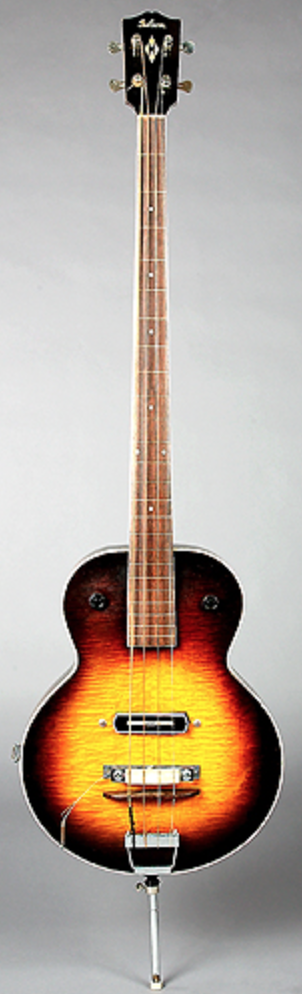
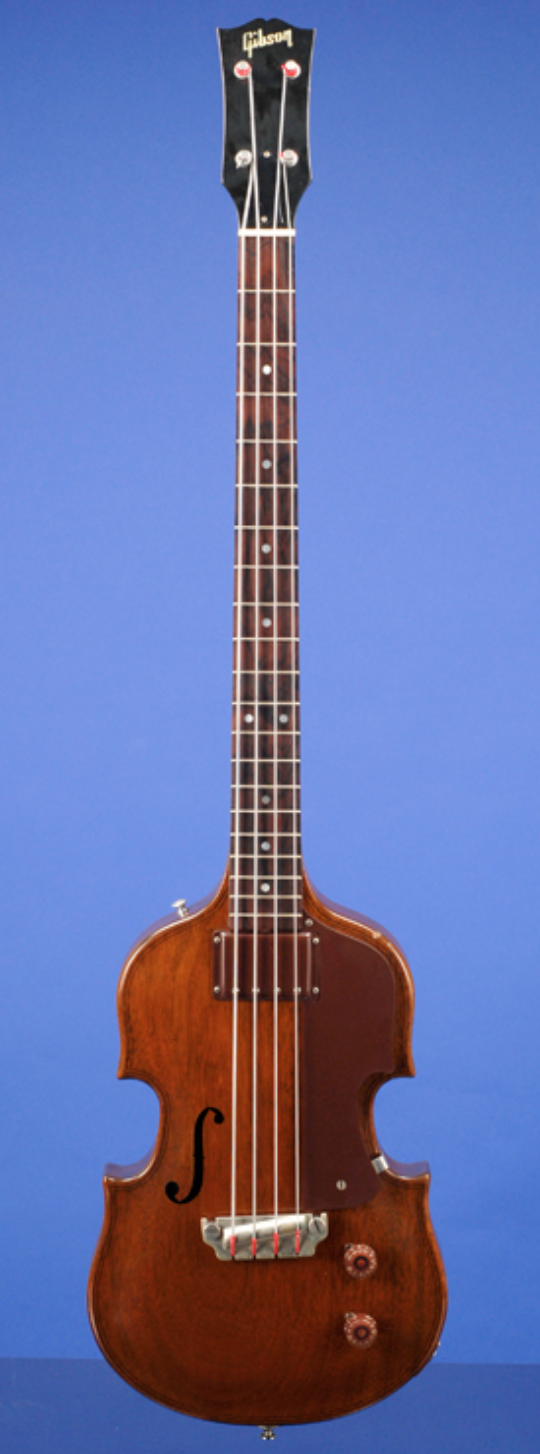

Gibson didn't start out making guitar-shaped basses. Their first, made around 1938 and dubbed an "Electric Bass Guitar" had a semblance of guitar shape, but stood on an endpin like a double bass, about 5 feet tall. It was followed in 1953 by the EB-1 which wasn't guitar-shaped at all. So I think they moved toward guitar-shaped basses because that's the way the market was shifting.
View attachment 3689546View attachment 3689553
I am going to take this post as an opportunity for a slight derail and also reference @hrodbert696 's well-spoken and graciously-put post #152 above. For Christmas my daughter gifted me Play It Loud, the companion book for the exhibit of the instruments of rock 'n' roll shown at the NYC MOMA this year past. In one section discussing the appearance of Fender on the scene it is stated that Gibson was a "legacy" company whose history gave it an image to uphold and a reputation to protect, which in the early 1950s would have inhibited any free-range ideas regarding instrument design. Fender, as the upstart crow, had no such dampers placed on its product line. So, aside from the EB (later the EB1), Gibson could not stray too far from what their market expected.
This extended to choice of electronics as well. Gibson's history of electrics was in jazz, so they preferred the deep, mellow tones (which led to the mudbucker pickup for bass), whereas Leo Fender's fondness for country music led to the twang and comparative mid-ranginess of Fender instruments. And, having no legacy to protect, Fender could adopt a more "industrial" manufacturing process than its competitors. Face it, in the early 1950s, nearly everybody, except Guild and possibly Danelectro, were a legacy brand with a history to protect.
Couple things here. First, I completely agree that Gibson is somewhat out of touch with bassists and the bass market, partially because it is an adjunct market for them and partially because Gibson’s marketing branch sucks harder than Hoover’s industrial division. Even with the original Les Paul, they didn’t really understand it or recognize that it was catching on exactly as they were replacing it. And that’s their core business.I don't know anyone at Gibson, and I'm hesitant to apply some broad-brush "group-think" bad-intent to their design and marketing decisions... heck, they probably have had multiple people making those decisions over the years.
But the fact that Gibson bass fans seem to always passionately bring up the short-lived Victory, the Ripper-Grabber-G3's and the RD's... models that were not around long, probably due to lack of sales... must make them scratch their heads in bewilderment. "Nobody wanted them enough to continue producing them THEN... why are they considered our BEST basses ever...now?" And the new re-tools of some of them are uninspiring, like an expensive copy.
At least, it shows a disconnect from the "pulse" of the bass marketplace. Whoever is making these product/design/marketing decisions don't understand it, or they just don't care. One or the other.
Second, people here are referencing these short-lived models not because they are better than other Gibson basses, but just to make the point that Gibson can and has made unique designs; they just don’t sell well. That shouldn’t confuse Gibson.
If I weren’t pissed at Gibson over their creepy “Play authentic” extortion racket, either an SG or more likely an LP Jr would be my first Gibson bass. I bought a new SG Special just before the ad campaign and it’s superb in fit, finish, playability and sound - and fully American made for $700. To me, that’s a hell of an accomplishment.
Let’s face it Gibson is really a Guitar company that also happens to make Basses, not the other way around. I am sure that the LP’S and SG’s are the bread and butter, everything else goes along for the ride. I own, collect and play the ‘Victory” models. Do I have other stuff, you bet. They had it mostly right with the Victory, just the WRONG body wood. I will be hoping to fix all of that in the spring. Should have been Mahogany, or Alder. What they really should do is standardize on a couple of body, and headstock designs, and stick with it for awhile. Not change things every hour on the hour or try to keep up with some kind of “trend”. After all “tradition” is what makes a LP a LP, and what makes a P-Bass a P-Bass.


