
I have a 1979 RD Standard which was the breadwinner for many, many years (when I could only afford one guitar) and in my profile picture I'm playing my 2005 SG bass. Both of these are stellar guitars. The RD is heavy the the SG is small scale. I also have a Music Man Stingray, a MIA Fender Jazz, 2 Shecter Stilleto's (4 and 5 string) and an SX fretless. My point is that each guitar is unique in action and sound and each represents another tool in the box. I have put the RD Standard up for now but I regularly play specific basses for whatever the gig requires. There is no bad answer, I love both of my Gibson basses and have never just assumed that they are cloned 6 string guitars minus 2 strings.

Enjoy the benefits of a premium membership!
Upgrade Account
-
TalkBass has been independent since 1998. Add your voice.
Create a free account to reply to discussions, view embedded media, and browse with fewer display ads.
Join free Log in
Want zero display ads or expanded classifieds tools? Compare plans.
You are using an out of date browser. It may not display this or other websites correctly.
You should upgrade or use an alternative browser.
You should upgrade or use an alternative browser.
Controversial Opinion: Gibson Basses Questionable Design Choices
- Thread starter peteygrizz
- Start date
More options
Who Replied?
I agree with your point--but Gibson did make a Victory guitar and a Victory bass--at the same time.
To me it looks more like the Victory guitar was a derivative of the Victory bass than the reverse. Either way I really, really like the looks of both. And either way, "Gibson isn't very innovative in bass design" or "Gibson has sometimes made basses from guitar designs" are both obviously way more accurate than is "Gibson only makes basses from guitars". OP's original thesis needs to be revised for accuracy, even though he's correct about Gibson's general lack of interest and innovation in the bass market. And Gibson's customer base is probably directly responsible for both things. If people are paying a premium for my products and those people get highly agitated when I change anything, then I'm highly motivated not to change anything. Especially if I'm struggling with bankruptcy - although that was way more a King Henry thing more than a Gibson thing. (Note to self: Buying up companies on credit with no better plan than "slap the Gibson name on their products and raise prices" is not a particularly wise long term business plan.)
But it is a bass "guitar" not a new instrument. So, there is rational there in calling it what it is. Just like in other instruments, there is a bass clarinet, baritone sax, bass trombone, etc. The taxonomy of the various instruments related more the range than the need to define a new instrument because it has a different range. Whether you like it or not is personal preference. Basses were not a strategic product line for Gibson although I have to say that the SG Gibson bass was my dream bass after seeing Jack Bruce play one in the early 70s. Never had one and ended up (thankfully) with a 1960 Fender Precision that I still have in my collection after 50 years.

This is like saying a double bass is lame because it's just an upscaled violin. Why didn't they design a completely different instrument? Maybe because there was no need to.
This argument holds no water since we all know that violins are just meager, petite versions of a proper double basee.

It's all about taste, and personal preferences. I have no desire to acquire a Gibson, Warwick, Ibanez, Rickenbacker et al.So I was thinking about why Gibson Basses are so rarely used and why I have never felt a connection to any Gibson bass I have ever played and it hit me:
Gibson's approach to basses is to simply make a larger guitar. There is no consideration of it being its own instrument with its own needs. They simply make a larger version of their guitars, take two strings off, and call it a bass.
Now I understand there are many guys who like their Thunderbirds, and I'm not trying to poopie in anyone's cereal, I'm just pointing out that while Fender designed the P and Jazz basses from the ground up as unique instruments, Gibson simply made a Les Paul bass, an SG bass, a Firebird bass... Why couldn't they have a designer work with some working bassists and design a bass that wasn't just an upscaled guitar. They build some of the finest guitars ever made, why can't they make great basses as well?
Regardless of history or one's interpretition of history, here are my thoughts on the Thunderbird and EB0 basses. As a builder of 85 individual, custom instruments, I have certain design pet peeves. One of them is a neck heavy bass. Both the Thunderbird and EB0 are noticably neck heavy, in part because of the small body and, particularly, the position of the left strap button. The heavy tuners, as compared to lighter weight tuners like the Gotoh, contribute to the neck heavyness. Perhaps the small body of the EB0 and the almost non-existant upper horn on the Thunderbird contribute to the balance issue. Short or long scale is not so much an issue, in my opinion. Gibson's choice of left strap button location, dictated by body shape is the obvious culprit. Thanks for listening.
I totally agreeEb4 though, the old and the newer one. When they try something else than 'oversized guitar', people call them ugly and don't buy em. Can't blame Gibson for discontinuing basses like the Ripper and grabbing that traditionalist cash.
No need to go into long details about my reasoning.

That's funny because when I look at a P-bass or a J-bass, all I see is a bigger Strat or a bigger Jazzmaster...I say this as someone who owns both a Ripper and a P-bassSo I was thinking about why Gibson Basses are so rarely used and why I have never felt a connection to any Gibson bass I have ever played and it hit me:
Gibson's approach to basses is to simply make a larger guitar. There is no consideration of it being its own instrument with its own needs. They simply make a larger version of their guitars, take two strings off, and call it a bass.
Now I understand there are many guys who like their Thunderbirds, and I'm not trying to poopie in anyone's cereal, I'm just pointing out that while Fender designed the P and Jazz basses from the ground up as unique instruments, Gibson simply made a Les Paul bass, an SG bass, a Firebird bass... Why couldn't they have a designer work with some working bassists and design a bass that wasn't just an upscaled guitar. They build some of the finest guitars ever made, why can't they make great basses as well?
That was pretty cool! Thanks for sharing that. Although I play a Fender J-Bass, I love looking at all makes of basses. Each bass has its own personality in my opinion.OP needs to do some research. I recommended starting here: Gibson Bass Guitars >> FlyGuitars
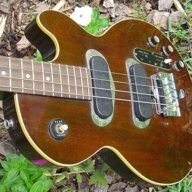
Never understood the shade thrown at Gibson for their bases - they were the bass of choice for many in the 60-70's due to their warm punch versus the harder thump of a Fender. I've played many a bass over the last 5 decades - Fenders, Warwicks, Ricks, Hofners and Gibbies. Each has their obvious unique tone, vibe and usability. In my last band I played my LP Triumph bass with the recommended flatwounds to capture that warm 'wump' that Classic Gibsons are known for. Yes, the weakness of those 60-70's bases were their original 2 & 3-point bridges. Having updated all mine with the Hipshot direct replacements makes adjusting and playing them enjoyable again and the sound output improves dramatically (esp midtones). Some folks also rag on Gibbies pushing the shorter 30" scale on non-thunderbird basses or the tree trunk like necks on those Norlin grabber/rippers or sounding too muddy. To each their own...
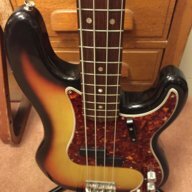
I bought a Ripper in '74 because Rick Danko had recently switched to one. I played it in a band setting for a while but eventually switched to a Fender P and then a Reverend. Can't say I really loved the Ripper that much, but if you wanted a balls-to-the walls BASS sound the #1 setting was the place to go. The other settings were just weird sounding (for what I was playing). The neck twist warped within the first month or so, but Gibson fixed it and it has remained perfect ever since. I never considered it to be a bass version of a guitar.
I played a friend's Thunderbird Bass at a jam recently and I was amazed at the tone and punch! My bass collection currently includes 5 basses and I did not want to buy another, so I didn't buy a Thunderbird, but I came close – and still might! Great sounding bass!So I was thinking about why Gibson Basses are so rarely used and why I have never felt a connection to any Gibson bass I have ever played and it hit me:
Gibson's approach to basses is to simply make a larger guitar. There is no consideration of it being its own instrument with its own needs. They simply make a larger version of their guitars, take two strings off, and call it a bass.
Now I understand there are many guys who like their Thunderbirds, and I'm not trying to poopie in anyone's cereal, I'm just pointing out that while Fender designed the P and Jazz basses from the ground up as unique instruments, Gibson simply made a Les Paul bass, an SG bass, a Firebird bass... Why couldn't they have a designer work with some working bassists and design a bass that wasn't just an upscaled guitar. They build some of the finest guitars ever made, why can't they make great basses as well?
...and yes, the Ripper bridge was awful. I had to do an incredible amount of filing on the saddle grooves to get decent action.
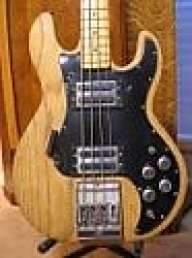
I have a 1978 Gibson RD Artist bass that can beat up your bass.
Oh, I dunno........I think my nearly 14-pound Peavey T-40 can beat up ANYBODY's Bass!


When I first began playing BASS guitar, in 1970s, I bought a Teisco Kimberly Bass from Lafayette Electronics, $49.99. It basically had the design features of a Gibson bass of the period : short scale (30"), narrow bridge string spacing, and dual coil humbuckers. I could emulate the dying frog tone of Jack Bruce, but few other bassists. Over the years, I learned of the better tone of long scale (34"), single coil pickups, but I disliked the wide string spacing (0.750) of the Fenders, having small hands, etc. There are other nuances of the Fenders ("sweet spot" at the halfway point between bridge and 19th fret) that distinguish them from other long scale basses. Another Fender feature was magnet loaded pickups instead of induced magnet pickups.
In retrospect, Gibson bass designs used the same pickup size as their guitars, hence the narrow string spacing. In fact, many other manufacturers did likewise - except Fender. Only later did other manufacturers match the wide string spacing of the Fender.
I suspect that the 30" short scale came about from baritone guitar designs. It is reasonable to form chords on a six string baritone on a 30" scale. But when you get to 34" scale, it becomes impractical for most players.
In a nutshell, Gibson and other instrument manufacturers were making "bass guitars" derived from guitars, while Fender was making "basses."
I hope this helps.
In retrospect, Gibson bass designs used the same pickup size as their guitars, hence the narrow string spacing. In fact, many other manufacturers did likewise - except Fender. Only later did other manufacturers match the wide string spacing of the Fender.
I suspect that the 30" short scale came about from baritone guitar designs. It is reasonable to form chords on a six string baritone on a 30" scale. But when you get to 34" scale, it becomes impractical for most players.
In a nutshell, Gibson and other instrument manufacturers were making "bass guitars" derived from guitars, while Fender was making "basses."
I hope this helps.
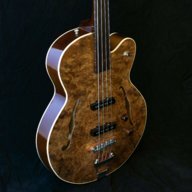
I own a Gibson Les Paul bass guitar. In this instant, you're right. They made the whole damn thing the size of a bass guitar, including the body. If it weren't chambered, I'd need a stand to rest it on. It is thunderous. It is beautiful - even in it's ugly gold paint. It plays wonderfully. And it's always funny when some one wants to come up and admire my "6-string" Les Paul.

I have a 1979 RD Standard which was the breadwinner for many, many years (when I could only afford one guitar) and in my profile picture I'm playing my 2005 SG bass. Both of these are stellar guitars. The RD is heavy the the SG is small scale. I also have a Music Man Stingray, a MIA Fender Jazz, 2 Shecter Stilleto's (4 and 5 string) and an SX fretless. My point is that each guitar is unique in action and sound and each represents another tool in the box. I have put the RD Standard up for now but I regularly play specific basses for whatever the gig requires. There is no bad answer, I love both of my Gibson basses and have never just assumed that they are cloned 6 string guitars minus 2 strings.
OMG, I completely forgot about the RD’s. Never owned one but played them a lot when music store I worked for back in the day carried them. As I recall, a little heavy but killer sustain, natural feel, great neck and rock solid instrument. Awesome for slap that was just emerging on the scene.
I’ve always been a Fender, Ric, Ibanez, MM, and GL bass guy although always felt at least a few Gibson Basses were quite nice and respectable.
Last edited:
I'm primarily a Fender guy, but I definitely see the positive attributes of the EB-2 (and/or EB-2B), EB-3 and Thunderbird, among other Gibson models. In the right hands those can be monster axes.

I didn't take it as a troll post. I get what the OP is saying, just the way he said it could have been phrased differently, i.e. the resemblance to their guitars is irrelevant whereas their lack of popularity as compared to other basses is more of a topic for discussion...
Even though I've owned two basses that were copies of EB's back when I was in the learning stages and didn't have a lot of money, once I got better and developed my ear I never desired to own a Gibson. The T-birds are cool-looking but feel awkward to me. I couldn't decide whether or not I liked the Ripper back in the 70's (Peter Cetera of Chicago had one and I was in bands that did mostly Chicago music in the 70's), kept going back to the music store and playing it and ultimately never bought it.
When you see someone playing one, it seems more of a curiosity than anything. They just don't seem to have staying power. The Ripper and it's companion, The Grabber (Gene Simmons played one) never took off in popularity and were discontinued after a few years. None of them had an instantly-identifiable sound that everyone wanted. Whereas players can be specific about wanting Rick crunch, or the Jazz zing, or the deep thump of Carol Kaye on a Precision. Just my opinion, I could be way off on all of this and will defer to those with more knowledge and experience...
Even though I've owned two basses that were copies of EB's back when I was in the learning stages and didn't have a lot of money, once I got better and developed my ear I never desired to own a Gibson. The T-birds are cool-looking but feel awkward to me. I couldn't decide whether or not I liked the Ripper back in the 70's (Peter Cetera of Chicago had one and I was in bands that did mostly Chicago music in the 70's), kept going back to the music store and playing it and ultimately never bought it.
When you see someone playing one, it seems more of a curiosity than anything. They just don't seem to have staying power. The Ripper and it's companion, The Grabber (Gene Simmons played one) never took off in popularity and were discontinued after a few years. None of them had an instantly-identifiable sound that everyone wanted. Whereas players can be specific about wanting Rick crunch, or the Jazz zing, or the deep thump of Carol Kaye on a Precision. Just my opinion, I could be way off on all of this and will defer to those with more knowledge and experience...
Last edited:
So I was thinking about why Gibson Basses are so rarely used and why I have never felt a connection to any Gibson bass I have ever played and it hit me:
Gibson's approach to basses is to simply make a larger guitar. There is no consideration of it being its own instrument with its own needs. They simply make a larger version of their guitars, take two strings off, and call it a bass.
Now I understand there are many guys who like their Thunderbirds, and I'm not trying to poopie in anyone's cereal, I'm just pointing out that while Fender designed the P and Jazz basses from the ground up as unique instruments, Gibson simply made a Les Paul bass, an SG bass, a Firebird bass... Why couldn't they have a designer work with some working bassists and design a bass that wasn't just an upscaled guitar. They build some of the finest guitars ever made, why can't they make great basses as well?


