• TalkBass has been independent since 1998. Add your voice.
    Create a free account to reply to discussions, view embedded media, and browse with fewer display ads.
    Join freeLog in
    Want zero display ads or expanded classifieds tools? Compare plans.
Convert to Medium Scale?

Moving the bridge forward an inch would work too.
Yes, but wouldn't the benefit of that be dubious? I'm interesting in reducing the need for the fretting hand (left, in the case of a righty like me) to stretch while reaching for notes.

Does the string tension lessen in this scenario? That would be an added bonus because it would make vibrato and bends easier.
 
Moving the bridge forward an inch would work too.

Unfortunately, no it won't. Moving the bridge is only half the job. While it does change the length of the strings it doesn't change the location of the frets. Both must happen to change the scale length.

The intonation error increases as one plays toward the bridge.
 
If you only play on the first six frets (like I do) it may not matter much. But the frets will not be spaced correctly for the scale, and it will not be intonated correctly.

Also - the fret spacing will still be that for a 34" scale, just as far apart as the standard scale bass. I don't think you will gain anything in terms of playing comfort, and you will guarantee that the bass is out of tune on higher notes.

Have some fun - pick up a short scale bass like the Gretsch 2202 Electromatic Jr Jet. IMO the difference between 32 and 30 isn't enough to worry about.
 
Unfortunately, no it won't. Moving the bridge is only half the job. While it does change the length of the strings it doesn't change the location of the frets. Both must happen to change the scale length.

The intonation error increases as one plays toward the bridge.

Damm, thought I came up with that one to quickly for it to be a good idea :).
 
Buy a medium or short scale bass. I have tried and tried but find I consistently return to my short, 30", scale basses. Your fretting hand and wrist will thank you for it.
I am indeed struck by how much I enjoy playing the Squier Bronco Bass. And while the sound is not as rich as on my Fender Jazz Bass, it's got a certain snarl and bark to it that is really appealing. I can't get over how nice the neck feels!

If the Bronco were available with a rosewood fingerboard, finished in Surf Green with a white pearloid pickguard, and a regular P-style pickup, I'd be in seventh heaven!
So maybe I'll buy one, strip and refinish it, cut myself a pickguard from a blank, route out the cavity a bit, and put in that pickup. Oh, and a Gotoh 201 bridge with multislotted saddles added. And new nut. Still no rosewood though.

Jay Turser makes a 30" scale bass that is closer to these specs. It has a P pickup, rosewood board, and it's in seafoam green (close enough). A bit concerned about the quality, though.
 
Using a capo on the first fret gets you close. It effectively turns the scale into 32.092 inches. That is less that a one percent error over the length of the scale. Translated nut to first fret, the capo method is approximately 7/64" longer than a 32" scale. That is less than an eighth of an inch. Which when you think about it, as soon as the fret hand leaves first position, negates all arguments and accompanying whining about small hands vs. long scale basses.
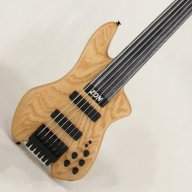
By the way, the distance between the nut and first fret on a 36" extended scale bass is 2.02". Once at the second fret, everything should feel like home. (Apologies to Carl Thompson.)
 
Maybe the key thing is to focus on learning to play as much in second and third position as possible. After all, the only notes that absolutely must be played in the first are the lowest F, F#, G, and G#. Admittedly, I use those notes a lot, but they are still there when I need them.
That is less than an eighth of an inch. Which when you think about it, as soon as the fret hand leaves first position, negates all arguments and accompanying whining about small hands vs. long scale basses.
Isn't that true even without the capo?

I think it would be a fun experiment to take an inexpensive longscale bass (e.g., an SX) and replace the first fret with a secondary nut. I wonder if that would work.