• TalkBass has been independent since 1998. Add your voice.
    Create a free account to reply to discussions, view embedded media, and browse with fewer display ads.
    Join freeLog in
    Want zero display ads or expanded classifieds tools? Compare plans.

Double Bass Cracked peg box?

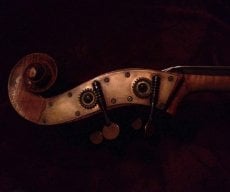
My upright hasn't seen much action lately and when I took it out to a band practice this week, I noticed a crack in the peg box. It's only a cheap plywood bass, well 'cheap' as far as double basses go! So I'm wondering about home repair options. PVA glue into the crack, then drill & fit a wooden dowel maybe? Or similar but with epoxy and a metal pin? Or is the sensible thing to leave well alone and get a professional?

daisy - 1.jpeg daisy - 2.jpeg
 

Attachments

  • image.jpeg
    image.jpeg
    475.9 KB · Views: 129
Keep PVA away from that kind of joint- that is better suited for porous surfaces that need flexibility.

If you wanted to get it done properly, take it to a professional. I had a similar crack on my old Czech bass, and the crack was opened up more than yours, so it required a dowel pin + hot hide glue and a finish touch up.

A luthier may determine that wicking in thin hide glue may be sufficient-which may be a relatively inexpensive fix. I have seen too many nasty repairs with glues that can’t be re-worked if the repair fails.
 
  • Like
Reactions: neddyrow and Gruff
Epoxy. Hide glue and PVA aren't strong enough. Forget dowels. Will make it worse. One of the few situations we will use it, especially on that quality of instrument, and its location. You never want that to open again. Epoxy with a 15 minute open time should be ok compared to a full strength overnight clamping epoxy. Do a dry run of clamping before glue it or take it to someone.
 
Epoxy. Hide glue and PVA aren't strong enough. Forget dowels. Will make it worse. One of the few situations we will use it, especially on that quality of instrument, and its location.

Really appreciate your share of expertise... I would have guessed hide glue as others have.

Just some questions... Doing a clean job is going to be important if the owner doesn't want to look at an epoxy mess all the time. What kind of masking should be involved? Also, that looks like a seam separation involving some sort of hardwood joint, perhaps not a literal crack at all... If it is a seam, how would someone open it up enough to get epoxy in there, without causing the similar seam on the other side of the box to also separate? Lastly, should the strings be slacked for this job, and/or the tuners removed from the area?

Thank you!
 
Really appreciate your share of expertise... I would have guessed hide glue as others have.

Just some questions... Doing a clean job is going to be important if the owner doesn't want to look at an epoxy mess all the time. What kind of masking should be involved? Also, that looks like a seam separation involving some sort of hardwood joint, perhaps not a literal crack at all... If it is a seam, how would someone open it up enough to get epoxy in there, without causing the similar seam on the other side of the box to also separate? Lastly, should the strings be slacked for this job, and/or the tuners removed from the area?

Thank you!
Hide glue is the best glue in the world. It should be used for 99% of all jobs. This is just one of the few times its ok. You just work it in with an artist palette knife or some other thin spatula like tool. Can rub it into the opening and force it. Yes you have to clean it up. Just don't try to make too much of a mess. Some solvents can help you clean it up. Its nasty stuff and I don't like using epoxy but sometimes you have to. Removing the tension can make the crack open up or close it. Only one way to find out, just try and soon you will know. Maybe tension opens it and releasing the tension closes it. Be careful clamping the crack closed that you don't clamp too tight and squeeze out all the glue. Even the simplest tasks have several things that have to be considered.
 
I don't think it's an open joint but indeed a crack. From the grain direction it does seem like a grafted on scroll. Anyway, with epoxy you can wipe away the splooge with alcohol on a rag. You naturally wouldn't do this on an instrument with spirit varnish, but that looks like nitrocellulose lacquer. Personally? I'd use thin CA glue. It would be a bit dangerous to open up the crack enough to get epoxy in there. With CA you only need to open it to like office paper thickness. It looks like an easy thing to clamp, but naturally plan your clamping strategy well. You want to get the glue in and the clamp on really fast so you can wipe away the excess before it starts to harden. Also, with CA, the more clamping pressure you can create, the better.
 

Latest posts