• TalkBass has been independent since 1998. Add your voice.
    Create a free account to reply to discussions, view embedded media, and browse with fewer display ads.
    Join freeLog in
    Want zero display ads or expanded classifieds tools? Compare plans.

Crimping Roundcores....?

Below in the pic is a set of La Bella Low Tension Flats......Roundcore.

It is said on TalkBass to crimp roundcores.

Should you crimp a set like this......?

How would you?
Luthier says crimping isn't really necessary ....as long as the tang on the end of the string is inserted to make a 90 degree bend in the tuner slot and then wind it on....

What would you do?
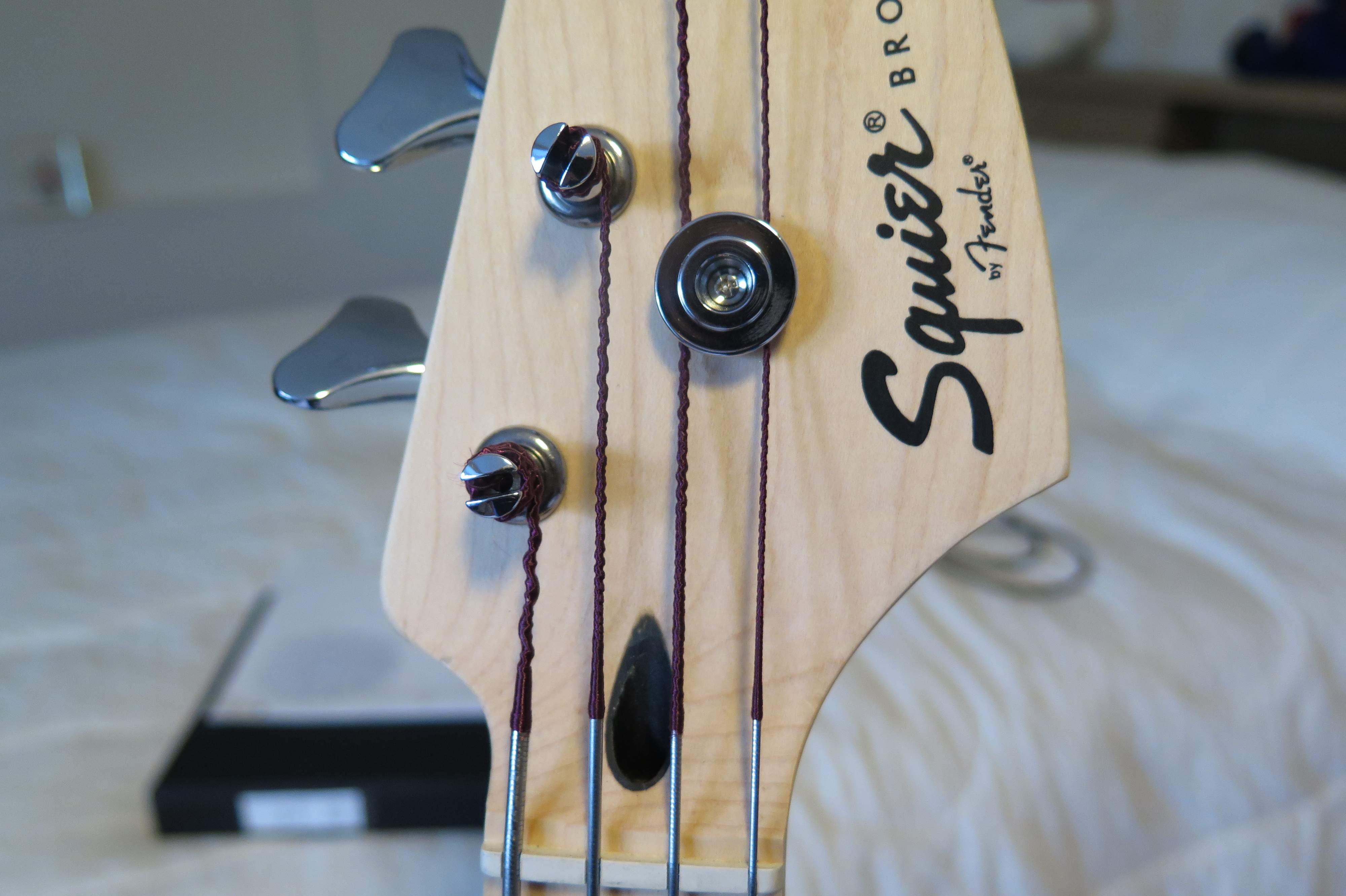

IMG_0091.JPG
 
Being that those ends are already uncoiled under the length of silk I'd have to assume they are factory compressed before the transition. If not there would be no way to address slippage with that design.
 
crimping isn't really necessary ....as long as the tang on the end of the string is inserted to make a 90 degree bend in the tuner slot and then wind it on....

What would you do?

The whole idea is to put a 90 degree crimp/bend in the string before cutting it. That is to lock the windings and core so they cannot slip.
Did you ever look at the instructions in the string packs of Fodera and DR round-core packs? There's a reason for it.

Same importance for flats, if they need to be cut.

Or, get lucky with the install and don't ever change them.
 
Last edited:
The whole idea is to put a 90 degree crimp/bend in the string before cutting it. That is to lock the windings and core so they cannot slip.
Did you ever look at the instructions in the string packs of Fodera and DR round-core packs? There's a reason for it.

Same importance for flats, if they need to be cut.

Or, get lucky with the install and don't ever change them.

I've never used Fodera or DR strings yet......or other roundcore flats....so no, I'm not really familiar with their explicit directions...

Thanks for the tip...from now any roundcores I use get a 90 degree bend "before" cutting....

The strings don't sound like there's anything wrong with them currently....what am I likely to encounter if they were?
 
I've never used Fodera or DR strings yet......or other roundcore flats....so no, I'm not really familiar with their explicit directions...

Thanks for the tip...from now any roundcores I use get a 90 degree bend "before" cutting....

The strings don't sound like there's anything wrong with them currently....what am I likely to encounter if they were?
I didn't bend my first two sets of DR black beauties, but on the 3rd, I ruined 3 out of 5 strings...lesson learned.lol
 
Some people complain about 'dead' strings in a set, and don't know why, but if they didn't 'crimp/bend' before cutting, that's one possible reason. The wraps are wound at a specific tension on the core and/or previous wraps for that string's designed performance. If the wraps slip on the core, the string cannot play as designed, the tone will be way off, as will the flexibility, etc.
I first measure (to get enough wraps on the post- this gives the needed break angle and keeps the direct tension off the bend at the slot), then crimp/bend a sharp 90 degree angle (never had a core break), and cut about 5/8" past the crimp/bend. I stick the bent section into the hole in the tuner, bend the string out of the slot, and wind it up to pitch Setting the witness/contact points at the saddle, nut, and tuner post).
Never had a problem with round-cores of flats, but I use the same procedure regardless of string type, as it's a lot faster (and cheaper) to do it right the first time, than to have to do it over w/ another set of strings.

I don't remember what that most recent thread was titled, but a search should bring it up, and I posted photos of Fodera's and DR's instructions in it.
 
Some people complain about 'dead' strings in a set, and don't know why, but if they didn't 'crimp/bend' before cutting, that's one possible reason. The wraps are wound at a specific tension on the core and/or previous wraps for that string's designed performance. If the wraps slip on the core, the string cannot play as designed, the tone will be way off, as will the flexibility, etc.
I first measure (to get enough wraps on the post- this gives the needed break angle and keeps the direct tension off the bend at the slot), then crimp/bend a sharp 90 degree angle (never had a core break), and cut about 5/8" past the crimp/bend. I stick the bent section into the hole in the tuner, bend the string out of the slot, and wind it up to pitch Setting the witness/contact points at the saddle, nut, and tuner post).
Never had a problem with round-cores of flats, but I use the same procedure regardless of string type, as it's a lot faster (and cheaper) to do it right the first time, than to have to do it over w/ another set of strings.

I don't remember what that most recent thread was titled, but a search should bring it up, and I posted photos of Fodera's and DR's instructions in it.
Mine either worked perfectly or wouldn't tune up to pitch.. Made me crazy until I looked on the inside of the DR package..lol I felt pretty dumb..
 
I think they (Fodera and DR) should somehow make a note to the instructions for those using their strings the first time- I just happened to see that something was printed inside the pack, and was curious- I don't just bust the packs wide open, 'cause if I don't like a set of strings on one bass, I'll take 'em off and try them on another, later, and they're put back into the package 'til then.
WebStrings has a note on the outside of the package of the Detroit Flats regarding crimping/bending before cutting.
 
  • Like
Reactions: BigBobbyBass
To repeat what others have said (for emphasis) - bending or crimping gives the winding an anchor point so the string retains the tension that was put into the winding at the time of manufacture. Either method works great although we basically use the terms interchangeably.

Strictly speaking, crimping means "to compress (something) into small folds or ridges". I have crimping tools for electrical connectors. Those tools look like clumsy pliers with odd shaped jaws designed to put a dent into the body of the connector to hold the wire in place. That's the idea here and it would work well but nobody does this to bass strings AFAIK.

Getting a good 90+ degree bend in the wire is what we're talking about when we say 'bend or crimp'. That bend should be done before trimming the length of the string.
 
this is something I've never heard of, and never had an issue with, but I've never played flatswounds, nor round core strings to my knowledge. But I will make sure to do it in the future just in the off chance it makes a difference for my application.