• TalkBass has been independent since 1998. Add your voice.
    Create a free account to reply to discussions, view embedded media, and browse with fewer display ads.
    Join freeLog in
    Want zero display ads or expanded classifieds tools? Compare plans.
Cunetto Era Relic Basses

Let me reword it...there are a large number of guitar players who go nuts over Cunetto Era Fender Custom Shop Relic Strats and Teles. Because he made so few basses, do his relic Fender basses have the same cult following among bass players (since they are so few and not as readily available).

Hope that makes more sense. If not I’ll just start a new thread on what’s the best bass for playing Indy Rock. LOL
 
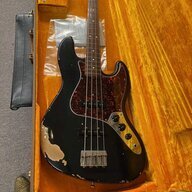
My 1997 Cunetto Relic '64 Jazz

64 Jazz wth mute.jpg
 
Have you owned it long? Was the fact that it was a Cunetto era part of your decision in purchasing?

Yes, I bought it new in 1997 along with a Cunetto-reliced '64 Jazz Bass in Olympic White that I later ordered from the Custom Shop that I've since sold. (I preferred the sound of the sunburst one)

I also had a 1996 Cunetto-reliced '56 Custom Shop "Mary Kaye" blonde Stratocaster that I bought new that I also sold when I was downsizing gear after retiring from live playing.

And yep, when these were purchased I was very aware that Vince Cunetto was doing the relicing for the Fender Custom Shop. The Custom Shop took over that process in 1999 after giving Vince very little notice.

Just my humble opinion, but the relicing that Vince and his crew did in 1995-99 was far more tastefully done than some of the current CS ones that look like instruments that have been dragged behind a pickup truck on a gravel road. Evidently there are buyers that prefer the "I've played 10,000 gigs in sweaty bars" look.
 
Last edited:
Let me reword it...there are a large number of guitar players who go nuts over Cunetto Era Fender Custom Shop Relic Strats and Teles. Because he made so few basses, do his relic Fender basses have the same cult following among bass players (since they are so few and not as readily available).

Hope that makes more sense. If not I’ll just start a new thread on what’s the best bass for playing Indy Rock. LOL

I think they do have a small cult following. Remember, you're asking about an era that was 22-26 years ago, so many TB'ers don't know about these. When I see ads for Cunetto basses, my ears perk up and I've got to see pics of it.
 
Yes, I bought it new in 1997 along with a Cunetto-reliced '64 Jazz Bass in Olympic White that I later ordered from the Custom Shop that I've since sold. (I preferred the sound of the sunburst one)

I also had a 1996 Cunetto-reliced '56 Custom Shop "Mary Kaye" blonde Stratocaster that I bought new that I also sold when I was downsizing gear after retiring from live playing.

And yep, when these were purchased I was very aware that Vince Cunetto was doing the relicing for the Fender Custom Shop. The Custom Shop took over that process in 1999 after giving Vince very little notice.

Just my humble opinion, but the relicing that Vince and his crew did in 1995-99 was far more tastefully done than some of the current CS ones that look like instruments that have been dragged behind a pickup truck on a gravel road. Evidently there are buyers that prefer the "I've played 10,000 gigs in sweaty bars" look.

I also have a cunetto J bass and Strat. I just purchased the bass last week and in doing research I found Talk Bass and an old post of the bass I just purchased. It belonged to and was being sold by a member here back in 2017.

I have read that Vince only made 200 basses so that was part of my initial question about them having a “cult” following when so few were made compared to the thousands of guitars.
 
  • Like
Reactions: TN WOODMAN
That seems kinda trollish...no? At what point did I say anything remotely close to that. I asked if a certain luthier who relic’d 200 Fender bass bodies and hardware had a following. I never once hinted toward any comparison.
Seems like a far question considering WoodyJ did make that comparison. I’d imagine most of us here have never heard of Cunetto.

 
Seems like a far question considering WoodyJ did make that comparison. I’d imagine most of us here have never heard of Cunetto.


I don’t know bout dat...in all fairness his comment was about the AESTHETICS of Relicing being “far more tasteful” on Cunetto era guitars. Nothing about either being better or a general statement like “non cunetto basses aren’t as good” as the poster asked.

I’m not trying to get into a pissing match. Just thought it was an unnecessary pot stiring comment. It’s all good.
 
I always admired Cunetto relics. From the beginning I thought they were tastefully done and convincing. I especially like the Mary Kaye Stratocasters Jack mentioned. (Nice Jazz Bass btw!) I don't think there is any doubt that these are desirable to many and bring a premium. I believe Vince started the relic phenomenon, (or if not, was there at the beginning). The story as I recall is that Fender took several Cunetto relic'd guitars to that NAMM show decades ago and watched the people be fooled who assumed they were vintage originals. Needless to say, it was a sensation.
 
I asked if a certain luthier who relic’d 200 Fender bass bodies and hardware had a following.
I find it interesting that particular builders and pickup winders at Fender have developed cult followings to the point where Fender actually hypes it, like the Abagail Ybarra CS pickups that sell used for $1K now that she's retired. I hope they gave her a nice retirement bonus.
 
From a 2003 article by Tom Watson:


The Relic (and what would later become the Fender Time Machine series) story begins in 1994. John Page is the manager of the Fender Custom Shop. Jay Black is a Custom Shop Master Builder and has a good friend named Vince Cunetto. Black is aware of Cunetto's skill in making repro Telecaster bodies, pickguards, "aged" Tele blackguards, and a few "aged" Fender replicas Cunetto had built for himself. Black shows one of Cunetto's personal "aged" Fender replicas to Page who gives Black and Cunetto the green light to produce some "aged" replica samples. Page likes what he sees and lets Black and Cunetto (who was not then and never becomes a Fender Custom Shop employee) show two "aged" prototypes at the 1995 Winter NAMM show. They are a hit (meaning dealers are willing to place orders). These "aged" replica prototypes give birth to the Fender Relic.

The 1995 Custom Shop, however, is not prepared to produce the new Relics. Page decides to outsource the instrument components that need to be "aged" to the originator, Vince Cunetto, and in April of 1995, Cunetto sets up shop under the name, "Cunetto Creative Resources, Inc.," in Bolivar, Missouri (his wife's hometown) to produce the components.

Cunetto's new shop receives its first shipment of raw bodies, necks and parts from the Custom Shop at the end of May, 1995. On June 27, 1995, Cunetto ships the first reliced components back to the Custom Shop -- enough parts to produce twenty reliced Nocasters.

Cunetto describes the role he and his shop played in the production of the Relics from 1995 through May of 1999:

"Our work involved complete prep, finishing and cosmetic distressing of necks and bodies. We also aged and distressed all hardware, pickguards and metal parts. We got it down to a 20 piece per week schedule, and every Friday we'd lay out the week's guitars on a large, 24-foot padded table. Every single part on the guitar was then matched for visual consistency and appearance. We'd match necks to bodies, wear on guards to wear patterns on necks, hardware to body wear and on and on. Each part of each guitar was then labeled so that they'd be sure to be assembled as a unit after being packed and sent to Corona for final assembly.

Relic order numbers continued to grow, as did the number of custom and one-off orders. In May of '96, we moved the company to a larger, better-equipped facility and continued production. As efficiency and employee training improved, so did our shipping numbers. We also upped the number of customs and one-offs produced.

Production continued in the new facility. Over the course of '97, as orders for the regular Relics began to stabilize and taper, we began work on a new idea for the Relics, which we dubbed "The Relic Classic". The concept was simple: a nicely "aged" guitar in good shape. We'd had requests for pieces like this in custom orders and had done a few prototypes for [the] Custom Shop, which were well received. In late '97, the "Relic Classic" became the "Closet Classic", but Fender decided that it was a little late to get it ready for January '98 NAMM. Plans had already been made to re-tool and change the specs of the "Time Machine" Custom Shop guitars over the course of '98, and the new Relic model would be put off until later.

By the latter part of '98, [the] Custom Shop had seen a lot of changes. John Page had left to run the Fender Museum. Because of new Custom Shop management and corporate policies, it was decided that the Closet Classics would be done in-house at Custom Shop. We continued to do the majority of the "standard" Relics during '98, although there were a few done "in-house" as Custom Shop honed their "relicing" chops.

By early '99, things at Custom Shop had changed quite a bit, and I had a pretty strong feeling that they'd changed enough that using an outside vendor didn't make sense for Custom Shop. In March of this year [1999], I got a call from Mike Eldred, the new Custom Shop manager, informing me that they intended to do all Relics in-house after we finished the then-current back order. That was it, and we shipped the last "Cunetto Relics" in May of 1999."


The Stratocaster Relics in which Cunetto and his shop played a role in producing (in addition to various Telecaster and bass models), have come to be known on the street as "Cunetto Relics" and are receiving ever growing attention from buyers, players and collectors. While instruments from the Time Machine series produced today may be more historically accurate, it is believed by many that the care and attention given to the parts "aged" by Cunetto and his shop distinguish those earlier instruments from their current descendants.