• TalkBass has been independent since 1998. Add your voice.
    Create a free account to reply to discussions, view embedded media, and browse with fewer display ads.
    Join freeLog in
    Want zero display ads or expanded classifieds tools? Compare plans.

curved fingers / flat fingers

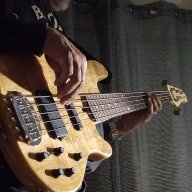
Most instruction methods teach having frettting fingers flat across the fretboard. However, many bassists have their fingers curved. Does it really matter? What are pros and cons of both ways of keeping your fretting fingers? Thanks
 
Your hands get tired a lot slower if you make a circle with your left hand, with curved fingers. Naturally, this is sort of impractical due to the width of some bass necks, but curved is definately better than flat. Think of moment force - with flat fingers your forearms have to apply pressure from a finger-length back. Would you hold something heavy in at your chest, or way out at arms length?
 
I was always taught to use the tops of your fingers to fret correctly, since flattening your fingers and using them as "pads" will dull your sound and express unwanted acoustics. Using the "points" of your fingertips will give you a sharper sound and better intonation, especially on a fretless.
 
I agree that curved is usually preferable to flat. Soundwise, it's hard to demonstrate much of a difference IMO, since it's the fret that's really stopping the string, not your fingertip (except on fretless, of course). But for the sake of firmly fretting consistently, I think fingertips are best.

Having said that, I do tend to keep my index finger relatively flat on the strings most of the time. It mutes the higher strings when playing on lower strings.
 
I do not prefer curved fingers on bass. My callouses are not on the tips, like they are for guitar, but rather under a bit and slightly away from my thumb. I don't think it matters for a fretted bass. It does NOT dull my sound. I also use 124 with 3 moving with 4, not all the time, but most of the time (it's a throwback to when I played upright). Also, I don not go along with having one's fingers be parallel with the frets. Mine are usually at an angle, very naturally. Sometimes my palm stands away from the back of the neck with my thumb more along the middle, but moreso the neck is "in" my hand, depending on what I'm playing. I think all this adds up to why I can play on and on for hours. I've been playing as a working bass player for the last 23 years since I switched from guitar. No problems with my ergonomics, right or left hand.
 
Curved or flat, well the answer regardless of what any one can use or handle is curved. A curve is a stronger and safer structure than a flat one, and in the case of the fingers the curve takes a lot of stress and strain away from the finger joints by allowing it to run through them rather than over them.

If the fingers are not curved then where is the bend coming from to get them to contact the fretboard? Answer...the wrist, with variations in bass height.
The wrist has to compensate for any lack of curve the fingers have because the flatter the fingers the more wrist angle is needed to achieve contact with the fretboard. With curved fingers ( varying degrees are personal) the angle of the wrist can be reduced thus reducing the stress and strain on them.

I is a individual thing to each player, but should never taught as such, it should always be taught curved finger. Yes i know there are players that play flat finger and handle it with great ease, but like i said it is an individual thing...exceptions to the rule do not prove the rule.

If in doubt or not quite sure about what i am saying about the relation in the angle of the wrist and the curve of the fingers then look at your own. Notice as you straighting the wrist, the finger need more curve, the joints come in to play more, the stresses, strains, energy, movement etc, are all going through the joints and through the joints in a chain reaction, all joints are involved. Put your hand palm down on a hard table/surface with the fingers spead out flat. Now press the tips into the surface...see how the top joint closest to the tips goes in on itself slighty and goes white a bit. That is the stresses and stains going over that joint, not through it. Put some curve in the fingers and it will go away because it is now working in line with the other finger joints. This will protect the joints and stop the likelihood of any joint going in on itself and causing damage.

That damage can take the form of wear and tear and may not show up until later life, but as i say it is an individual thing.
As far as tone goes, again subjective to the person, as for comfort..subjective to the person, ability to do either one, subjective to the person.... as you can see it is the players choice and if you have one, because not all players do, then it is curved fingers everytime....and that is in both hands for the exact same reasons.:)
 
personally i find that flat fingers will mute the unused higher strings easier.

your fretting fingers will be further away from the fret board in a curved position.
it will be fine if you are using your unused fingers to mute the higher strings (which i cant)
 
I just keep the fingers flat enough to mute and curved enough to fret a note and leave the other strings to be able to play second note on a lower fret but higher string... Of course I vary it depending on the second note O_o
 
Most instruction methods teach having frettting fingers flat across the fretboard. However, many bassists have their fingers curved. Does it really matter? What are pros and cons of both ways of keeping your fretting fingers?

I've only seen instructions that encourage curved finger fretting. I'm not arguing that perhaps you've seen otherwise, but I have not.

Personally, like others, I prefer curved finger playing. The fingers not in use are resting flat against the non-playing strings, as a mute. I've always just assumed that this is how most players do it. :D

I don't grip the neck like a baseball bat, which many players seem to do. Instead, I put my thumb right in the middle of the neck, and play 'through' the neck, as if I'm doing finger-thumb touch exercises.

This was the method shown to me by another player when I was first starting out, and the reason he gave was that although it's more difficult at first, once the thumb gets stronger it helps reduce overall hand and wrist fatigue. Sounded good to me at the time, so that's the way I learned to play and it's now very natural feeling.

Who knows what's 'right'. All I know is that it works for me, and allows me to move around very quickly when needed. Same goes for playing with curved fingers: works for me.

:bassist:

-kdiggity
 
I guess I need to clarify my position. My fingers are not totally flat, but only curved enough to prevent any joint from bending inwards. My point is that I don't have my fingers curved like when I play guitar. They are much flatter. As for where I learned this, I didn't. It just feels natural.