• TalkBass has been independent since 1998. Add your voice.
    Create a free account to reply to discussions, view embedded media, and browse with fewer display ads.
    Join freeLog in
    Want zero display ads or expanded classifieds tools? Compare plans.

Custom Classic Jazz Bass

joeyl said:
I agree with SamJ that it will not cure the dead spot, but it made my dead spot less noticeable on my old cheap Squier, and it is the reason I still have my first real bass with me. It did change the bass sound a little.

I actually like the Gotoh bridge spec'd on the Roscoe Beck IV and made for Fender a lot, and asked Dennis Galuszka to use it on my new Jazz he's building.. he asked me why? and I said because it seems to have more mass, and "looks" cooler.. he said, "to be honest I'll do what ever you want, but my advise, and the advise of most of the guys here in the CS is to keep the original bridge if you like the sound of the Jazz bass."

He went on to explain how in the string thru body design, and with the extra weight of this bridge (compared to the vintage MIA, and current MIM line) this design "amplifies" the Jazz bass sound, or "Growl" tone .. and unless I didn't like that sound that I should stick to the "standard" Jazz bridge..
 
SamJ said:
no he doesn't... the CS Bridge has a lot of mass, and if he changed out the bridge he compromises that "Jazz bass" sound that people pay money for.

Throw a P-Pickup in a Jazz and yeah you'll be compromising the "Jazz Bass" sound. He won't lose anything. But he will gain increased sustain, and clearer harmonics. At least that's what I experienced when I swapped my MIA Fender's bridge for a Badass III.
 
needmoney said:
Zwahh? Bridges can do that now?


This is what Dennis told me.. Think about it, the vibrations of the strings pass thru that point. More over, if you're paying for a "Fender Jazz Bass" why pay the money, then change out the bridge.. etc?

Come to think of it, I take what I said back.. Get the Bad Ass III, and come back and tell us if his sustain gets better; I'll bet it doesn't.
 
SamJ said:
I actually like the Gotoh bridge spec'd on the Roscoe Beck IV and made for Fender a lot, and asked Dennis Galuszka to use it on my new Jazz he's building.. he asked me why? and I said because it seems to have more mass, and "looks" cooler.. he said, "to be honest I'll do what ever you want, but my advise, and the advise of most of the guys here in the CS is to keep the original bridge if you like the sound of the Jazz bass."

He went on to explain how in the string thru body design, and with the extra weight of this bridge (compared to the vintage MIA, and current MIM line) this design "amplifies" the Jazz bass sound, or "Growl" tone .. and unless I didn't like that sound that I should stick to the "standard" Jazz bridge..

If the CS guys said that then they are all dreaming. Changing a bridge cannot discount everything else on the bass that gives it tone. In truth, the bridge is probably as accountable for tone and the knobs are. Plus, string-through design has been proven time and time again to not add much, if anything, at all to tone.

That said, that is one of the nicest looking basses I've seen in a while.
 
SamJ said:
no he doesn't... the CS Bridge has a lot of mass, and if he changed out the bridge he compromises that "Jazz bass" sound that people pay money for.

Probably so. In my experience, adding a badass II to a MIM Jazz 60's
classic DID change the tone somewhat, but it still sounds like a Jazz to
me. The tone has a little more "core" to it, and the sustain is
increased noticibly (remember this an alder MIM with rosewood FB). I
actually use a fat finger AND a bass ass II on my Jazz, which dimishes
the dead spot. I also feel it results in a more articulate singing tone, with
good growl and plenty of burpy mid-punch when the neck pup and tone
are rolled off a bit. :smug:

My question is this: Isn't a more massive bridge sort of the opposite of
adding a fat finger, in that it increases the mass at the body end of the
bass, whereas the fat finger adds mass at the head stock? :confused:
 
Jim Carr said:
Probably so. In my experience, adding a badass II to a MIM Jazz 60's
classic DID change the tone somewhat, but it still sounds like a Jazz to
me. The tone has a little more "core" to it, and the sustain is
increased noticibly (remember this an alder MIM with rosewood FB). I
actually use a fat finger AND a bass ass II on my Jazz, which dimishes
the dead spot. I also feel it results in a more articulate singing tone, with
good growl and plenty of burpy mid-punch when the neck pup and tone
are rolled off a bit. :smug:

Good point, the MIM's and older Vintages had much smaller (thiner) bridges, than the MIA and new Custom's..

My question is this: Isn't a more massive bridge sort of the opposite of
adding a fat finger, in that it increases the mass at the body end of the
bass, whereas the fat finger adds mass at the head stock? :confused:

Also a good point.. The thing to look into, and I did this with my new Master Buit, is a different "String tree" like that found on the Roscoe Beck IV.. It takes the ADG and pulls them down better than the old style J-bass tree.. If you ordered this part and had your Luthier install it, not only would it look nicer, but it would surly add sustain.. This is why Roscoe spec'd it after, and why I copied him.

175994121.gif
 
Cerb said:
If the CS guys said that then they are all dreaming. Changing a bridge cannot discount everything else on the bass that gives it tone. In truth, the bridge is probably as accountable for tone and the knobs are. Plus, string-through design has been proven time and time again to not add much, if anything, at all to tone.

I'll take their dreams over the truths of the on-line world.. ;)


That said, that is one of the nicest looking basses I've seen in a while.

It's been proven to add to the sustain.. and have no negative effect on tone with the new Fender bridge, this is after all why Fender poured a lot of money into the R&D on this prior to it's release.
 
SamJ said:
I'll take their dreams over the truths of the on-line world.. ;)


It's been proven to add to the sustain.. and have no negative effect on tone with the new Fender bridge, this is after all why Fender poured a lot of money into the R&D on this prior to it's release.

It's common sense that a hunk of metal, usually of the same basic shape between makes, and usually of the same basic density will not discount the effects that everything else on the instrument has. I've done countless hours of research regarding this, and have tons of experience swapping out parts on basses. I also built my main bass and am in the process of building a second. My "online truths" are much more sensible than the CS guys saying that a bridge change will take away the "jazz tone".

Also, there are many who would dispute the addition of sustain with the string-through bridge, including myself. There have been countless threads dealing with just that. The overwhelming majority cannot hear a single difference between the two.
 
tutash said:
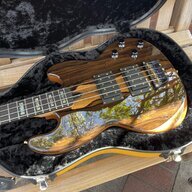
Okay, after some heartache, here are the photos of my new Jazz.

...

The setup and fatfinger worked well to lessen the dead spot. Otherwise, this is a perfect bass for me.

Hey Tutash,
Beautiful bass! :hyper:

I'm curious if you experimented with the fat finger placement. I found it worked better if I put mine here:
attachment.jpg
 

Attachments

  • fatfinger.JPG
    fatfinger.JPG
    43 KB · Views: 1,652
tutash said:
I actually am having trouble figuring out where to place it. I'll try further up on the headstock like you're doing, and see how that works. Under the strings it tends to get in my way when playing at the first fret.


I also have mounted the fat finger in between the two extremes, over the fender logo. I keep it from touching strings or tuners. Try things.

Good luck and enjoy your bass! :p