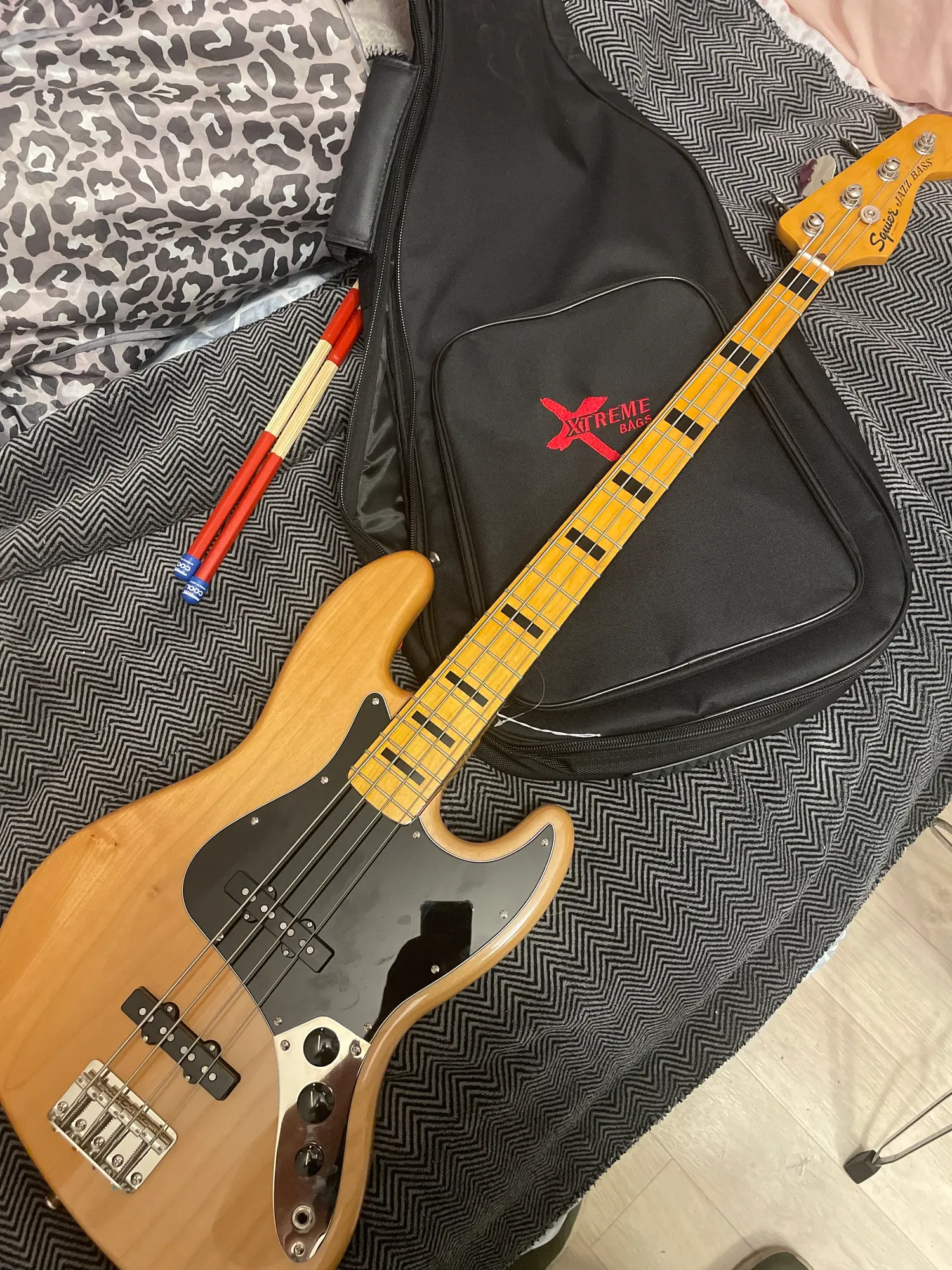
I picked a 70s because I love maple fingerboards. I know I know they don’t make a difference to the sound except they do except they don’t, I just like the look and the feel of them. (And yes I know you don’t feel the fingerboard. Let me finish!)
I tried digging round and didn’t get anything but does the sixties CV have the original pickup locations and the 70s CV have the changed ones? From memory the bridge pickup was moved about 1/2 an inch.
View attachment 7218006
Or is it a vibe thing and they’re the same body with different fingerboards?
Thanks in advance.
The difference in the spacing of the pickups is just under 1/2" at .04". The pickup spacing on the 60's and current Fender Jazz Basses is 3.6" center to center. The spacing on the 70's era pickups is 4" center to center. The neck pickup is the same on both. My first Jazz Bass was a 1965 Jazz that I bought in 1966. It had the rosewood fretboard, no skunk stripe of the back and the 3.6" pickup spacing.
My current Jazz that I bought after my first one was stolen, is an '82 Jazz that I bought in mint condition in 1985. It has the all-maple neck with the 70's era pickup spacing. Both sound like a classic Jazz Bass but with significant differences.
My '65 Jazz had a little darker sound than my '82 does and the sustain on that bass left a LOT to be desired. After playing that bass for 5-years, I joined a touring nightclub group and played about 750 performances in that 3-years I toured with them. I got to know the neck on my '65 pretty well.
A few months into the tour I decided to take off the big chrome Ashtray bridge pickup cover and clean everything underneath it. When I did that I noticed that there was a strip of open-cell foam glued on the inside of it with the impressions of all 4 strings in it. It was one of Fender's many approaches to mutes that I knew nothing about back then. It was obvious what it was immediately though so I tore and scrubbed it off. Lo and behold, my '65 did have some sustain after all. Not huge amounts mind you, but some. I was very pleased. All things considered, I loved that bass and it, along with all my touring gear was stolen in 1976.
After my Jazz was stolen, I went looking for a new one. But every single Jazz Bass I checked out had this obese neck on it. My '65 had what I believe is now called the 60's Slim C-shape Neck with 7.25" radius. None of the Jazz Basses I found had a slim neck. They were all fat. Not as fat as the P-bass but much fatter than my Jazz and that was uncomfortable for me to play.Then, in 1985, I was working PT at Apple Music in Portland, OR when this guy brought in an Olympic White 1982 Jazz. When I picked it up off the wall to try it out a few days later it felt like coming home. The neck was an all-maple neck but it felt exactly the same as my '65 Jazz did. Took a month but I did buy it and have been playing it ever since.
I didn't however find out about its sonic properties until 1997 when I finally got another amp and was able to hear it. It has a little brighter sound than my '65 did because of the pickup placement and it growls easier than my '65 did. Just dig into the strings over bridge pickup and it will growl all night. But the most amazing thing was how much more sustain it has than my '65 did. When playing Eminence Front by the Who, I can hit a low F# once and it will ring out for the full two measures before I move to the C#. My '65 couldn't do that. So I ended up with a Jazz Bass that is a little brighter than my '65 and has great sustain without the need for a compressor. I'd love to have my '65 back, but even if I did, my '82 Jazz would remain my primary bass.
Here's a shot of a Jazz Bass with the standard pickup spacing on a Squire Fender Jazz next to my '82Jazz in Olympic White with its 70's era 4" center to center spacing.