• TalkBass has been independent since 1998. Add your voice.
    Create a free account to reply to discussions, view embedded media, and browse with fewer display ads.
    Join freeLog in
    Want zero display ads or expanded classifieds tools? Compare plans.

D Standard Club (DGCF)

GHS Balanced Nickels Short Scale, 44-60-80-106.

Here's a comparison in tension figures between the EXL220S (EADG) and the BN (DGCF)...

D'Addario EXL220S in EADG:

G 040 - 25.24 lbs.
D 060 - 31.81
A 075 - 27.57
E 095 - 24.65 (Total 109.27)

GHS Balanced Nickels Short Scale in DGCF:

F 044 - 29.4 lbs.
C 060 - 28.4
G 080 - 28.3
D 106 - 27.7 (Total 113.8)

The Balanced Nickels (pure nickel roundwound on a round core) are specifically designed for balanced tone on a short scale across all four strings as well as up and down the neck. As you can see above, they have plenty of tension for overall stability even when tuned down to DGCF.
Thank you Michael-t and MarindM, I will try the GHS Balanced Nickels. Enjoy the day
 
Hi, I’m just curious as to anyone with a preference or just experience playing light gauge strings (prosteels more specially) in D standard.
i do know of a bass player( Derek Boyer of Suffocation) who uses lights and I’m pretty sure they’re in C#, so it can be done, probably all in the setup…
I'm currently using ProSteels on my 35" sixer (130-100-80-65-45-32 "light gauge") tuned to A standard, and my 34" four string (100-80-65-45) tuned to drop C.
On the 35" the strings aren't *too* loose but I'm having a hard time playing at the same speed as before. But then again, they say less is more, right?
The tone is amazing. Lots of fret clank since I switched back to using fingers in stead of a pick, and the grunt'n'growl is brutal as all hell. Think Alex Webster.

One caveat is that (unintentionally) bending the strings is a lot easier, so I had to woodshed a bit to get used to the increased flexibility.
I don't remember any issues with dropping the 100 down to C on the 34", but it has been a few months since I played it.

As for setup, I had to adjust the neck on the 34" and the intonation still isn't quite right, but the 35" (which I've had for at least six or seven years and never bothered to setup properly) is perfectly intonated in A standard without me having to do anything to the bridge or neck. Go figure.

I'm noticing a lot less tuning stability compared to B standard, and it is harder to tune (because the TC Polytune is absolutely terrible on bass, even in B standard), but other than that I've got no complaints.

I have got a set of DR Lo-Riders that I'll be putting on soon. Last time I tried them was a few years ago in standard tuning, and they were so stiff I *had* to use a pick. Now I'm thinking they might be perfect for dropping to A standard if they're just a tiiiny bit stiffer than the ProSteels.
 
Awesome, thanks for your insight, have you considered trying D’addario NYXL on the bass that you’re having tuning stability issues with? The tuning stability is definitely as advertised with those strings, and with a little tweaking of EQ I think they sound just like prosteels all the while being more comfortable to play.
 
  • Like
Reactions: MirandM
Hi, I’m just curious as to anyone with a preference or just experience playing light gauge strings (prosteels more specially) in D standard.
i do know of a bass player( Derek Boyer of Suffocation) who uses lights and I’m pretty sure they’re in C#, so it can be done, probably all in the setup…

If I played exclusively in D Standard I would be happy playing a lighter set with a low D around 100, because I prefer lower tension in general. I generally have to go a little heavier because my main band tunes to CGCF by default with only a few of our tunes in DGCF, and for me there is a big difference between a C and D in the low string.

I don't think there is anything special about the setup for going with lighter strings, other than you might need slightly higher action/more neck relief depending on how hard you play and how low your action already is. I think the bigger difference is playing style... as the prior post mentions, the strings will be a lot more "active" under both strings, which makes some things easier and other things harder, and affects the tone in some ways too.
 
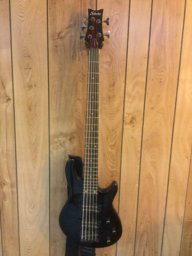
20220303_144320.jpg


I just tuned my 5 string multiscale down to A standard with black beauties light 45-125 and I love it. I have to make adjustments to relief as I normally like a straight neck with higher tension but this is still very playable with a lighter touch and higher action.. If I keep this bass with this tuning I'll go to mediums but it's good to know I can pull it off with these strings and a light guage
 
I don't think there is anything special about the setup for going with lighter strings, other than you might need slightly higher action/more neck relief depending on how hard you play and how low your action already is.
Agreed, in my above post I gave the truss a quarter turn and raised each saddle a quarter turn and I'm good to go. I can play buzz free fingers with a quick but lighter touch.
 
  • Like
Reactions: MirandM
Awesome, thanks for your insight, have you considered trying D’addario NYXL
I ran NYXL for almost 10 years and then discovered I liked the sound of EB Cobalts better and have run them for the most part. I never noticed any tuning instability on any strings I've had that didn't come from the tuning machines. I've abused SIT, DR, Nyxl, cobalt, la Bella, and various types of each brand. If I have a bass rat goes out of tune it'll do it regardless of what string or guage I'm using
 
  • Like
Reactions: MirandM
A minor annoyance I've been trying to figure out how I want to address is that two of my fretted basses use the Buzz Feiten system for intonation and the BF-capable stompbox tuner I have is hard-coded to do BF on bass in BEADGC.

I could do it manually as long as I could get a tuner that lets me dial in +/- 1 or 2 cents... but that seems to involve tuners that are expensive, huge, or both.

At present, I'm just intonating by eyeballing multiple frets across the instrument.
Compared to the 12th harmonic, if the 3rd, 7th, 12th and 15th frets are so close to dead on that my tuner thinks they're AOK, I'm good. If I have to, I'll split the difference.
 
  • Like
Reactions: MirandM
Posting here for myself. Been experimenting with down tuning off and on for about 6 months. At the moment I have 5 p basses two in standard (rounds/flats) and the rest in Eb/D/Db. The D standard is the only one that feels best to me as a bass/tuning that i could use full time. I can see myself committing to this tuning for a while once gigs get more solid, but I’m almost tempted to start now. Huge fan of Jimmie Sloas and Mark Hill and I’m told they both use down tuned basses most of the time
 
  • Like
Reactions: MirandM and RodRy
View attachment 4607350

I just tuned my 5 string multiscale down to A standard with black beauties light 45-125 and I love it. I have to make adjustments to relief as I normally like a straight neck with higher tension but this is still very playable with a lighter touch and higher action.. If I keep this bass with this tuning I'll go to mediums but it's good to know I can pull it off with these strings and a light guage

I see your Witcher books in the background. Good choice sir! I'm currently reading through Sword of Destiny :D
 
  • Like
Reactions: RodRy and Nuage420
A minor annoyance I've been trying to figure out how I want to address is that two of my fretted basses use the Buzz Feiten system for intonation and the BF-capable stompbox tuner I have is hard-coded to do BF on bass in BEADGC.

I could do it manually as long as I could get a tuner that lets me dial in +/- 1 or 2 cents... but that seems to involve tuners that are expensive, huge, or both.

At present, I'm just intonating by eyeballing multiple frets across the instrument.
Compared to the 12th harmonic, if the 3rd, 7th, 12th and 15th frets are so close to dead on that my tuner thinks they're AOK, I'm good. If I have to, I'll split the difference.
Apart from your method, which is ok, you could use an online tuner. In my setup I linked the PC audio output to my mixer table so I get both my bass and the online tuner at same time. Some of these online tuners have custom config so you assign whatever notes you want to your strings. Works for me.
 
  • Like
Reactions: 4StringTheorist
Ooo. Do you have one that displays down to + or - one cent? That sound like a great idea!

MTD Buzz Feiten instructions said:
F string open at pitch against the F at the 12th fret 1 cent flat
C string open at pitch against the C at the 12th fret 1 cent flat
G string open at pitch against the G at the 12th fret 1 cent flat
D string open at pitch against the D at the 12th fret 1 cent flat
A string open at pitch against the A at the 12th fret 1 cent sharp
E string open at pitch against the B at the 7th fret 1 cent sharp
B string open at pitch against the F# at the 7th fret 1 cent sharp

Apart from your method, which is ok, you could use an online tuner. In my setup I linked the PC audio output to my mixer table so I get both my bass and the online tuner at same time. Some of these online tuners have custom config so you assign whatever notes you want to your strings. Works for me.
 
Last edited:
  • Like
Reactions: MirandM
Has anybody set up a short scale bass in D standard?
Since normally a short scale feels like looser tension when using standard (105-45) strings, would you want to do 115-55?
Do they make that gauge set in SS?
Yes. I have a Regal Dobro Bass. It is a 30 inch scale. I have GHS Bright Flats. They’re ground rounds. I have had this bass for over 20 years it has never sounded this good before. With the bronze strings that are normally on an acoustic bass, it was twangy. I didn’t like the sound all that much but it was Loud. I put the GHS on it sounded good but the strings was tight. First I retuned 1/2 step then to D standard. WOW now it sounds great!
87B69C9D-1AC8-44F9-B9F0-A6AEFF3B3D18.jpeg
 
I put the GHS on it sounded good but the strings was tight. First I retuned 1/2 step then to D standard. WOW now it sounds great!

Are you talking about the medium set, 49-108?

EDIT: Wait... I forgot these are short scale you're talking about. 49-108 would be the only option for that, so you can disregard my question.
 
Last edited:
Hi, I’m just curious as to anyone with a preference or just experience playing light gauge strings (prosteels more specially) in D standard.
i do know of a bass player( Derek Boyer of Suffocation) who uses lights and I’m pretty sure they’re in C#, so it can be done, probably all in the setup…

Before i sold the Yamaha TRBX504 C standard tuned with EB Cobalt flat 65.80.100.130 (pretty stiff ! with just half step up), i put a set Sadowsky BLK SS 45-105 on it and she work well on C# tuning. Less floopy than NYXL 45-100 in D std tuning.

Hope help
 
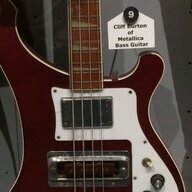
Does anyone in this club have a Rickenbacker 4001/4003 that they keep tied to D standard? If so, what brand / gauge strings do you find work best?
I do, tuned in D standard the next day I received it. I played the standard setup for the first day just to get a feel of the sound, before changing to D.

Now rick has these weird gauges so it's bit complicated to get a compatible set that will work well.
Default they have 45-55-75-105
since I use my rule-of-thumb to go +5 up for DGCF this leads to: 50-60-80-110
now guess what... Stringjoy makes custom sets exactly as you want them and they are just GREAT.
I had them already available so after replacing the strings and adjusting the intonation I found I didn't need to adjust the neck, which was what I expected after checking with their string tension calculator, I got within 10% of the original total tension, so spot on.
These strings don't lose their tuning, right from day one and sound equal or even better then the original Rick strings and not expensive at all.
I can recommend them 100%.