• TalkBass has been independent since 1998. Add your voice.
    Create a free account to reply to discussions, view embedded media, and browse with fewer display ads.
    Join freeLog in
    Want zero display ads or expanded classifieds tools? Compare plans.

D'Addario Chromes User Group- Chromeys Speak Out!

Yes! So good to hear that. I like these strings and that’s an easy fix

From Fender:

PICKUPS
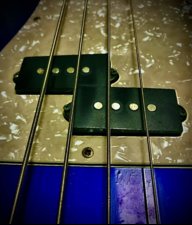
Setting pickups too high can cause a number of unusual occurrences. Depress strings at last fret. Using a 6" (150 mm) ruler, measure the distance from the bottom of the first and fourth strings to top of the pole piece. A good rule of thumb is that the distance should be greatest at the fourth-string neck pickup position and closest at the first-string bridge pickup position. Follow the measurement guidelines from the chart below as starting points. The distance will vary according to the amount of magnetic pull from the pickup.

Note: Larger string gauges need wider vibrational allowances. If you have a five-string bass or are using heavier-gauge strings, your measurements must be increased accordingly.

Bass Side Treble Side
Vintage style
8/64"(3.2 mm) 6/64" (2.4 mm)
Noiseless™ Series 8/64"(3.2 mm) 6/64" (2.4 mm)
Standard "J" or "P" 7/64"(2.8 mm) 5/64" (2 mm)
Special Design Humbuckers 7/64" (2.8 mm) 5/64" (2 mm)
 
Last edited:
How difficult or impossible is it to mount Chromes ECB84 (designed for long scale) on a 30" scale bass (Fender Musicmaster)? My concern is turning around the tuning poles with these flats…

Installing "long scale" strings on a "short scale" bass is always a risky proposition, especially with flats.

You might want to consider Dunlop Flats as an alternative to the Chromes. They do come in "short scale" either in 40-100 or 45-105.
 
  • Like
Reactions: cyberprimate
Installing "long scale" strings on a "short scale" bass is always a risky proposition, especially with flats.

I'm asking this because I just bought a Fender Musicmaster that has nearly perfect playing feel with a set strings that I think is probably the standard D'Addario EXL170 (long scale roundwounds). And so I'm looking to buy a flatwound string set with about the same tension. The ECB84 is the closest I've found. It's frustrating because neither Fender or Dunlop… mention the lbs of their strings. TI does it, but by experience they're too supple for my playing (favourite tone though).
 
I'm asking this because I just bought a Fender Musicmaster that has nearly perfect playing feel with a set strings that I think is probably the standard D'Addario EXL170 (long scale roundwounds). And so I'm looking to buy a flatwound string set with about the same tension. The ECB84 is the closest I've found. It's frustrating because neither Fender or Dunlop… mention the lbs of their strings. TI does it, but by experience they're too supple for my playing (favourite tone though).

One thing to keep in mind is there is a difference between "tension" (as in pulling weight) and "stiffness/flexibility" (as in playing feel). When you compare a set of Chromes flats that are the same "tension" (as in pulling weight) a set of nickel rounds, the chances are the Chromes would feel stiffer.

Dunlop flats are known for their roundwound-like flexibility and suppleness without being overly loose and floppy. I would venture to say Dunlop flats 45-105 in short scale would feel closer to EXL170 in long scale in terms of "stiffness/flexibility" (= playing feel).

(DISCLAIMER: I have no personal experience with Dunlop Flats; my recommendation is based on everything I've read about them.)
 
  • Like
Reactions: dmc79
It's frustrating because neither Fender or Dunlop… mention the lbs of their strings.

As someone who used to live and die by the tension numbers, one thing I learned is when you're dealing with different types of strings (eg rounds vs. flats) tension figures are only a small part of the whole equation when trying to find a set of strings with the right tone and the right feel.

If I were you, I would start with ECB81S (Chromes 45-100, short scale) and go from there.
 
I just bought a Fender Musicmaster that has nearly perfect playing feel with a set strings that I think is probably the standard D'Addario EXL170 (long scale roundwounds). And so I'm looking to buy a flatwound string set with about the same tension. The ECB84 is the closest I've found.

EXL170 (45-65-80-100) = 165.6 lbs. in total tension (on long scale).
ECB80 (45-60-75-95) = 163.1 lbs. in total tension (on long scale).

EXL165 (45-65-85-105) = 174.3 lbs. in total tension (on long scale).
ECB84 (40-60-80-100) = 173.1 lbs. in total tension (on long scale).

ECB80 (40-60-75-95) is actually closer to EXL170 in terms of total tension, while ECB84 is closer to EXL165. If you have to use the "long scale" string on your "short scale" bass, having smaller A and E would help when the main body of the string needs to be wrapped around the tuning post.
 
I'm sorry if this is a dumb question, but:

I want to try Chromes on my Fender Jazz (fretted 4 string). I normally play GHS pressurewounds 44-106

The jazz is used mainly for my praise and worship group. What do you suggest I try?
 
I normally play GHS pressurewounds 44-106

The jazz is used mainly for my praise and worship group.

As a church bassist, I started out with the Chromes on my Fender Jazz. Then I discovered the Pressurewounds and haven't looked back.

That said, if I were to get a set of Chromes that feel close to PW 44-106 in terms of tension/stiffness, I'd try a custom set, 45-60-80-105.
 
So you would councel me to stay with the pressurewounds, right?

Not necessarily... It all depends on your tonal goal.

I play in a contemporary, non-traditional church, where we rock it out pretty good, and the Pressurewounds provide the tone I need. If you play in a more traditional setting with quieter, more laid-back style of worship music, the Chromes might suit better.
 
  • Like
Reactions: dmc79 and Rimshot
I play at a church and we do a mix of traditional orchestral arrangements and modern praise and worship. The pressure wounds work pretty well. You can really get a mellow sound out of them by plucking close to the neck, or for the the D and G strings, actually plucking over the neck.
 
  • Like
Reactions: dmc79 and Rimshot
Which gauge do you guys suggest? I'm currently using the 45-65-80-100 (EC81), but I've been hearing the 40-60-80-100 (EC84) is better balanced. Is it worth switching over?

My personal favorite is the ECB82 "medium" set. But then again, I like a stiffer string feel, and I'm in the camp that believes that putting together a good set of strings is more complex than just making sure that the tension is even balanced.
 
  • Like
Reactions: Pantone 333