
Enjoy the benefits of a premium membership!
Upgrade Account
-
TalkBass has been independent since 1998. Add your voice.
Create a free account to reply to discussions, view embedded media, and browse with fewer display ads.
Join free Log in
Want zero display ads or expanded classifieds tools? Compare plans.
You are using an out of date browser. It may not display this or other websites correctly.
You should upgrade or use an alternative browser.
You should upgrade or use an alternative browser.
Darkglass Anagram Multi FX Announced
- Thread starter Elmstreet
- Start date
More options
Who Replied?
daste
Commercial User
- Apr 2, 2026
- 18
- 68
- Disclosures
- Orastron (orastron.com), Clack.DIGITAL (clack.digital), dangelo.audio (dangelo.audio)
Really? I mean, it would be easy to do, but is it exciting/interesting enough?What about A-SID for Anagram? We need more experimental blocks.

I would say yes, but for the right price/features.Really? I mean, it would be easy to do, but is it exciting/interesting enough?
A Wah for bass might benefit from a Mix and Volume parameters to help balance it. Maybe also different Cutoff and Resonance Controls.
On the HX I would increase the Mix/Cutoff/Resonance on Toe Down, then back them off on Heel Down. Maybe the Resonance was opposite, but modifiying multiple parameters really helped with getting it to work for me.
Also I like the RAT from Clack, but one thing keeping me from pulling the tigger is a LPF on the Mix. It would be nice to have the Clean be Low Passed from say 400 Hz (adjustable), so that when you blend it's not a clean next to a distortion, but a low passed clean that only fills out the bottom end and leave any mids/treble to the drive.

An Ehx FeeezeWhat’s the block, you would like to see the most from 3rd party developers? Some kind of onboard recording for me. Preferably multitrack.
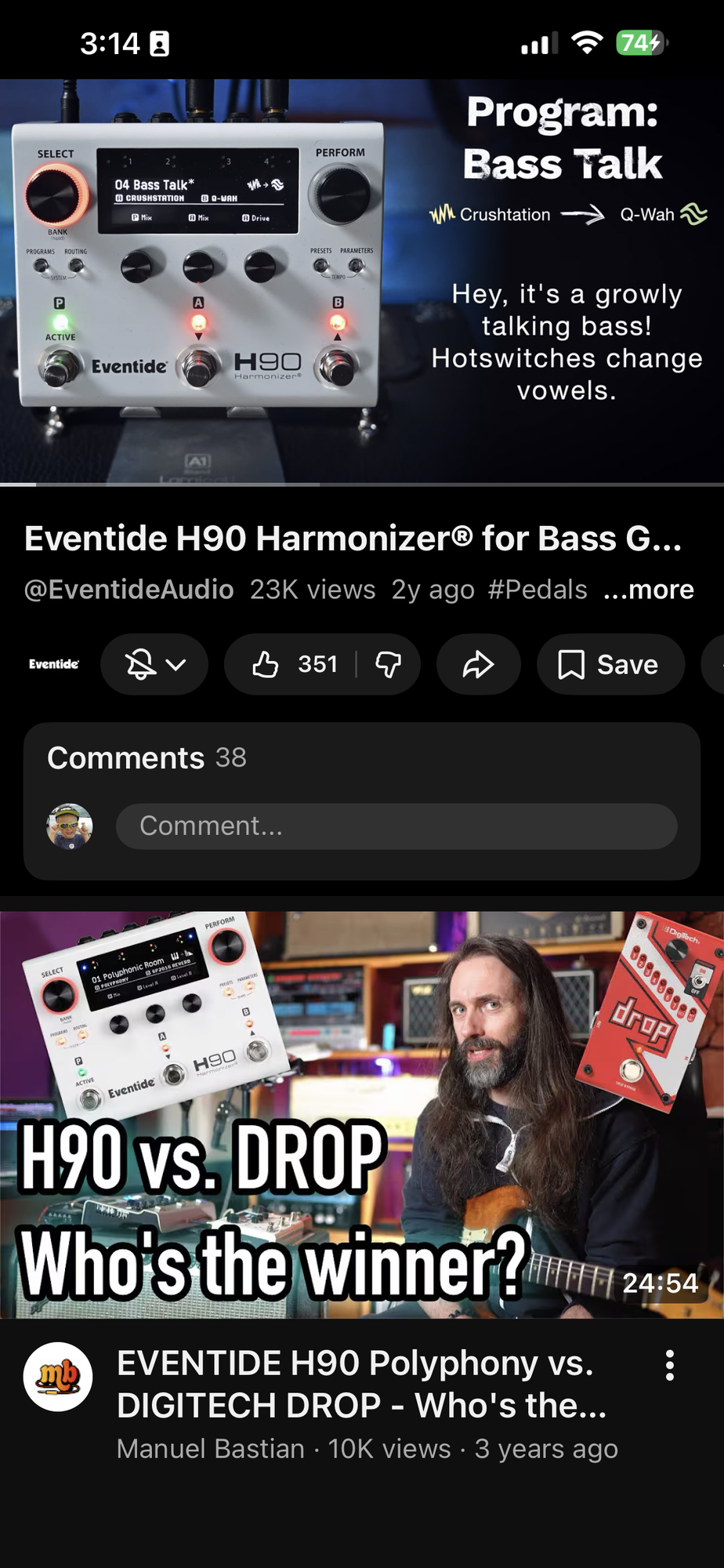
What I want more than anything, is that Talk Bass effect from the Eventide H90. It uses Crushstation and a Q filter. I've tried to copy it, and gotten some cool sounds, but can't get it exactly with the filters available for Anagram.
I know there's been lots of chatter about the output volume and Ivan just put out this video. I feel dumb now for not unlinking my outputs from master and now I don't need gain blocks at the end of my presets. Hopefully this helps some people. Thanks Ivan!
In all honesty, that was also the most important 'nugget' of information I took away from that video as well.
I don't have any issue with output volume from the Anagram so it's not an issue I need to solve, but I definitely had a "oooohhh... duh. Of course!" epiphany moment as I watched that and will be filing that away in the memory bank!
Really digging the Studio Pre block. It adds enough saturation to thicken up your tone, and can go even further, but I like as a subtle drive/boost/thickener. Good stuff coming through the Marketplace!
 marketplace.anagram.shop
Anagram Marketplace
daste
Commercial User
- Apr 2, 2026
- 18
- 68
- Disclosures
- Orastron (orastron.com), Clack.DIGITAL (clack.digital), dangelo.audio (dangelo.audio)
I would say yes, but for the right price/features.
A Wah for bass might benefit from a Mix and Volume parameters to help balance it. Maybe also different Cutoff and Resonance Controls.
On the HX I would increase the Mix/Cutoff/Resonance on Toe Down, then back them off on Heel Down. Maybe the Resonance was opposite, but modifiying multiple parameters really helped with getting it to work for me.
If I ever release it for Anagram, it would be for free for sure.
What keeps me from doing it is that, after all, is that under the hood it's just a basic bandpass filter with fixed resonance with a few weird "features" that are even hard to hear on bass/guitar.
Aren't the stock and marketplace wahs good enough? (I haven't tested them yet TBH)
I don't quite get what you're doing on the HX, but AFAIK a regular (Cry Baby style) wah has lower resonance corresponding to higher cutoff (toe down), and viceversa high resonance at low cutoff (heel down). It has no "mix" though, and I struggle to see what would be good about a mix control in a wah.
Also I like the RAT from Clack, but one thing keeping me from pulling the tigger is a LPF on the Mix. It would be nice to have the Clean be Low Passed from say 400 Hz (adjustable), so that when you blend it's not a clean next to a distortion, but a low passed clean that only fills out the bottom end and leave any mids/treble to the drive.
Let me guess, you play metal?

That would be doable but I wonder how many users need that. The risk on my side is feature creep and making things less immediate/understandable.
Can't you can achieve that with split/merge and macros already?

Just to play devil’s advocate: I’m not a metal player but have really enjoyed the Damnation MBD-1 and 2, and the Tech 21 Geddy pedals, all of which use a low passed clean blend in parallel with the drive circuit. It works well for the pop, RnB, funk and soul I’m usually found playing.Let me guess, you play metal?
daste
Commercial User
- Apr 2, 2026
- 18
- 68
- Disclosures
- Orastron (orastron.com), Clack.DIGITAL (clack.digital), dangelo.audio (dangelo.audio)
Agree 100%. It was just an excuse to try and get to know my (potential?) user base a bit better.Just to play devil’s advocate: I’m not a metal player but have really enjoyed the Damnation MBD-1 and 2, and the Tech 21 Geddy pedals, all of which use a low passed clean blend in parallel with the drive circuit. It works well for the pop, RnB, funk and soul I’m usually found playing.


Following up on the topic of levels: should we set up the instrument input signal peaks just below the maximum level?
What bit depth does the Anagram use internally? Float?
Should each block aim for unity gain so that the final output level stays close to the maximum?
Do we need to monitor the level of each individual block to make sure it’s not clipping? What’s the best approach here?
What bit depth does the Anagram use internally? Float?
Should each block aim for unity gain so that the final output level stays close to the maximum?
Do we need to monitor the level of each individual block to make sure it’s not clipping? What’s the best approach here?

I wouldnt change the input level at all unless you really have to match two different basses signal level. All the amps/pedals ect have been designed to work just like in real life and respond just like plugging your instrument straight to them

"It all comes to the start".
What are we thinking?
My bet is a Flip Top amp and the three knob yellow pedal I have no idea.

Yes, but many/most effect pedals have an input gain, and regardless, the blocks in Anagram all respond quite differently based on your input gain level. Adjusting input gain to optimize instrument performance is provided and should be used rather than just hoping a bass has an appropriate output level for the default setting.I wouldnt change the input level at all unless you really have to match two different basses signal level. All the amps/pedals ect have been designed to work just like in real life and respond just like plugging your instrument straight to them
Leave yourself some headroom to avoid clipping from added gain within your signal chain. IME, the envelope filter blocks, drives and compressors all respond most expectedly when dialing in an average input gain that has the input meter hitting around 2/3 to 3/4 of the way up the meter. I generally shoot for my absolute loudest peaks to just touch 3/4 of the way up with more normal playing sitting around the 2/3 mark.should we set up the instrument input signal peaks just below the maximum level?
Just listen when adding a new block. Do you hear clipping or notice the output meter getting slammed? If so, adjust the newly added blocks output or add a gain block just after it as a trim.Do we need to monitor the level of each individual block to make sure it’s not clipping? What’s the best approach here?

For me, it’s the opposite. A simple clean blend can easily be added with a split, and I can always filter that clean channel and add effects, but that is usually to work around something lacking in the current blocks.Let me guess, you play metal?
That would be doable but I wonder how many users need that. The risk on my side is feature creep and making things less immediate/understandable.
Can't you can achieve that with split/merge and macros already?
I would prefer that each block took a more considered look at its clean blend (if any), and added options specifically for that effect that would make the clean blend more useful. That could be a simple LPF, or added compression, an octave effect, as long as it’s something that works well with the block itself.
It’s that kind of added attention that will make someone that already has 5 Rat blocks take a look at a new one.
Well saidI would prefer that each block took a more considered look at its clean blend (if any), and added options specifically for that effect that would make the clean blend more useful.
For me, it’s the opposite. A simple clean blend can easily be added with a split, and I can always filter that clean channel and add effects, but that is usually to work around something lacking in the current blocks.
I would prefer that each block took a more considered look at its clean blend (if any), and added options specifically for that effect that would make the clean blend more useful. That could be a simple LPF, or added compression, an octave effect, as long as it’s something that works well with the block itself.
It’s that kind of added attention that will make someone that already has 5 Rat blocks take a look at a new one.
Damnation dirtfixer type thing within the anagram? Yes, please!
daste
Commercial User
- Apr 2, 2026
- 18
- 68
- Disclosures
- Orastron (orastron.com), Clack.DIGITAL (clack.digital), dangelo.audio (dangelo.audio)
So here we went from lowpass on the dry to a 4-band EQ on the wet + some more complex filter on the dry.Damnation dirtfixer type thing within the anagram? Yes, please!
You see, that is exactly my point: given the Anagram UX (but that would apply to any UX, including common analog pedals), now every distortion block should include all the functionality of something like that to make some users happy. Then in the future people will want all parameters to have sample-accurate modulation capability (which works "the opposite" as regular knobs), and then why not some internal LFO, an envelope follower, and then something else, and something else again, etc. and every block becomes a spaceship.
Bassement Plague and Amp Squeezer already include a simple Mix (dry/wet blend) control and I'm not against adding features. But they need to be A. very significant, B. relatively obvious, and C. possibly to be implemented in an "standard/unambiguous" way.

Apologies if this is old news, I've never paid any attention to what a Darkglass Anagram is or does
...until today, when I saw an announcement from Looperlative Audio claiming that the latest OS for the Anagram now includes a fully functional Looperlative looper!
"LP3" they called it (to differentiate between the Looperlatrive LP1 and LP2 hardware devices).
Anyone know any more details about this?
...until today, when I saw an announcement from Looperlative Audio claiming that the latest OS for the Anagram now includes a fully functional Looperlative looper!
"LP3" they called it (to differentiate between the Looperlatrive LP1 and LP2 hardware devices).
Anyone know any more details about this?


