
Enjoy the benefits of a premium membership!
Upgrade Account
-
TalkBass has been independent since 1998. Add your voice.
Create a free account to reply to discussions, view embedded media, and browse with fewer display ads.
Join free Log in
Want zero display ads or expanded classifieds tools? Compare plans.
You are using an out of date browser. It may not display this or other websites correctly.
You should upgrade or use an alternative browser.
You should upgrade or use an alternative browser.
Double Bass DB Bridge Placement
- Thread starter thandy
- Start date
More options
Who Replied?

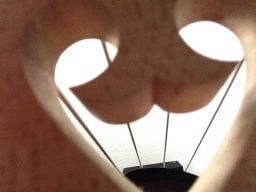
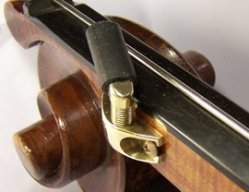
4 things that I see:
1. the E foot appears to have a slight gap at the F hole side - it's as if it has slid towards the F hole, and is no longer in the position at which it was fitted.
2. the G foot adjuster looks misaligned - it should be sitting flush against the top of the foot - in the photo, it is very crooked. Not A Good Sign.
3. it appears that there are "skid marks" where the feet have slid into their current position. This may just be Optical Confusion on my part. Did the bridge get bumped?
4. the adjusters are at different height adjustments - you mentioned raising the G side adjuster, higher than the E side. This is a No-No in my experience, as it is introducing alignment stress into the adjuster holes, (both the threaded and un-threaded holes), via the adjuster shafts.
FYI - I Am Not A Luthier.
Let the wild rumpus begin!
Thanks.
1. the E foot appears to have a slight gap at the F hole side - it's as if it has slid towards the F hole, and is no longer in the position at which it was fitted.
2. the G foot adjuster looks misaligned - it should be sitting flush against the top of the foot - in the photo, it is very crooked. Not A Good Sign.
3. it appears that there are "skid marks" where the feet have slid into their current position. This may just be Optical Confusion on my part. Did the bridge get bumped?
4. the adjusters are at different height adjustments - you mentioned raising the G side adjuster, higher than the E side. This is a No-No in my experience, as it is introducing alignment stress into the adjuster holes, (both the threaded and un-threaded holes), via the adjuster shafts.
FYI - I Am Not A Luthier.
Let the wild rumpus begin!
Thanks.
Hey Don, thanks for the input. Yeah, the bridge has been bumped but most of those scratches came with the bass when I bought it. Your point about the adjusters are is well taken. On further inspection, it seems that the angle of the bottom foot on the adjuster is not the same angle as the bridge above the adjuster. As you say, that doesn't seem to be a good sign. Obviously, it needs a tune up from my luthier but the guy I use is almost 4 hours away. I live on the Central Coast of California about half way between LA and SF. I think I will lower (or raise) the adjusters so it is flush and see what happens. I don't know, the G action is too low but if I raise the whole bridge then the action is too high everywhere else. All part of the joy of DB. Thanks for the advice!
Hey Don, thanks for the input. Yeah, the bridge has been bumped but most of those scratches came with the bass when I bought it. Your point about the adjusters are is well taken. On further inspection, it seems that the angle of the bottom foot on the adjuster is not the same angle as the bridge above the adjuster. As you say, that doesn't seem to be a good sign. Obviously, it needs a tune up from my luthier but the guy I use is almost 4 hours away. I live on the Central Coast of California about half way between LA and SF. I think I will lower (or raise) the adjusters so it is flush and see what happens. I don't know, the G action is too low but if I raise the whole bridge then the action is too high everywhere else. All part of the joy of DB. Thanks for the advice!
thandy,
You're Welcome.
One thing you can try is to loosen the strings (with the bass on its back), and gently move the bridge toward the G string side, to re-position the strings evenly across the fingerboard. (This will essentially raise the G string height a bit, as well.) If the neck is out of alignment, the bridge may have been cut to compensate for this and was not cut to sit "exactly" between the F holes. Also, use a straightedge to square-up the feet before bringing the strings up to pitch, AND, make sure the bridge itself remains fairly "perpendicular" to the top of the bass, as it will have a tendency to "bend" toward the fingerboard during re-tuning. (Gently push it toward the tailpiece.) This will at least make the bass playable until the Luthier can examine and comment.
Also - FYI. The workmanship on the adjusters is suspicious - the installer didn't even bother to remove the small chips on the edges where the cuts were made to install the adjusters.
"Sloppy Is, as Sloppy Does".
Just my $0.02.
Again, thanks for the input. I don't think the neck is out of alignment. Perhaps, but no cracks and it has never been a problem before. Is it okay for the bridge to sit more one side than the other so the strings are dead center on the fingerboard and should there always be a straight line from one the f hole notch to the other? One is perhaps a quarter inch higher than the other relative to the f hole notches.
Again, thanks for the input. I don't think the neck is out of alignment. Perhaps, but no cracks and it has never been a problem before. Is it okay for the bridge to sit more one side than the other so the strings are dead center on the fingerboard and should there always be a straight line from one the f hole notch to the other? One is perhaps a quarter inch higher than the other relative to the f hole notches.
thandy,
You're Welcome.
One thing you can try is to loosen the strings (with the bass on its back), and gently move the bridge toward the G string side, to re-position the strings evenly across the fingerboard. (This will essentially raise the G string height a bit, as well.) If the neck is out of alignment, the bridge may have been cut to compensate for this and was not cut to sit "exactly" between the F holes. Also, use a straightedge to square-up the feet before bringing the strings up to pitch, AND, make sure the bridge itself remains fairly "perpendicular" to the top of the bass, as it will have a tendency to "bend" toward the fingerboard during re-tuning. (Gently push it toward the tailpiece.) This will at least make the bass playable until the Luthier can examine and comment.
Also - FYI. The workmanship on the adjusters is suspicious - the installer didn't even bother to remove the small chips on the edges where the cuts were made to install the adjusters.
"Sloppy Is, as Sloppy Does".
Just my $0.02.
Thanks Don. I decided to quit worrying so much about the bridge feet being perfectly balanced between the f holes and took your advice to just move the bridge over so that it is aligned on the fingerboard. (Not sure how it got way over in the first place...) I did that and all seems well. One thing I didn't anticipate is the action seems higher on the G string which is want I wanted all along. Thanks so much! One of the things I love about TalkBass is you get great advice without ego.
On another point, I see you are based in the LA area. Do you know of any decent DB Luthiers going north? I live in the Arroyo Grande area near San Luis Obispo. My guy is based in South San Francisco. It might be time to get some other opinions. Also, thinking about upgrading to the next step. Not a lot of choices up here. Been playing a Englehart Swingmaster with a pro setup using Spirocore medium orchestras. Thinking about moving up a notch any suggestions? Maybe time for a carved. I play mostly jazz on DB and blues and jazz on BG. Thanks again!

When your bridge slid to the bass side it lowered the G string relative to the fingerboard. Center the bridge first, then bring your adjusters into alignment with each other and see where you really are on the fingerboard.
Thanks Steven. I will try that. Still not sure why the bridge got moved over. Maybe a bump or perhaps just digging in pulled it over in time. Need to pay more attention...for such a large instrument they are delicate little things.
Thanks Don. I decided to quit worrying so much about the bridge feet being perfectly balanced between the f holes and took your advice to just move the bridge over so that it is aligned on the fingerboard. (Not sure how it got way over in the first place...) I did that and all seems well. One thing I didn't anticipate is the action seems higher on the G string which is want I wanted all along. Thanks so much! One of the things I love about TalkBass is you get great advice without ego.
On another point, I see you are based in the LA area. Do you know of any decent DB Luthiers going north? I live in the Arroyo Grande area near San Luis Obispo. My guy is based in South San Francisco. It might be time to get some other opinions. Also, thinking about upgrading to the next step. Not a lot of choices up here. Been playing a Englehart Swingmaster with a pro setup using Spirocore medium orchestras. Thinking about moving up a notch any suggestions? Maybe time for a carved. I play mostly jazz on DB and blues and jazz on BG. Thanks again!
thandy,
Sounds like you found the solution.
Just FYI - a quick search of my past posts here will confirm for you the fact that I'm definitely NOT ""without ego"!
Sorry, I don't have any sources for a luthier in the SLO area. There are a few NoCal/SF cats that post here - they might be able to offer some suggestions.
If you can make it to LA, a great resource is LA Bassworks/Lisa Gaas... and, further south of LA, about 1 hour, is Lemur Music.
Good (P)Luck.
Thanks man. Didn't mean to imply musicians don't have egos. Just that the egos seem mostly in check when people offer free advice. I'll check out LA Bassworks next time I'm down there.thandy,
Sounds like you found the solution.
Just FYI - a quick search of my past posts here will confirm for you the fact that I'm definitely NOT ""without ego"!
Sorry, I don't have any sources for a luthier in the SLO area. There are a few NoCal/SF cats that post here - they might be able to offer some suggestions.
If you can make it to LA, a great resource is LA Bassworks/Lisa Gaas... and, further south of LA, about 1 hour, is Lemur Music.
Good (P)Luck.

When I move my bridge around, I usually turn the adjusters all the way down first. To me that secures that the feet are closest to their intended position.
Some great advice and comments here, as usual on these forums.
And it makes me wonder - as I was surfing the Internet looking up some of the founding fathers of modern Jazz upright playing, like Wellman Braud, Walter Page, not to mention Ray Brown, Mingus et al,I have to wonder how they got on as far as setup and the overall playing condition of their basses! Looking at old pics of them, their basses don't seem to me to be that great - splotchy finish, dodgy bridge positions, WAY fat strings , probably gut, and god knows what all else. Unless these guys were all semi-pro luthiers, which I doubt, how did they keep their basses in shape?
I mean, I'm a mediocre player at best, and certainly no luthier (someone on Quora postulated that I may be a buffoon - but isn't that a woodwind?) but with all the help I get on these forums, my bass is probably tuned and set up to the best of its potential. These old guys probably just stuffed their bass in a bag and threw it in a truck to go to the next gig!
As an example, here's an old pic of Wellman Braud, who was a big influence on Basie's bassist Walter Page. He started the 4/4 walking bass pattern, really. Excuse me for any flippant remarks - I'm sure his Mum was a lovely lady.
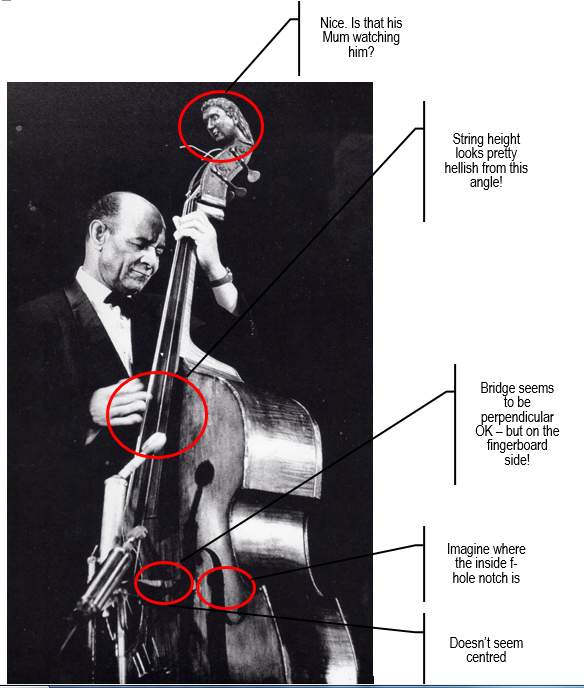
Does anybody have any anecdotal evidence of the condition of the basses of the old time greats?
I don't mean to hijack this thread or anything - just curious, really.
And it makes me wonder - as I was surfing the Internet looking up some of the founding fathers of modern Jazz upright playing, like Wellman Braud, Walter Page, not to mention Ray Brown, Mingus et al,I have to wonder how they got on as far as setup and the overall playing condition of their basses! Looking at old pics of them, their basses don't seem to me to be that great - splotchy finish, dodgy bridge positions, WAY fat strings , probably gut, and god knows what all else. Unless these guys were all semi-pro luthiers, which I doubt, how did they keep their basses in shape?
I mean, I'm a mediocre player at best, and certainly no luthier (someone on Quora postulated that I may be a buffoon - but isn't that a woodwind?) but with all the help I get on these forums, my bass is probably tuned and set up to the best of its potential. These old guys probably just stuffed their bass in a bag and threw it in a truck to go to the next gig!
As an example, here's an old pic of Wellman Braud, who was a big influence on Basie's bassist Walter Page. He started the 4/4 walking bass pattern, really. Excuse me for any flippant remarks - I'm sure his Mum was a lovely lady.
Does anybody have any anecdotal evidence of the condition of the basses of the old time greats?
I don't mean to hijack this thread or anything - just curious, really.

I have seen a pic of a player, probably from the 1940s, who had his bridge aligned with the top eye of the f-holes.
- Aug 1, 2005
- 3,546
- 1,421
- Disclosures
- Private Inventor - Bass Capos
Two ideas come to mind here for me.
1: There is a wide range of workable setup ("workable" doesn't mean "proper" or "ideal", of course).
2: Really talented and dedicated players will work with/around the limitations of their instruments/setups.
That said, I get sad when I watch videos of some of the old masters playing on what you can plainly see are incredibly poorly set up instruments. Some of the basses are good, some total junk. As good as the playing is, I just can never stop thinking about how much better these guys would have sounded if they had owned even my modest Pfretzchner with it's current setup.
1: There is a wide range of workable setup ("workable" doesn't mean "proper" or "ideal", of course).
2: Really talented and dedicated players will work with/around the limitations of their instruments/setups.
That said, I get sad when I watch videos of some of the old masters playing on what you can plainly see are incredibly poorly set up instruments. Some of the basses are good, some total junk. As good as the playing is, I just can never stop thinking about how much better these guys would have sounded if they had owned even my modest Pfretzchner with it's current setup.
Last edited:
Some great advice and comments here, as usual on these forums.
And it makes me wonder - as I was surfing the Internet looking up some of the founding fathers of modern Jazz upright playing, like Wellman Braud, Walter Page, not to mention Ray Brown, Mingus et al,I have to wonder how they got on as far as setup and the overall playing condition of their basses! Looking at old pics of them, their basses don't seem to me to be that great - splotchy finish, dodgy bridge positions, WAY fat strings , probably gut, and god knows what all else. Unless these guys were all semi-pro luthiers, which I doubt, how did they keep their basses in shape?
I mean, I'm a mediocre player at best, and certainly no luthier (someone on Quora postulated that I may be a buffoon - but isn't that a woodwind?) but with all the help I get on these forums, my bass is probably tuned and set up to the best of its potential. These old guys probably just stuffed their bass in a bag and threw it in a truck to go to the next gig!
As an example, here's an old pic of Wellman Braud, who was a big influence on Basie's bassist Walter Page. He started the 4/4 walking bass pattern, really. Excuse me for any flippant remarks - I'm sure his Mum was a lovely lady.
View attachment 818514
Does anybody have any anecdotal evidence of the condition of the basses of the old time greats?
I don't mean to hijack this thread or anything - just curious, really.
Take a look at Willie Dixon's bridge placement.

One thing not mentioned above is the possibility that the E string side of the belly has sunk at all. This will show up as the bottom wing of the F hole being raised and the upper wing being lower. The belly twists, moving the bridge and strings across. However, when I see the old footprints of the bridge feet I don't think this will be the case. Are you sure these are the same footprints as the current bridge covered when you bought the bass?


So much has already been said on this, the only thing I can add (I think..) is that the axes of the adjusters should really be parallel. Otherwise the distance between the feet depends on the height setting (even if they are both set at the same level, as they should). That leads to lateral tension & potential damage.
I think a proper set-up is in order; maybe this bridge can be saved, maybe not. Best see a good luthier.
(PS: a fixed tuner there is not necessarily a good idea; it acts a little bit as a mute.)
I think a proper set-up is in order; maybe this bridge can be saved, maybe not. Best see a good luthier.
(PS: a fixed tuner there is not necessarily a good idea; it acts a little bit as a mute.)


