• TalkBass has been independent since 1998. Add your voice.
    Create a free account to reply to discussions, view embedded media, and browse with fewer display ads.
    Join freeLog in
    Want zero display ads or expanded classifieds tools? Compare plans.

Dead spots on my bass neck

I have a Fender precision Lyte. I am having issues with "dead" spots. I can be playing and hit certain notes and there is hardly any sound or sustain.
This occurs when I hit the notes Ab, A, and Bb most often. And I can play any of these notes at any octave or string and get the same resulting response. What is causing this? I can change strings and it isn't quite as noticable until I use the strings for a 2 or 3 concerts than I begin noticing it again.
 
It's a very common issue for both bassists and guitarists.

In short, dead spots are caused by the vibrations of the neck/headstock in addition to the string vibrations that come from playing. When the frequencies get close, they cancel each other and bam, dead spot.

Here is an article that will explain all the technical stuff
Invalid Link Removed

To fix them, try applying a little weight to your headstock. Interestingly enough, I found your post looking for the answer to a question I have. Is it dependent on weight or can you just "insulate" the headstock (aka, slide a piece of foam behind the nut or something).

Try one of these, or simply put a capo on the headstock and see if it helps any.
Invalid Link Removed

And forgive me, this is my first post. Lucky you, lol so don't take my word for it, ask around too.
 
I have a Fender precision Lyte. I am having issues with "dead" spots. I can be playing and hit certain notes and there is hardly any sound or sustain.
This occurs when I hit the notes Ab, A, and Bb most often. And I can play any of these notes at any octave or string and get the same resulting response. What is causing this? I can change strings and it isn't quite as noticable until I use the strings for a 2 or 3 concerts than I begin noticing it again.

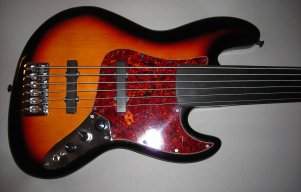
It's caused by a resonance in the neck wood so anything that changes that will change the dead spots. I had them appear just from weather or old strings or other factors. You can move them or get rid of them by doing things that change the neck resonances. Those include different strings, truss rod adjustments, and weight on headstock. On my bass I found that a weight about equal to that of a capo reduced the dead spots to nearly nothing. New strings eliminated them without the weight. Damping (like foam) did not seem to have an effect. Fenders are especially noted for neck dead spots. In really bad cases the only solution is to sell the bass.
 
All kinds of stuff can cause it. Try using different gauge strings (usually lighter works best), adjusting the truss rod & even lowering the pickups. A Fatfinger might help as well.
 
And I can play any of these notes at any octave or string and get the same resulting response.
THAT is unusual. Normally this 'dead spot' problem will be confined to the G string alone, and usually is centered near B or C.
Maybe something is loose and causes a vibration, at or near A. Do you hear or feel this when playing unplugged? Maybe the truss rod is a loose fit and is rattling in the neck, or maybe the neck screws are not tight enough? Or the bridge? Just give all the hardware the once-over with a screwdriver. Beyond that, I just don't know. Very odd.
 
This occurs when I hit the notes Ab, A, and Bb most often. And I can play any of these notes at any octave or string and get the same resulting response. What is causing this?

Looking at this again reminded me of something so I have a couple of questions.

Are you standing in the same spot in the same room when this happens?

Does it happen with other basses?

Reason I ask is there is one club I gig frequently that has a weird resonance or some other voodoo going on that causes all my A notes to nearly vanish. It happens with any bass I play.

The place has a tiny stage so there's not much chance of me moving from my spot and it wasn't until somebody sat in on bass for a couple of songs (one was a blues in A) that I found the A notes could be heard fine in the room. That bassist also noticed the dead A notes.

Turns out it was just a dead zone for my A notes in that area of the stage. Very annoying to try to hear for me but not a problem anywhere else.
 
I have 8 basses and my 2 Cort B4FLs each had a dead spot at C on the A string (third "fret"). Both of these basses are fretless with LaBella 760M flatwounds, but everything else on these basses is different. I tried a Fatfinger but that only helped a little. I took the neck off of the swamp ash bass and found a long plastic shim about 1mm thick. I took the shim out and the dead spot went away! I took the neck off the mahogany/cherry bass and it had a paper shim (like a piece of a business card) and the neck pocket was painted with a lot of orange peel. I removed the shim and the dead spot was still there but much better. I sanded the paint out of the neck pocket so I could get a wood to wood joint and the dead spot went away. I prefer a high action so the shim was unnecessary for me, but if it were I would use a full pocket wedge of hardwood for a shim. When looking for dead spots, always listen through headphones. My room likes to eat Fs.
 
A number of the above posts have mentioned adding mass to the headstock. One quick way to see if this will make a difference is to put a wood working "c" clamp on the headstock. Use some padding and don't tighten it so much that it damages the finish. Start with a small one and move it around. If it helps then invest in a "Fatfinger" which is essentially a piece of machined brass (i think) that accomplishes the same thing.
 
  • Like
Reactions: MattyMcMattface
Had a dead spot on fret number number 5 G string C note. Just spent the weekend trying to figure out why that fret was dead.
This morning I figured maybe the strings were dead. I started to replace the strings when I noticed there were too many winds on the G string. The G string at the tuner was over lapping on top of the winding on the post.
I removed the string, cleaned the string with AxeWax. Then I clipped around one inch off of the end of the G string.
After replacing the G string the dead spot was gone…no dead spots at any frets of the G string.
The tuning machines only need 2 winds on the post. Anything more than two winds and you will have a problem with dead frets. I’m going to play these old strings on my bass for another week and then replace them.
My Bass is a Fender American pro 2 P bass 75th anniversary. At some point Guitar Center replaced the Strings but put too many winds on the G string. There was over four windings on the post.
 
  • Like
Reactions: Zooberwerx
Had a dead spot on fret number number 5 G string C note. Just spent the weekend trying to figure out why that fret was dead.
This morning I figured maybe the strings were dead. I started to replace the strings when I noticed there were too many winds on the G string. The G string at the tuner was over lapping on top of the winding on the post.
I removed the string, cleaned the string with AxeWax. Then I clipped around one inch off of the end of the G string.
After replacing the G string the dead spot was gone…no dead spots at any frets of the G string.
The tuning machines only need 2 winds on the post. Anything more than two winds and you will have a problem with dead frets. I’m going to play these old strings on my bass for another week and then replace them.
My Bass is a Fender American pro 2 P bass 75th anniversary. At some point Guitar Center replaced the Strings but put too many winds on the G string. There was over four windings on the post.

Yes, there should be 3-4 wraps with the last "hitting the deck" or closest to the headstock...no overlaps. Another trick is to slightly loosen the neck bolts with the strings tuned-to-pitch. This may allow the neck heel to seat itself more firmly within the pocket and improve coupling between the components. Don't forget to re-tighten!

Riis
 
Looking at this again reminded me of something so I have a couple of questions.

Are you standing in the same spot in the same room when this happens?

Does it happen with other basses?

Reason I ask is there is one club I gig frequently that has a weird resonance or some other voodoo going on that causes all my A notes to nearly vanish. It happens with any bass I play.

The place has a tiny stage so there's not much chance of me moving from my spot and it wasn't until somebody sat in on bass for a couple of songs (one was a blues in A) that I found the A notes could be heard fine in the room. That bassist also noticed the dead A notes.

Turns out it was just a dead zone for my A notes in that area of the stage. Very annoying to try to hear for me but not a problem anywhere else.
I had that problem last night at a new venue. All of my F#'s were substantially quieter than all other notes. This is a newly acquired bass but I've played it at two gigs, at two different venues, and didn't have that problem. I will do some testing but I'm going to assume it's the room, or the stage itself.