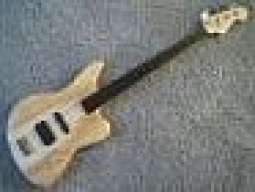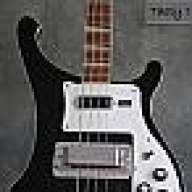
I've noticed that a lot of mighty fine basses (only among 4 or 5 string, I never look at anything more extreme) tend towards either quite massive one-piece bridges or minimalist individual monorail types. Not all - but a lot of them.
The philosophy in support of massive bridges (MB's from now on) seems to go like this:
high mass allows the string to retain more of its energy, yields longer sustain, more punch, whatever.
Minimalist, individual monorail types (monorail, from now on) allow the body wood to absorb some of the energy and contribute to the sound -yada yada yada.
Like I said, some damn fine basses are made with both of these. Yet the theory behind them appears to be inherently contradictory. What gives? Lotsa smart people on TB. Is this all a bunch of malarkey? Could I just as easily drive a few well-placed nails into the end of my bass and save myself some dough?
There's a reason for this post, you know. I am waiting for some carefully chosen (and hopefully, assembled) parts from Warmoth that will be the chassis for my new bass. I got lots of other components figured out (I think) but can't decide on which end of the bridge spectrum to commit to. Already have a brass ABM from eBay. But I'm almost tempted to get some light monorails and bolt them through the body to a single steel plate located on the back. I'm not kidding. Gets the tone wood (whatever that is) into the act, and grounds them all together. I can't use string-through, though, because the strings I use are too heavy/tense (Labella DTB medium flats). By the way, since the Warmoth neck is going to be heavy, the ABM will help balance it, right?
Bill Oetjen
[email protected]
The philosophy in support of massive bridges (MB's from now on) seems to go like this:
high mass allows the string to retain more of its energy, yields longer sustain, more punch, whatever.
Minimalist, individual monorail types (monorail, from now on) allow the body wood to absorb some of the energy and contribute to the sound -yada yada yada.
Like I said, some damn fine basses are made with both of these. Yet the theory behind them appears to be inherently contradictory. What gives? Lotsa smart people on TB. Is this all a bunch of malarkey? Could I just as easily drive a few well-placed nails into the end of my bass and save myself some dough?
There's a reason for this post, you know. I am waiting for some carefully chosen (and hopefully, assembled) parts from Warmoth that will be the chassis for my new bass. I got lots of other components figured out (I think) but can't decide on which end of the bridge spectrum to commit to. Already have a brass ABM from eBay. But I'm almost tempted to get some light monorails and bolt them through the body to a single steel plate located on the back. I'm not kidding. Gets the tone wood (whatever that is) into the act, and grounds them all together. I can't use string-through, though, because the strings I use are too heavy/tense (Labella DTB medium flats). By the way, since the Warmoth neck is going to be heavy, the ABM will help balance it, right?
Bill Oetjen
[email protected]