For the 30+ years I've been playing, I've heard luthiers/players speak of the effect of the neck on tone, specifically the contributions of different woods, both fingerboard wood and neck wood. Maple sounds different from ebony which sounds different than mahogany which sounds different than [insert material here]. I've always wondered, "Well, why not capture it?"
There is a wonderful quote from Phil Kubicki in the great book, "American Basses" (page 110) that reinforced my theory about the influence of the neck on an instrument's tone. He noted that indeed the neck vibrates too:
"Since the neck is a lot less massive than the body, it can vibrate easily and more freely in response to string motion than the body can. This means the neck acts as an exposed acoustical brace with the strings, much like the tines of a tuning fork.
Fortunately when I was exploring what components to use for my designs, I discovered the dime-sized BigShot piezo transducer (by K&K Sound
http://www.kksound.com, who also makes our dual-channel onboard preamp). When we built the prototype, I had confidence that the piezo at the neck heel would indeed be able to capture such vibrations. The result: it captures a really great resonance: alone it almost sounds like a warm archtop instrument. The undersaddle bridge piezo sounds like you would expect it to, well-balanced yet somewhat bright (note: the brightness can be easily tamed via that channel's onboard 3-band EQ or at your amp). The addition of the piezo at the neck heel to the undersaddle transducer produces a full, almost 3-D, sound; it's difficult to describe, but those who played either the guitar or bass at NAMM experienced it.
The potential downside is that if the piezo at the neck heel is cranked to the max, it can capture some left-hand "noise", but that is easily taken care of by attenuating the volume of that pickup without affecting its "musical" contribution. In addition to the sonic contributions described above, an unexpected upside is that several guys at our NAMM booth were playing funk/slap on the bass and raving about the fact that they were FINALLY able to capture the click/percussion they'd always wanted to hear, due primarily to the transducer located at the neck heel.
Thanks for the question; I hope that explains it adequately.

 Thanks to LajoieT for calling it to my attention - and for the nice words on my new bass.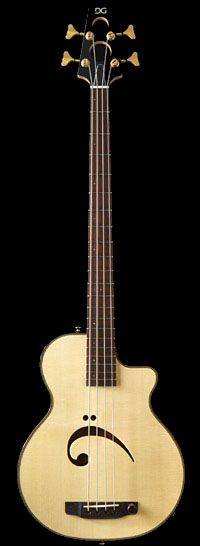








 I guess the "A" in ABG has a very loose interpretation! That's why I called my guitar and bass "chambered solid-body acoustic/electric" instruments.