
I realize playing bass is all about the notes. It makes sense to do drop tunings on a guitar because it offers alternate chord shapes and what not, but what about the bass? I'm starting a new project and we've been tuning to drop b. I'm fairly well versed in standard tuning and drop is definitely a fun and interesting new challenge but I'm wondering if it wouldn't be better to maybe just play in b standard since I have a better understanding of that type of tuning. What do you think? Should the bassist also be in drop tunings if the guitarist is?

Enjoy the benefits of a premium membership!
Upgrade Account
-
TalkBass has been independent since 1998. Add your voice.
Create a free account to reply to discussions, view embedded media, and browse with fewer display ads.
Join free Log in
Want zero display ads or expanded classifieds tools? Compare plans.
You are using an out of date browser. It may not display this or other websites correctly.
You should upgrade or use an alternative browser.
You should upgrade or use an alternative browser.
More options
Who Replied?
buldog5151bass
Kibble, milkbones, and P Basses. And redheads.
Depends whether those low notes are needed.
Last edited:


The band I play in drops 1/2 step I help out a band the drops a whole step.
What I did was purchase a Digi Drop pedal so I tune my 5 string standard and #1is a 1/2 step and #2 is a whole.
No floppy strings and no neck adjusting
I love it
They’re not cheap average price I’ve seen is $180
But it no muss no fuss
Duke
What I did was purchase a Digi Drop pedal so I tune my 5 string standard and #1is a 1/2 step and #2 is a whole.
No floppy strings and no neck adjusting
I love it
They’re not cheap average price I’ve seen is $180
But it no muss no fuss
Duke

I’ve toyed around with drop tunings a bit and found it’s much easier to drop all the strings the same, that way our shapes of fingerings are consistent. When i’d just drop the low string i had to think too much. I’m sure the more i played like that, the more natural it would have become, but i decided i’d rather have the consistency.
I always detune all the strings the same - just easier to remember the familiar shapes  I do it for 2 reasons - for the singer, and for certain songs where you either need a lower note or it makes the use of open strings easier.
I do it for 2 reasons - for the singer, and for certain songs where you either need a lower note or it makes the use of open strings easier.
I taught myself how to play with standard bands, using the bass tuned DGCF (with 50-105 strings). Lots of times a guitar player will have D tuned guitars, and it works well to have the low D available. You've still got all the other notes, assuming you can get used to them being in different locations. You get a bit of a different sound than regular E tuned players as well. One problem is if the guitars look at your hands for guidance, they will get lost...

I wonder how THIS guy remembers the shapes after all the tuning changes.

By "drop B" do you mean the lowest note is an open on what would oitherwise be your E string?
You do realize that's just called a 5 string bass, right?
Or you could string a 4 string BEAD and call it a day.
You do realize that's just called a 5 string bass, right?
Or you could string a 4 string BEAD and call it a day.
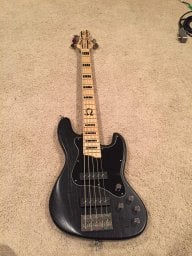
My band's guitarists play in drop B, but I play a 5 string in standard, just because I prefer the feel of standard tuning and it's what I'm more used to. The other benefit is that we have some songs in drop A, so when that happens I just have to drop my low string and be in the same tuning as the guitars, whereas they have to swap axes.

I play in B standard for my bands. I don't use drop tunings because they don't really serve a purpose for me on bass, as I don't play power chords on the lowest two strings.I realize playing bass is all about the notes. It makes sense to do drop tunings on a guitar because it offers alternate chord shapes and what not, but what about the bass? I'm starting a new project and we've been tuning to drop b. I'm fairly well versed in standard tuning and drop is definitely a fun and interesting new challenge but I'm wondering if it wouldn't be better to maybe just play in b standard since I have a better understanding of that type of tuning. What do you think? Should the bassist also be in drop tunings if the guitarist is?
Should the bassist also be in drop tunings if the guitarist is?
I just posted this in another thread: There ain't no need to tune drop-D just because everyone else is doing it. As long as you're holding down your fort.
If you think a 5 string looks "silly", how does a 6 string look??All solid advice! Yeah dropping all the strings the same amount makes the most sense it seems cuz the shapes will be more familiar. A five string would probably make the most sense but I think they look kinda silly lol
Doubly sillyIf you think a 5 string looks "silly", how does a 6 string look??

Lol nah I got nothing against 5 strings I just snagged up this black peavey t-40 and I love the sound and the look and I really just want to use it in this band haha

I used to tune a 5 string to Open G for a band that played in Drop C. My advice would be to use a tuning which makes playing and contributing to the band easy for you.

There are a couple versions of a "drop B". If you mean your B is a whole step lower, it is up to you if you want to do that or just use a BEAD tuning. I do a CGCF tuning just because it is easier for me to follow the guitar and not do math on the fly.I realize playing bass is all about the notes. It makes sense to do drop tunings on a guitar because it offers alternate chord shapes and what not, but what about the bass? I'm starting a new project and we've been tuning to drop b. I'm fairly well versed in standard tuning and drop is definitely a fun and interesting new challenge but I'm wondering if it wouldn't be better to maybe just play in b standard since I have a better understanding of that type of tuning. What do you think? Should the bassist also be in drop tunings if the guitarist is?
There is also a BADG tuning. We do this too. I just use a standard B tuning and forget about my E.
BEAD is easy because you can just use the bottom four strings of a five string set.

Drop tuning can be easier if you just want to follow the guitars and play the same notes, if you think you'll struggle to transpose the notes to work out basslines. Personally, I think some music lends itself to the tuning it was written in - for example you can play "The Grudge" by Tool on any bass with a low D note, whether that's on a 5 string in standard tuning, or a 4 string in any number of tuning combinations, however it's easiest on a 4 string tuned in drop D because of the pull offs to the open D, which are a lot less natural feeling when you're trying to pull off to the D on the third fret of a B string for example.
Generally though, I do prefer standard tunings so that scale patterns, arpeggios and chords work better, drop tunings can make some of them a bit of a pain. Just work out how low you're going to need to go, sort your bass out and start working from there. If you're writing the lines, you'll make them fit to the music based on what you've got to work with.
Generally though, I do prefer standard tunings so that scale patterns, arpeggios and chords work better, drop tunings can make some of them a bit of a pain. Just work out how low you're going to need to go, sort your bass out and start working from there. If you're writing the lines, you'll make them fit to the music based on what you've got to work with.
I've met a few guitarists who can't stand for the bassist to be tuned different than them. I don't get that.
I think maybe they had control issues. They certainly weren't any fun to be around.
I think maybe they had control issues. They certainly weren't any fun to be around.
I am doing this:
1. Tune BEAD - of course with appropriate string gauges.
2. Using a Kyser clip capo on 5th fret.
3. Then all "open" strings are the same as a regular 4 string EADG bass.
4. In order to utilise this, you have to have a fanned fret bass. Scaled from 34" to 36,5". I do.
5. Because - otherwise - if you play high up on the thick b-string it sounds bad, and out of tune. No matter how well intonated.
6. As fast as a number requires "drop" anything, I'll just move the capo back a fret or two, or whatever is required. I never capo past 5th fret.
7. I can even in the middle of a number change capo positions, should the tune have a key change, and a long enough drum fill to snap, and re-clip the capo.
So far it works a charm and no one complained.
1. Tune BEAD - of course with appropriate string gauges.
2. Using a Kyser clip capo on 5th fret.
3. Then all "open" strings are the same as a regular 4 string EADG bass.
4. In order to utilise this, you have to have a fanned fret bass. Scaled from 34" to 36,5". I do.
5. Because - otherwise - if you play high up on the thick b-string it sounds bad, and out of tune. No matter how well intonated.
6. As fast as a number requires "drop" anything, I'll just move the capo back a fret or two, or whatever is required. I never capo past 5th fret.
7. I can even in the middle of a number change capo positions, should the tune have a key change, and a long enough drum fill to snap, and re-clip the capo.
So far it works a charm and no one complained.


