Recently I switched to new flatwound strings by Sadowsky. I really like how they sound! But I was curious how they would record with DI, dynamic and condenser microphones. Here are the results, which may be educational from several perspectives so I’ll cross post as appropriate. The files are downloadable for easy comparison in your DAW. Or you may listen to them here one by one.
SIGNAL CHAIN
Room: home studio with hardwood floor, bright ambiance
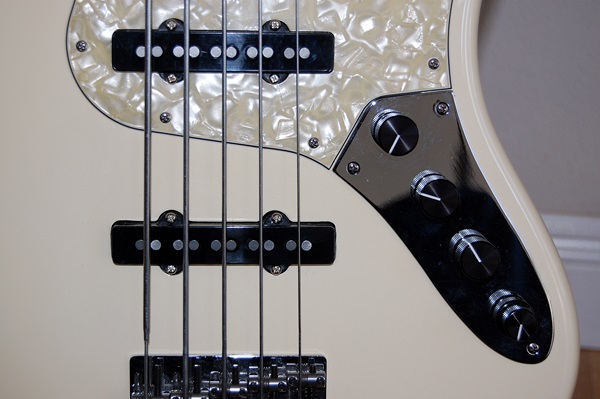
Instrument: 1996 Fender American Jazz Deluxe 5 with Sadowsky preamp and Lindy Fralin pickups, J pup slightly rolled off, VTC preamp on full, bass & treble boost on about 25% (see photo)
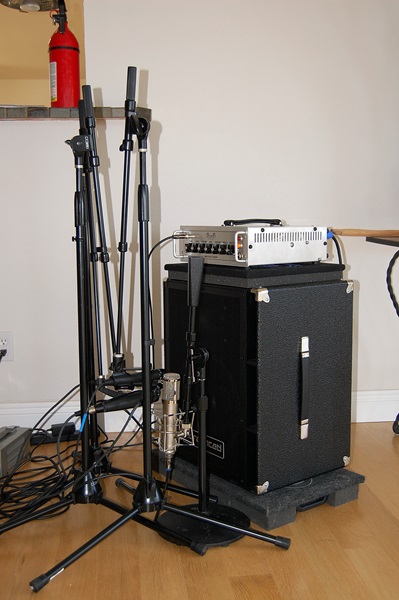
Amp: Reiner Studio 1200 with all tube preamp (two 12au7s and one 12ax7); all EQ set flat. TalkBass discussion here.
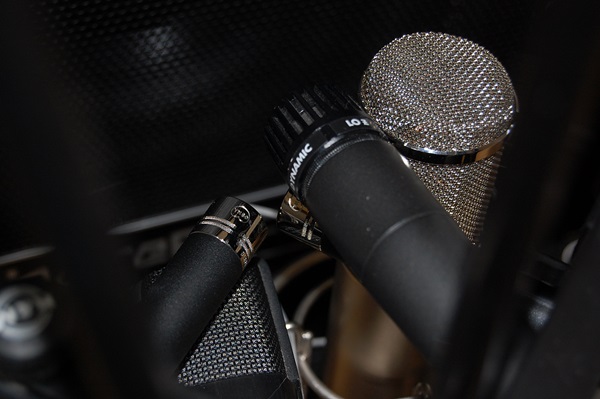
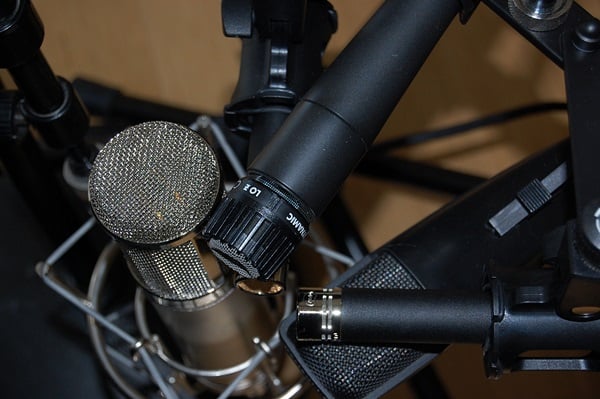
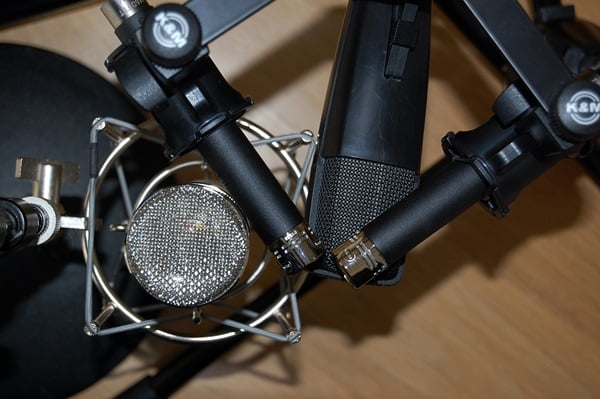
Cab: Barefaced Big Baby 2 (horn rolled off about 33%) with all mics in same area at midpoint of front grill about 5.5 inches from grill to allow a touch of air but minimize proximity effect and room noise (see photos); cab and amp physically cushioned with Auralex Gramma pads (see photos). TalkBass discussion here.
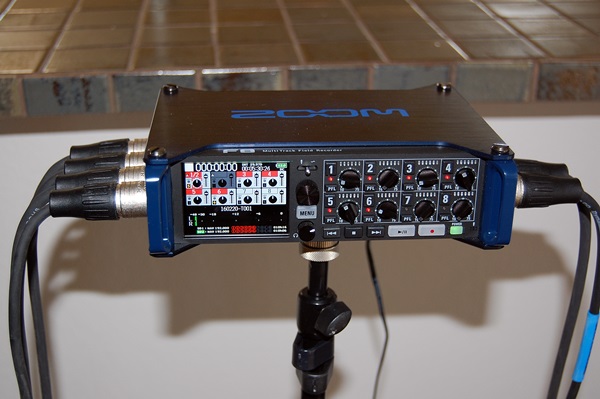
Recorder: here. The ultra quiet preamps sound great and have been compared as almost indistinguishable to the Sound Devices 744T. All inputs were simultaneously recorded to WAV files in 192kHz sample / 24-bit depth
THE MUSIC PATTERN
Played fingerstyle from bottom almost to top of neck starting with open B. Pattern was a two-octave chordal scale up and down, then repeat on C, etc. This pattern reveals string performance all over the fretboard and eases comparisons between mics.
RESULTS
All files are the raw recordings with no EQ or effects applied. All are the same volume level. Each has a playtime of 2:55
Download all files at once in compressed ZIP format from my Dropbox: WAV 192/24 (576MB) or WAV 44.1/16 (88.2MB)
Links below are WAV files @ 44.1kHz/16-bit
Direct Injection. Used the DI built into the Reiner Studio 1200. The signal went through the 3-tube preamp, which is coupled with the power amp by a Jensen transformer. The studio-grade DI uses a second Jensen transformer and provided a pre-EQ signal to the Zoom F8 recorder. CLICK TO PLAY
Shure SM57 cardioid dynamic microphone. The SM57 is the “workhorse” of live sound. Recording bass is not this mic’s forte. It demonstrates the quality of a low-end dynamic mic on bass. CLICK TO PLAY
Sennheiser MD421-II dynamic microphone. The MD421 is a better grade cardioid dynamic mic that is often used for bass guitar, toms and kick drum. CLICK TO PLAY
Telefunken M60 small diaphragm FET condenser microphones in X/Y stereo pattern. The [Invalid or Expired Link Removed] is Telefunken’s Field Effect Transistor version of the ELA M 260 small diaphragm tube microphone. Similar to the Neumann KM 184 as both are cardiod mics; I prefer the M60’s more even response. Used as a matched pair in 90 degree X/Y configuration, they provide a slightly bigger yet tightly focused sound. CLICK TO PLAY
Peluso 22 251 large diaphragm tube condenser. The Peluso 22 251 provides the harmonic richness and vintage vibe of the Telefunken ELA M 251, which is a close cousin to the AKG C12 (used on Sir Paul’s Abbey Road sessions with The Beatles). The Peluso was set to cardioid mode and its tube infusion provides a slightly rounder and sweeter tone than the M60s. It’s my personal favorite for recording the Sadowsky flatwounds. CLICK TO PLAY
SIGNAL CHAIN
Room: home studio with hardwood floor, bright ambiance
Instrument: 1996 Fender American Jazz Deluxe 5 with Sadowsky preamp and Lindy Fralin pickups, J pup slightly rolled off, VTC preamp on full, bass & treble boost on about 25% (see photo)
Amp: Reiner Studio 1200 with all tube preamp (two 12au7s and one 12ax7); all EQ set flat. TalkBass discussion here.
Cab: Barefaced Big Baby 2 (horn rolled off about 33%) with all mics in same area at midpoint of front grill about 5.5 inches from grill to allow a touch of air but minimize proximity effect and room noise (see photos); cab and amp physically cushioned with Auralex Gramma pads (see photos). TalkBass discussion here.
Recorder: here. The ultra quiet preamps sound great and have been compared as almost indistinguishable to the Sound Devices 744T. All inputs were simultaneously recorded to WAV files in 192kHz sample / 24-bit depth
THE MUSIC PATTERN
Played fingerstyle from bottom almost to top of neck starting with open B. Pattern was a two-octave chordal scale up and down, then repeat on C, etc. This pattern reveals string performance all over the fretboard and eases comparisons between mics.
RESULTS
All files are the raw recordings with no EQ or effects applied. All are the same volume level. Each has a playtime of 2:55
Download all files at once in compressed ZIP format from my Dropbox: WAV 192/24 (576MB) or WAV 44.1/16 (88.2MB)
Links below are WAV files @ 44.1kHz/16-bit
Direct Injection. Used the DI built into the Reiner Studio 1200. The signal went through the 3-tube preamp, which is coupled with the power amp by a Jensen transformer. The studio-grade DI uses a second Jensen transformer and provided a pre-EQ signal to the Zoom F8 recorder. CLICK TO PLAY
Shure SM57 cardioid dynamic microphone. The SM57 is the “workhorse” of live sound. Recording bass is not this mic’s forte. It demonstrates the quality of a low-end dynamic mic on bass. CLICK TO PLAY
Sennheiser MD421-II dynamic microphone. The MD421 is a better grade cardioid dynamic mic that is often used for bass guitar, toms and kick drum. CLICK TO PLAY
Telefunken M60 small diaphragm FET condenser microphones in X/Y stereo pattern. The [Invalid or Expired Link Removed] is Telefunken’s Field Effect Transistor version of the ELA M 260 small diaphragm tube microphone. Similar to the Neumann KM 184 as both are cardiod mics; I prefer the M60’s more even response. Used as a matched pair in 90 degree X/Y configuration, they provide a slightly bigger yet tightly focused sound. CLICK TO PLAY
Peluso 22 251 large diaphragm tube condenser. The Peluso 22 251 provides the harmonic richness and vintage vibe of the Telefunken ELA M 251, which is a close cousin to the AKG C12 (used on Sir Paul’s Abbey Road sessions with The Beatles). The Peluso was set to cardioid mode and its tube infusion provides a slightly rounder and sweeter tone than the M60s. It’s my personal favorite for recording the Sadowsky flatwounds. CLICK TO PLAY
Last edited: