• TalkBass has been independent since 1998. Add your voice.
    Create a free account to reply to discussions, view embedded media, and browse with fewer display ads.
    Join freeLog in
    Want zero display ads or expanded classifieds tools? Compare plans.

Disconnecting driver?

NoiseNinja

Experimental-psychedelic-ambient-noise-drone
Inactive
Feb 23, 2011
6,258
5,534
Denmark
soundcloud.com
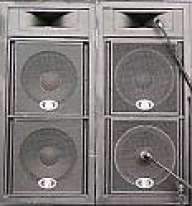
I have a Behringer active p.a speaker B212D I use together with my Hartke Kickback 15. The pa speaker has a driver and I'm not fond of the sound comming from the driver, especially when I use my fuzz pedals. My question is If I can simply cut the wires to the driver and solve the problem that way?

 
Unless you consider possibly blowing your amp an ill effect. :eek:
It's rare, but it can happen. If you use lots of distortion get a speaker that doesn't have a tweeter.
I suppose it can, but then it deserved to blow, IMO. It's a pretty crappy amp that goes into oscillation when the tweeter goes south.


But yes, it's probably the wrong tool for the job.
 
I suppose it can, but then it deserved to blow, IMO. It's a pretty crappy amp that goes into oscillation when the tweeter goes south.
If the tweeter blows, its voice coil has opened, which means (assuming the crossover is a real one and not just an in-series capacitor) the amp is now driving a tank circuit at tweeter frequencies at and around the crossover point. That's the long way 'round of saying that your amp is now seeing a dead short at those frequencies. It's not the amp's fault that it oscillates under that condition. I'd be surprised if it didn't. By the way, this scenario is what Bill F was referring to. Disconnecting your tweeter looks the same to the amp as the tweeter's voice coil blowing.

Edit: Clarify where, frequency-wise, the amp sees a short circuit; also ref. Bill F's comment.
 
Not when the load is a dead short, and that's what can happen if you disconnect a tweeter. The entire crossover should be disconnected to prevent that possibility.

Didn't really think about the difference, but that's true. Of course that depends on the crossover. If it's your average 12dB/octave filter there will be a very low impedance at a specific frequency due to the series resonance of the cap & inductor, limited by the series resistance of the inductor. If the "cross over" is simply a series cap there's no difference.

Still, busted tweeters is a fact of life, and the amp should be able to handle that. But the correct solution is to disconnect the tweeter part of the crossover completely.

However, that's a moot point in this case since this is a powered speaker with separate amps for woofer and tweeter and an active crossover, so there's nothing to worry about.