• TalkBass has been independent since 1998. Add your voice.
    Create a free account to reply to discussions, view embedded media, and browse with fewer display ads.
    Join freeLog in
    Want zero display ads or expanded classifieds tools? Compare plans.

Distortion/Overdrive for bass

Apr 23, 2011
1,710
1,443
Europe
Hey guys!

I was wondering how you guys tackle the "good ole" distortion/overdrive vibe in a recording. How to maintain the "clunk" or, "definition" of a note pluck and string growl, while still maintaining a massive wall of distortion behind.

Obviously the first thing that comes to mind is having a multitrack, keeping one track clean or saturated enough for the definition to come through and then blending it in with distortion - but here comes the real question - how do you tackle phasing issues? And on top of that - distortion tends to muddy up the low mids quite a lot which creates a lot of muddiness in a mix, detracting from every other instrument and clouding things up - how do you approach this issue? Cutting the 200-300hz region is obvious enough, but then there comes a point where the sound gets too thin and you start losing the weight of the sound. I tend to think about Muse (band) when thinking of distortion and I wonder how that is done.

Also, is there a good starting point to figuring out the amount of LPF needing to be applied to make sure you mask the annoying buzzy top end of the distortion? I have also tried experimenting with only driving up certain bands of the signal, but almost always realize something's missing - as if the distortion is "there", but not really there - hard to explain.

I'd be very happy to hear from some of you experienced overdrivers how you guys tackle it. I assume the same could be applied to electric guitar?
 
I have also tried experimenting with only driving up certain bands of the signal, but almost always realize something's missing - as if the distortion is "there", but not really there - hard to explain.

I find selectively overdriving the bands is what gives me the best results. The tricky thing I find is how multiband overdrive/distortion reacts to different notes and dynamics. I often get it dialed in where it might sound like a unified whole (but still with full fundamental) and then at other note or dynamic ranges it seems separate, almost multitracked. Sometimes, granted, I want that, but not usually.

So I had been using MSaturatorMB for this in the box, but recently acquired a Source Audio Ultrawave. At least in practice, yet to record with it, I'm feeling like the 'live' aspect of using it is getting me better results.
 
IMO one needs at least 2 tracks for over driven bass sounds, adding a third if full on distortion is needed.

DI- clean, supplies bottom and possibly upper end clarity. Lots of compression
amp/Mic 1/mildly dirty DI- provides mids and growl. Moderate compression
amp/Mic 2/ distorted/fuzz DI- gets into the upper mids and gives chunk, little compression, moslty provided by overdriven device.

Some folks use guitar amps for channel three, like Dug Pinnick of Kings X (used Mesas).

I like to keep the DI supplying anything below 100Hz, then high pass the mid signal right above it, and the super chunky signal as high as 250Hz. Mix to taste.
 
  • Like
Reactions: Sparkl
but here comes the real question - how do you tackle phasing issues?
You don't tackle it. You can't. Phase is both time and frequency dependent. Many people will time align the first sample of a mic'd bass track to a DI track and assume that the signals are now in phase with each other. Distortion of any kind adds harmonic content and thus the frequency content has changed. Distortion also tends to be non-linear meaning the amount of harmonic content added is not constant on all parts, therefor you can't get the two tracks perfectly in phase with each other. Ever.

The reality is that this doesn't matter provided you like what the phase relationship between the two tracks is doing. More often than not it means that you see some reduced content in the midrange. If you're WAY out of phase you may see some reduction of bottom end. Either of these could be a benefit or a problem depending on the mix.

Be careful if you're using any form of multiband processing for distortion, be it a standalone plugin with internal crossovers like the Sansamp PSA plugin or Neural DSP's Darkglass plugin, or if you're filtering multiple bass tracks to have different tracks for separate frequency ranges and levels of distortion. With these crossed over frequency ranges happening you can run into very severe phase incoherency when adding aux sends to busses. If you're using a crossed over sound for bass and you hear it as a thin phasey sound be sure that your aux sends aren't screwing things up.
 
  • Like
Reactions: Sparkl
This isn't my are of experience, so I'm following out of curiosity.

Next on my purchase list is the Ugritone IR Loader and this package. The sale price is pretty good, and I've had luck with their drum plugins.
[Invalid or Expired Link Removed]

They claim:
FinnBazz IR Pack features 3 patches that were crafter for Modern Metal.
Created to mimic the classic Bass chain consisting of DI/Distortion, Close Mic & Room mics. Thundering Bass tone with life.
Combine the miced signal with a foolproof DI/Distortion IR to ensure that these 2 won't interfere with each other.
 
  • Like
Reactions: Sparkl
Combine the miced signal with a foolproof DI/Distortion IR to ensure that these 2 won't interfere with each other.
Lots of IR companies make this claim. They've dialed it back in recent years to what you see here. Previously they would describe everything as being perfectly in phase, which anyone who understands phase relationships knows is impossible when you have two signals of the same source. It can't be done, but ultimately, as I stated above, if you like the sound of the phase relationship then who cares?

If you use a DI with this IR and combine it with a mic'd signal their claim that the two "won't interfere with each other" is completely bogus. They interfere in terms of a phase relationship which is unavoidable. Ignore that piece of marketing fluff as it's meaningless. Instead, grab a demo of the plugin and decide if you like the results. If you do, use it. If you don't, ditch it.
 
distortion tends to muddy up the low mids quite a lot which creates a lot of muddiness in a mix, detracting from every other instrument and clouding things up - how do you approach this issue?

Bass distortion pedals are voiced with this in mind, so I find it easier to record a dry DI track and add distortion to a second track with an Ampeg SCR-DI. Blend to taste.
 
  • Like
Reactions: Sparkl
Thanks a lot guys, you've given me some very good points to consider. I am not new to recording and mixing "per se" but I am not ashamed to admit I haven't done a lot of distorted stuff on my own and I always find fighting with distortion completely different as in mixing a "clean mix" (think modern music, pop, jazz, etc.).

So I found people have developed a million different ways of doing it that works for them and I am very curious to try different methods to see which correspond best with my idea of mixing.

You don't tackle it. You can't. Phase is both time and frequency dependent. Many people will time align the first sample of a mic'd bass track to a DI track and assume that the signals are now in phase with each other. Distortion of any kind adds harmonic content and thus the frequency content has changed. Distortion also tends to be non-linear meaning the amount of harmonic content added is not constant on all parts, therefor you can't get the two tracks perfectly in phase with each other. Ever.

The reality is that this doesn't matter provided you like what the phase relationship between the two tracks is doing. More often than not it means that you see some reduced content in the midrange. If you're WAY out of phase you may see some reduction of bottom end. Either of these could be a benefit or a problem depending on the mix.

Be careful if you're using any form of multiband processing for distortion, be it a standalone plugin with internal crossovers like the Sansamp PSA plugin or Neural DSP's Darkglass plugin, or if you're filtering multiple bass tracks to have different tracks for separate frequency ranges and levels of distortion. With these crossed over frequency ranges happening you can run into very severe phase incoherency when adding aux sends to busses. If you're using a crossed over sound for bass and you hear it as a thin phasey sound be sure that your aux sends aren't screwing things up.

Yeah I am aware that phasing in this case will never be possible to solve completely. So ultimately it falls down to the ear of the mixer.

Where should one be getting the low mid heft from though? I don't suppose there is a clear answer for that as ideally you probably want to blend the 250-ish hz area with both the DI and overdrive track - but is this really the case? Or is it better to just use the DI for sub 100hz only?

There is obviously no clear way on how to do it, but still, maybe you can provide some common practice to it. Also, is there a "safe bet" as in where is usually a good spot to set a LPF as a starting point? So far I tend to put it around 3-7khz, depending on the sound, trying to mimic what an average cab without a tweeter would normally put out.

Again, thanks for the answers!
 
Where should one be getting the low mid heft from though? I don't suppose there is a clear answer for that as ideally you probably want to blend the 250-ish hz area with both the DI and overdrive track - but is this really the case? Or is it better to just use the DI for sub 100hz only?
What does the bass drum sound like? Are there keys and if so what does their bottom end sound like? Are the guitars downtuned or resonant down low? What does the bass sound like on its own?

I typically try to do as little as possible when mixing, so if the answer is “do nothing, just bring up the fader” then that’s exactly what I’ll do. If you need to add content in the low mids then by all means do it. For my taste I’m generally not a fan of boosting at 250hz or 500hz if I can avoid it. They’re very cloudy, muddy, boxy sounding frequencies to my ears. If I need to add weight I almost always try to do it JUST above the resonant peak of the kick drum.
 
Last edited:
  • Like
Reactions: Sparkl
Also, is there a "safe bet" as in where is usually a good spot to set a LPF as a starting point? So far I tend to put it around 3-7khz, depending on the sound, trying to mimic what an average cab without a tweeter would normally put out.
What does the top end of the bass being used sound like? If it’s a P-Bass with flats I wouldn’t bother low passing at all. A super bright MTD with rounds trying to work on a blues track I’d take it WAY down into the 3-6khz range most likely. Some modern fusion thing with an active Jazz would likely be in the 10-12khz range so that it takes out the buzzes and squeaks but is otherwise inaudible.

With any EQ move you incur a phase shift and I find the fewer of these you have in a mix the more predictable it will be. Only low pass, or high pass, or band pass, or do anything if it needs it.
 
I’m not the biggest fan of this YT channel, and these aren’t the most detailed instructions, but…
There’s some interesting advice here, which I’ve seen elements of elsewhere over the years. You can probably jump to the 3:00 mark and get the main idea.

 
  • Like
Reactions: Sparkl
I’m not the biggest fan of this YT channel, and these aren’t the most detailed instructions, but…
There’s some interesting advice here, which I’ve seen elements of elsewhere over the years. You can probably jump to the 3:00 mark and get the main idea.


Hehe yeah, Glenn can be extremely annoying sometimes (especially towards the bass players, he he), but he's got solid advices most of the time. I like to watch his videos from time to time. :)
 
  • Like
Reactions: monsterthompson
I'm no expert (as a matter of fact, you can hear my lack of expertise in some of my tracks), but one thing I habitually do is create a duplicate bass track, high-pass around 300-500 hz, do whatever I want to it and mix it back in.
 
  • Like
Reactions: Zbysek
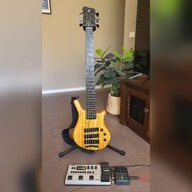
27554B50-110B-4281-B4F0-132BF1DE21A7.jpeg
 
I personally keep it a very straightforward recording approach. I don't bother with mic'ing cabs, I run direct out from my Ampeg SVT-7 Pro into an audio interface.

Firstly, I'm playing a Warwick, and despite not being the "most recorded bass in history", they cut through a mix better than anything I've heard. I run that into a Darkglass Alpha Omega pedal (my holy grail of overdrives) then put a touch of compression on the signal in the head, and a touch of EQ, usually a slight bump in the lows and a slight cut around 800Hz.

Software, I have a list of vsts longer than time permits to outline, however as a go-to for the sounds I like I will use TSE BOD (a free Sansamp DDI emulator that is very decent), and for other variations of drive/distortion I have Neural DSP Darkglass and Parallax plugins to throw into the chain as desired. I also have Blackice Beta Gamma (Alpha Omega amp sim) which is very good.

Parallax is very handy as it is a multiband compressor/drive/distortion with variable crossovers and distortion/compression levels.

I did this as an experiment in mimicking the tone Jon Stockman from Karnivool gets in Goliath, simply with the Ampeg, AO pedal and BOD plugin, blended 50/50 with the interface signal.

Dropbox - goliath.mp3 - Simplify your life

Just remember that bass that sounds amazing by itself is not necessarily what sounds best in a mix.
 
  • Like
Reactions: Zbysek