• TalkBass has been independent since 1998. Add your voice.
    Create a free account to reply to discussions, view embedded media, and browse with fewer display ads.
    Join freeLog in
    Want zero display ads or expanded classifieds tools? Compare plans.

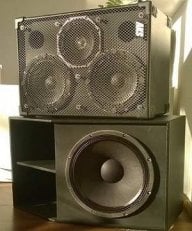
DIY Angle Cab - what would you load it with?

still need to use ISDonline to calculate port length for tuning mind

Scroll to the bottom of "reported data" (and speak centimeters) - you're welcome.

Ignoring the specifics of actual "Sd" on the given speakers to make a general argument:
2 8-inch have an area of 2*[4*4*Pi] or 32Pi 1 12-inch has an area of 6*6*Pi or 36Pi
 
Last edited:

well, 2x10 is 50Pi, so that's a beast of a different color, but then you're into the scale of my original suggestion to use the 1x15 at 56.25Pi (and considerably less baffle space overall) but you likely need more box volume for either of those to be happy. I'd have to imagine that the 1x12 is going to sound better than the 2x8, but I don't have any way to be sure other than build both and listen, which is a bit overkill. As a general rule one speaker (if it does what you want) has less sound issues than 2 speakers side by side (one over the other works better, but would make an interesting wedge build.)
 
Why 2x8" instead of none 12"?
Allthough the 8's may have more highs then your average 12, placing two 8" drivers side by side will definitely beam(in the horizontal plane) the mids/high more then a 12".
Instead of two beta 8's you could install a Beta-12LTA.
Btw. has anyone here ever used the Beta -12LTA for bassguitar? Kringle77?
 
Last edited:
Not really sure, I was planning to do something clever like low passing one of them to stop the horizontal beaming, but more to make something different rather than any particular advantage. I'm going to have a re-draw as looking at the Bill Fitzmaurice designs I quite like the layout of the XF guitar cab - http://www.billfitzmaurice.com/XFCabs.html - which has a more sensible wedge kind of cut than the 'standard box with a back bit missing' profile.

As another thought - this amp will drive 130W at 8ohm or 260W at 4ohm if I've got the figures right - so to gain maximum power I could either do with 2x 8ohm or a 4ohm 12 inch.
 
Last edited:
So, playing with the numbers, if I can push the cab up to a 2x10", I have to add a few inches to bottom of the cab, but they can just fit in. Cutting a little less off the back (and I have changed from 45deg tilt to 55 having looked a few monitor plans, as off the top of my head I think the tilt should be a little more - monitor wedges that tilt at 45 always seem to be a little low) I can get this curve

Screen Shot 2015-01-05 at 14.39.37.png

Which seems to be quite usable hopefully. This cab is going to be rubbish for anything over 2kHz, but if that is a major problem I can add a tweeter and low cut the cab, which may he helpful anyway...
 
yes - 2x BP102 in a 52 litre box. It does perform significantly better with 1x in the box though as the box is too small for them - although it isn't as loud it's linear to a fairr bit lower - so I may be over-complicating this
 
whatever we do is properly amplified, DI'd and monitored, so I don't need a 15" cab, and I'd like it to be a bit more compact
I may be over-complicating this

Your original post says you're looking for practice and performances where you are DI'd so you really don't need much amp, and you want something more compact (lighter was mentioned elsewhere, at least by inference). I'm pretty sure you are overcomplicating it. One driver should do everything you asked for.

As for "one over the other on a 210" (which I think is overcomplicating this) take a side by side 210 and do what you should do with those anyway - stand it on end. Then wedge it, which is the part that will look a bit unusual, since (from a normal 210 box) it would be a somewhat tall narrow wedge, not a wide flat one. But depending on the width of your amp, it might not be too far off "square-ish" when built as a combo, so it might not look too unusual. But your stated goals strongly suggest "one driver..." IMHO, and one 12 would work pretty well.
 
Last edited:
Ah - one over the other - sorry I see now somehow I had just missed that. I thought some unusual loading like a LAB sub.
Seems like I should probably be looking at 1x10 or 1x12 as I can do a nicer job with keeping it compact and get a nicer driver for the same money which seems to make a real difference in the responses - depending on how much the stats can be trusted.
 
  • Like
Reactions: T_Bone_TL
How would you expect a sealed and a vented cab to perform? Looking at WinISD online I seem to be getting better response around 60Hz on a sealed rather than vented box around 20L as it's hard to tune a box that small so low...

This is a 10inch ported cab but it performs flatter as sealed - however, with WinISD online I only get relative dB not absolute, so it's hard to tell what the overall sensitively is? The second online tool doesn't seem to be affected by how many ports either - doesn't seem to change any parameter
 
however, with WinISD online I only get relative dB not absolute, so it's hard to tell what the overall sensitively is? The second online tool doesn't seem to be affected by how many ports either - doesn't seem to change any parameter

Watch out for Xmax on the sealed front.

As I noted in @fdeck 's thread announcing the program, there does seem to be a goof on the number of ports front, so I figure just put in the area of the ports (summed) and divide it yourself; not 100% accurate due to port wall friction, but none of them are on that front, as far as I know.

As for tuning it low in a small box, shrink the port area, trying to stay below Mach 0.09, or 30 m/s or so, at frequencies we actually care about (40 and up)

And I suspect it's also giving a "relative" volume number (or the "transfer function", or 1 watt) since SPL output does not change with applied power, even though Xmax and port airspeed do. I was trying to do a quick compare last night and my 118 dB (per WinISD) box was sitting a hair below 100dB, so I said "hmm, this can't be right." We're free to fix it, but it's not usually the most critical number, and the odds of my mucking it up are well above my improving it.

If going larger (actually a bit smaller than the 52L version you had a few posts back) is fine, I kinda like this version with the B&C 12CL64 from lowactin's thread. Less drive power means we can get lower and still have safe Xmax; at least, believing fdeck's bass-based blue line we can - don't throw it any 41 hz sinewaves at 130W. Port is only 7.5 cm long.
thread announcing the program
 
Last edited:
It's approx 31L cab, and tuned with that port to around 58Hz (it's a 23cm port 43cmx3cm, so equivalent area to 12cm diameter port according to my maths - I'm a bit restricted at the moment as I am totally Mac-based at work and home so can only use the online version of WinISD, so it's a bit long winded)

The tuning of the cab calculates to 66Hz for 23cm port length.
(to your record, Winisd is sometimes very erroneous)
To get a tuning of 58Hz you will need a port length of 32cm.

Alternative port dimensions for 58Hz tuning:
2,5cmx43cm and a length of 26cm.
 
Last edited:
I've padded out the cab a bit, and I've got it up to 46.6litres.. i was aiming for 50 but lost a little bit through the sleeve and amp ports.

The ports are an unusual arrangement, as I'd rather go wider with the cab than taller in a monitor kind of format, and the depth is kind of fixed by the depth of the amp unit, so they are at the top at the sides of the amp sleeve. The amp sleeve is 85mm gap, so the ports are 85mmx50mm each, 180mm depth according to fdeck calcs.

BassAmpV5.jpg BassAmpV5 bottom.jpg BassAmpV5 port.jpg

Designed for a B&C 12CL64 as suggested.

Is it worth squeezing that last bit of size out for 50L?

Link to 46.6 cab Invalid Link Removed
 
  • Like
Reactions: T_Bone_TL
Looks good. You can expect some "virtual volume" from lining & stuffing it (adjustably, by ear) with polyfill, and really, very small tweaks don't make a lot of difference (and/or fall into the margin of error.) Looks like a good practical solution to the ports. Do be ready to test and adjust them, though - you will probably get significant "end effect" due to the fact that 3 sides of the port extend beyond the "port length" - this will make it act like a longer port.
 
Watch out for Xmax on the sealed front.

As I noted in @fdeck 's thread announcing the program, there does seem to be a goof on the number of ports front, so I figure just put in the area of the ports (summed) and divide it yourself; not 100% accurate due to port wall friction, but none of them are on that front, as far as I know.

As for tuning it low in a small box, shrink the port area, trying to stay below Mach 0.09, or 30 m/s or so, at frequencies we actually care about (40 and up)

And I suspect it's also giving a "relative" volume number (or the "transfer function", or 1 watt) since SPL output does not change with applied power, even though Xmax and port airspeed do.
That's right. In more detail, my program (barring bugs of course) takes "1 watt" and converts it into an equivalent voltage assuming the nominal impedance of the driver. WinISD seems to do it a bit different, using the coil resistance instead of the nominal impedance. At least that's what I intended....
I was trying to do a quick compare last night and my 118 dB (per WinISD) box was sitting a hair below 100dB, so I said "hmm, this can't be right." We're free to fix it, but it's not usually the most critical number, and the odds of my mucking it up are well above my improving it.
I'll do my own comparison to WinISD, to make sure there isn't some big hairy bug corrupting the results. I'll also compare it to my Excel spreadsheet, which theoretically does the same calculation.

An odd history is that I used the speaker modeling program as a way to try out a number of different programming languages, when I got sick of Visual Basic. I have chosen Python as my favorite language du jour, but am interested in gaining some Javascript skills due to the ease of porting programs to phones and tablets. So, if anybody is interested in a Python version of the program... ;)
 
Sure, I'd be interested in the Python version. Other than amusing antiques like PL/I it's the language I've most recently done much of any sort of programming in, so there MIGHT be a hope in heck. I'm a travesty to my BSCS, but that's life.

WRT WinISD .vs. your program and the transfer function-ish bit, they have the transfer function (which they normalize to 0dB out in the flatland section) and then they have the SPL graph that responds to what you enter for the wattage in the signal section (as your cone excursion and port airspeed graphs do) so it was a bit counterintuitive that your dB SPL graph didn't change when I changed the input wattage; that's all the issue there might be from my POV, anyway. At 1W, my box models to a bit below 100dB in WinISD, too. It is nice to have the "input sensitive" version if only for the "so how loud can THIS box get with THIS amp?" questions, though otherwise they are basically the same graph. And, of course, courtesy Randall Munroe's xkcd (and there are others on the Python theme):
electric_skateboard_double_comic.png
 
Not to try and be a scrounger but is the spreadsheet version hosted anywhere? I did wonder as I was using the online version that I could create a spreadsheet version to do the maths and graph it, and allow to save and compare different drivers easier as well - but I'd have to look up what all the maths was - and spreadsheets are pretty cross platform, even people on macs have a reasonable chance of having MS office.