Very cool stuff. An affordable headless bridge would be fantastic. Sub'd to see where this ends up

Enjoy the benefits of a premium membership!
Upgrade Account
-
TalkBass has been independent since 1998. Add your voice.
Create a free account to reply to discussions, view embedded media, and browse with fewer display ads.
Join free Log in
Want zero display ads or expanded classifieds tools? Compare plans.
You are using an out of date browser. It may not display this or other websites correctly.
You should upgrade or use an alternative browser.
You should upgrade or use an alternative browser.
DIY Headless Bass Tuner (Open Source)
- Thread starter Videojunkie
- Start date
More options
Who Replied?

Yes. Even though I won't build a headless for the foreseeable future, I still read along.Very cool stuff.

Nice work! You're getting there. Since you are still in the design phase, I'll toss out an idea that I've used a few times on custom hardware:
Make the main adjusting screw, the long one, have an Allen socket on the back end of the knob. Buy a long Socket Head Cap Screw, which has an Allen hex socket, and machine up a knurled knob which presses onto the screw from the threaded end. So, the hex socket is exposed on the back of the knob.
This means that you can use an external tool to spin the adjusting screw. On stage, you can finely adjust the tuning with your fingers on the knurled knob. But, when you take it back to the bench to change strings, you can pull out a T-handle Allen wrench or your Makita with an Allen driver bit. Quick work for the gross adjustment.
You don't have to have the external tool to change strings. In an emergency string change at a gig, you can turn the knob by hand. The tool makes it faster and easier. And most times that you are changing strings, you'll be at your home bench and have the tool.
What this means is that you can use a finer thread pitch for that long adjusting screw. Maybe M2.5? Something that makes the fine adjustment on stage comfortable. And then eliminate the whole secondary fine-tuner mechanism from your design. Simplify the whole thing. Make it very compact and easy to machine. Fewer parts.
Your idea about the hex socket exposed through the end of a knob is an excellent one I think I will use!
Regarding the fine pitch/small diameter threads, my initial experience testing with M3 fine threads ended with a lot of brass threads not staying in the block:
M2.5 would likely be worse.
There are potential workarounds, such as lengthening the screw and the threaded portion of the block it screws into, but those come with several issues:
- Simple tasks like string changes without power tools become a chore as it may take hundreds of screw turns to unscrew and then rescrew all the strings
- User error, and thus thread failure, is a distinct possibility as the user would need to know to pre-thread the screw by a certain minimum distance before string tension starts
- Finding fine thread long screws becomes increasingly impossible as the lengths approach those required to make bass tuners
Why not use a finer thread pitch on the tuner shaft and leave out the fine tuner? I know that string tension limits your options, but iirc the original Steinberger bridges used M3x.5 threads and tuning was generally good and the tuners didn't strip.
I had though this too. The answer is that there is a fundamental problem of diminishing returns with threads:
- For any standard threads, large diameter threads are invariably less fine, so fine tuning thread means small diameter thread
- Small thread pitch means less thread depth, resulting in less strong threads
The compounding of these two problems results in real limits to how fine you can go with threads.
Specialty threads are also possible, and a few 0.25 mm or 100 TPI thread options exist at exorbitant prices. But even with large diameters of these threads (ex: 1/4" and 6 mm) the threads will only hold a small fraction of normal bass string tension.
Thus the idea of using simple machines, such as worm gears and levers, can be useful. Everyone is familiar with worm gears from conventional tuners but levers are even simpler machines that can be put to good use.
Edit: I think Steinberger used M3.5x0.6 mm threads, which is a standard coarse thread size. I guess they worked OK, but it seems like there is room for improvement.
Last edited:

The answer to those questions about the threads is to go larger diameter, finer pitch. Metric threads in finer pitches are available, but harder to find. If you can stand the thought of going 'Merican, I recommend 10-32 threads for the adjustment screws.
I've built various Mule fixtures where I've used 10-32 screws as the linear way of tightening the strings. 32TPI is a reasonable mechanical ratio for tuning bass strings. With a 1/2" or more diameter knob on the screw, you can turn the screw by hand. And the resolution is fine for accurately tuning the string.
And 10-32 threads are pretty strong. That's what I use for my truss rods. 10-32 stainless threads on the rod going into brass blocks.
I've built various Mule fixtures where I've used 10-32 screws as the linear way of tightening the strings. 32TPI is a reasonable mechanical ratio for tuning bass strings. With a 1/2" or more diameter knob on the screw, you can turn the screw by hand. And the resolution is fine for accurately tuning the string.
And 10-32 threads are pretty strong. That's what I use for my truss rods. 10-32 stainless threads on the rod going into brass blocks.
The answer to those questions about the threads is to go larger diameter, finer pitch. Metric threads in finer pitches are available, but harder to find. If you can stand the thought of going 'Merican, I recommend 10-32 threads for the adjustment screws.
I've built various Mule fixtures where I've used 10-32 screws as the linear way of tightening the strings. 32TPI is a reasonable mechanical ratio for tuning bass strings. With a 1/2" or more diameter knob on the screw, you can turn the screw by hand. And the resolution is fine for accurately tuning the string.
And 10-32 threads are pretty strong. That's what I use for my truss rods. 10-32 stainless threads on the rod going into brass blocks.
Yes, I am sure 32 TPI thread would work fine. The M3 fine threads I was using were 73 TPI, which means the threads are less than half as high, which then has a huge impact on thread strength.
My next attempt will be with M5 fine threads, which are about 51 TPI. Still pretty fine, but should be much stronger.

On my turnbuckle tuners, it takes about 19mm to get up to pitch. That's at a higher tension with longer strings but it still takes 12-14 mm to get to standard tensions. Those are 1/4-20 and plenty fine adjustment wise.Looking good!
Couple of comments: I would recommend adding a thrust bearing between the coarse tuner and the bridge block to make the tuning smoother and easier. I would also recommend longer coarse tuner screws. Starting with less than 8 mm of tuning range may not be enough to get the string up to tension.
On my turnbuckle tuners, it takes about 19mm to get up to pitch. That's at a higher tension with longer strings but it still takes 12-14 mm to get to standard tensions. Those are 1/4-20 and plenty fine adjustment wise.
Yes, that's about what I've seen too. If you take a 35" scale bass string and clamp the other end down solidly, you'll have to pull the ball end back about a half inch to bring it up to tune from slack. That's how much a string stretches. You really should allow for 3/4" of linear travel in a headless tuner mechanism.
Here are a couple of headless tuners I made from brass. Both have M4 threads and are fine enough for tuning accurately. The first one has thumb screws and needs a bit of grip to turn. The second one has larger knobs and the surface area means you can turn them without much finger pressure.
Recovering from a mistake
Winter Build Off 2022 - Essence II
Recovering from a mistake
Winter Build Off 2022 - Essence II

Have you looked into differential screw threads? They are basically two "coarse" threads with slightly different pitch on the same screw. This can give you very fine linear movement with relatively coarse threads.
You could also try to find a way to increase the diameter of the tuning knobs. That will give you more leverage as well.
This. You'd be surprised how much of a difference a bearing will make in a system like this. Thrust bearings are relatively cheap and easy to implement.
For what it's woth, in the headless systems I have made I used M3 screws (IIRC). That seems to work pretty well. Just make sure you have enough threads to prevent wear on the threads under load.
Here is one of the build threads if you are interested: Project Bloodline
You could also try to find a way to increase the diameter of the tuning knobs. That will give you more leverage as well.
I would recommend adding a thrust bearing between the coarse tuner and the bridge block to make the tuning smoother and easier.
This. You'd be surprised how much of a difference a bearing will make in a system like this. Thrust bearings are relatively cheap and easy to implement.
For what it's woth, in the headless systems I have made I used M3 screws (IIRC). That seems to work pretty well. Just make sure you have enough threads to prevent wear on the threads under load.
Here is one of the build threads if you are interested: Project Bloodline

Also keep in mind that the load capability of a threaded fastener suffers from rapidly diminishing returns with increased depth of engagement. This diagram is for one particular case, but it's similar for any Unified or metric thread when both components are made of the same material.There are potential workarounds, such as lengthening the screw and the threaded portion of the block it screws into, but those come with several issues:
View attachment 5093420
You only have to overload the first thread, then when it fails it increases the load on the next thread, and so on, and the whole thing strips progressively. Adding more threads beyond the first 5-6 doesn't do much to reduce the load on the first thread, so it doesn't much increase the overall load capacity. If it was going to strip before, it will probably still strip, just take longer to do it.
The load distribution might be a bit better in this case with a steel screw going into a brass internal thread. As the brass starts to yield, it probably spreads the load from the screw over a larger number of threads. Still, diminishing returns.
You'd get more capacity by adding a steel thread insert (if there were room) or changing the whole block to steel.
Last edited:

I don't see a diagram... do you have a link?Also keep in mind that the load capability of a threaded fastener suffers from rapidly diminishing returns with increased depth of engagement. This diagram is for one particular case, but it's similar for any Unified or metric thread when both components are made of the same material.
I tried and failed to edit it. Cursed thing. This was supposed to be in post #30:
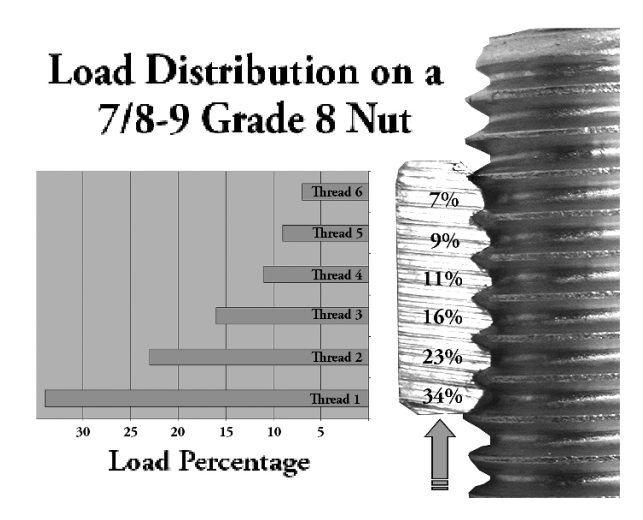
Also keep in mind that the load capability of a threaded fastener suffers from rapidly diminishing returns with increased depth of engagement. This diagram is for one particular case, but it's similar for any Unified or metric thread when both components are made of the same material.
View attachment 5093420
You only have to overload the first thread, then when it fails it increases the load on the next thread, and so on, and the whole thing strips progressively. Adding more threads beyond the first 5-6 doesn't do much to reduce the load on the first thread, so it doesn't much increase the overall load capacity. If it was going to strip before, it will probably still strip, just take longer to do it.
The load distribution might be a bit better in this case with a steel screw going into a brass internal thread. As the brass starts to yield, it probably spreads the load from the screw over a larger number of threads. Still, diminishing returns.
You'd get more capacity by adding a steel thread insert (if there were room) or changing the whole block to steel.
This is true, but keep in mind that the diagram if for a bolt tightened to it's max specified torque. In the situation we are discussing here the bolt will never see that high tension because the bolt is effectively pulling against the string. An M3 8.8 bolt is rated at about 2900N (About 1100N for a 4.6 M3 bolt). A bass string is more or less worst case 200N. (unless you use 2,5mm steel rods as strings
 )
)The thought about having more threads is more about wear resistance. It may not be needed but it won't hurt anything.

This is true, but keep in mind that the diagram if for a bolt tightened to it's max specified torque. In the situation we are discussing here the bolt will never see that high tension because the bolt is effectively pulling against the string. An M3 8.8 bolt is rated at about 2900N (About 1100N for a 4.6 M3 bolt). A bass string is more or less worst case 200N. (unless you use 2,5mm steel rods as strings
The thought about having more threads is more about wear resistance. It may not be needed but it won't hurt anything.
This is good info! I was a bit worried about the pivot point, but I'm pretty sure even with the small bearing surface, the design should be well within the 165MPa compression strength of brass.

FWIW, this is / was a good source for threaded rod: Threaded Rod Hangers for Wood | The Nutty Company, Inc. I used them eons ago when repairing Steinberger bridges.
Riis
Riis
I was aware of all the theoretical data about the threads, and yet, there I was looking at a bunch of threads pulled out of my brass block after just a few load cycles of 210 N. I guess I could have calculated the theoretical pressure on the threads and all, but if it doesn't work in the real world then all the theory doesn't matter.
My idea on longer thread depth was somewhat about the brass deflecting and thus distributing the load, but also that I had started with only enough turns on the screw to engage it in the brass block. String tension began right after that, probably the 2nd or 3rd turn. That meant all the initial load was on the first few threads. I did this intentionally as a worst case test, but it is entirely possible a user could do what I did.
My idea on longer thread depth was somewhat about the brass deflecting and thus distributing the load, but also that I had started with only enough turns on the screw to engage it in the brass block. String tension began right after that, probably the 2nd or 3rd turn. That meant all the initial load was on the first few threads. I did this intentionally as a worst case test, but it is entirely possible a user could do what I did.
On my turnbuckle tuners, it takes about 19mm to get up to pitch. That's at a higher tension with longer strings but it still takes 12-14 mm to get to standard tensions. Those are 1/4-20 and plenty fine adjustment wise.
Yes, that's about what I've seen too. If you take a 35" scale bass string and clamp the other end down solidly, you'll have to pull the ball end back about a half inch to bring it up to tune from slack. That's how much a string stretches. You really should allow for 3/4" of linear travel in a headless tuner mechanism.
I must be using very non-stretchy strings because all of the 34" scale strings I have tried have gone from slack to pitch in well under 10 mm, typically around 7 mm. 19 mm (3/4") is a lot of travel, though definitely safe.
I must be using very non-stretchy strings because all of the 34" scale strings I have tried have gone from slack to pitch in well under 10 mm, typically around 7 mm. 19 mm (3/4") is a lot of travel, though definitely safe.
My numbers are with stiff flatwounds, D'Addario Chromes and LaBellas, at 35" scale.
Yes, it's a fair point about the bolt not being near its limit, so it won't be stretching very much. On the other hand, the female thread in brass is very definitely near (or beyond) its limit, so that component will deform, which I think will cause the same effect of diminishing returns with additional threads. I could well be wrong, though.This is true, but keep in mind that the diagram if for a bolt tightened to it's max specified torque. In the situation we are discussing here the bolt will never see that high tension because the bolt is effectively pulling against the string. An M3 8.8 bolt is rated at about 2900N (About 1100N for a 4.6 M3 bolt). A bass string is more or less worst case 200N. (unless you use 2,5mm steel rods as strings
The thought about having more threads is more about wear resistance. It may not be needed but it won't hurt anything.
But we are definitely talking about failing the threads in the brass block, as @Jeff Siddall's excellent test demonstrated recently.
Mine are a little different then a standard bass. 48" long, 45" scale, .180 diameter tuned up to G0 for about 75lbs of tension. I would allow for atleast 16mm of travel for tuning for a standard bass.I must be using very non-stretchy strings because all of the 34" scale strings I have tried have gone from slack to pitch in well under 10 mm, typically around 7 mm. 19 mm (3/4") is a lot of travel, though definitely safe.


