• TalkBass has been independent since 1998. Add your voice.
    Create a free account to reply to discussions, view embedded media, and browse with fewer display ads.
    Join freeLog in
    Want zero display ads or expanded classifieds tools? Compare plans.

Do basses raise in value or drop value as they get older?

How long? What bass? What's the general economy doing during the time? Does "increase in value" mean worth more dollars or worth more buying power? So many variables.

In general, five years isn't enough to make any bass more valuable than it was new. But it depends on a lot of factors. Did the company go out of business but that particular bass is highly sought after? Were there major changes in construction (and it's immaterial whether the changes are good, bad, or neutral- the market will make decisions based things other than facts as often as not), etc.

The market values '70s Fender much more highly than a lot of people who bought and sold them in the '70s might value them. My Fullerton-era VS '62 P is worth a lot more than I paid for it in 1983 (at least in dollars- but not likely in real buying power). But a five year old VS '62 P is worth less than what it cost to buy new in 2006.

John

 
I don't think the tone actually improves with age as much as the OP is hoping for. Like one of the posters alluded to...you keep the one that feels good to you. Btw, it's amazing how much better a pre-aged instrument 'feels' with a bit of 'applied mojo'. If playing it makes others feel good too--you've got yourself a keeper.
 
Buying any instrument as an investment is a fool's errand, IMO.

If you want to not lose money, then buy used, care for it well and hope the marketplace swings favorably.

Even a bought-new boutique bass would usually* take many many many many years just to appreciate in value to the amount you paid for it.

*I'm sure there are exceptions, but I'm also sure they're few and far-between.

There most definitely are exceptions so saying "any instrument" is a large and imprecise brush.
:cool:

For example I've bought plenty of basses that were worth far more than I paid for them at the time. Still are. That's a good investment. Matter of fact my bass purchases are seriously outperforming my 401k's... and I get to play them.
 
Yeah I am not really concerned with selling the bass, my intention is to have a bass which I will keep for as long as I can. I guess I feel that I want to finally own a bass which will be with me forever :p. I feel my real question is if the aging of wood in an electric bass will change the sound of the instrument (more mature, settled..etc having a hard time trying to think of the words to use.

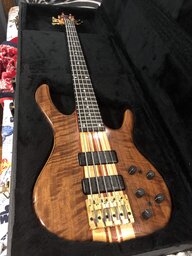
That kind of "investment" could be met with just about any bass that you

A. Like and
B. take care of


It can be that simple. Heck, it could be a nice Squier.
:cool:
 
Total crap shoot. Depends on how many were made and how much people want them. When Wal stopped, the value eventually got pretty high. Peavey Millennium was only made for a few years before it was canned and they're still worth much less than they sold for.

I wouldn't say total. For example, if you found a bass that's currently collectible for a well below market price, that'll probably be a good investment. The same with many of the more sought after high end basses. I'd be willing to bet that my Fodera Anthony Jackson Contrabass will continue to be a very good investment into the future considering what I have into it. Granted, if everyone who loved Foderas stopped loving them that could have an impact but I'd also bet against that happening anytime soon.

Knowledge of the market can give the buyer a big leg up. By the same token buying something with no market knowledge would be a huge crapshoot. And be realistic and don't let your feelings about an instrument distort your view of reality. You may love a high end bass that flopped on the market but who else will? You may hate brands with better track records but you're not going to be the one it gets resold to.
 
It just depend from the bass, how are his condition and especially how they sound, not all bass become more valuable during years and especially not after 5 years, you need at least 30 years...
Cheers. Enrico
YouTube
WebSite

Condition, yes. Sound, usually no.

BTW to be a good investment I don't think a bass has to be worth more than it's cost new. It should be worth appreciably more than you paid for it.
:D
 
It really depends on the brand. Old Fenders and Rickenbackers usually increase in value as they get older. Many boutique basses such as Alembic, Pedulla, Zon and other do not seem to hold up as well. For example, In 1970, you could buy a new Fender Precision or Jazz for around $300. Now they sell used for several thousand dollars. A new Alembic Epic costs $5,800. I bought a 17 year old Epic for $1,200 and have seen many selling for under $2,000.
 
The best thing you can do, IMO, is buy a used boutique bass. Do your research, make sure you follow the old Wall Street principle, BUY LOW, SELL HIGH. So buy something that you feel is a a bargain or a really good deal and more often than not the instrument will net you your initial cash outlay.

On face value, that may appear as breaking even but if you hold on to an instrument for say 10 years you will technically have made some money if you were to adjust for inflation.

I know boring stuff but that's the accountant in me!
 
I wouldn't say total. For example, if you found a bass that's currently collectible for a well below market price, that'll probably be a good investment. The same with many of the more sought after high end basses. I'd be willing to bet that my Fodera Anthony Jackson Contrabass will continue to be a very good investment into the future considering what I have into it. Granted, if everyone who loved Foderas stopped loving them that could have an impact but I'd also bet against that happening anytime soon.

Knowledge of the market can give the buyer a big leg up. By the same token buying something with no market knowledge would be a huge crapshoot. And be realistic and don't let your feelings about an instrument distort your view of reality. You may love a high end bass that flopped on the market but who else will? You may hate brands with better track records but you're not going to be the one it gets resold to.

The basses that go up in value have some sort of iconic value.

I've got a 1980 Ibanez Musician which is a phenomenal instrument but no way does it compete as an investment against Fenders or Ricks. I bought it about the same time I sold a Rickenbacker 4000 (early 80s) for about the same price. Now the Rick would sell for 2-3 times as much. Both awesome instruments, worthy to share a stage.

I'm told there was a time when Ricks were out of fashion and you could just about get one free with a box of breakfast cereal. Maybe the Ibanez is there now, and will appreciate one day. They certainly appeared on enough iconic recordings in the 1980s. Maybe your Fodera will appreciate and maybe not, but I don't know how you would pick it.

Meantime I have a flawless bass that I love playing, and having owned it for almost 30 years, I know that it was always good. It has not improved with age.
 
The basses that go up in value have some sort of iconic value.

I've got a 1980 Ibanez Musician which is a phenomenal instrument but no way does it compete as an investment against Fenders or Ricks. I bought it about the same time I sold a Rickenbacker 4000 (early 80s). Now the Rick would sell for 2-3 times as much. Both awesome instruments, worthy to share a stage.

I'm told there was a time when Ricks were out of fashion and you could just about get one free with a box of breakfast cereal. Maybe the Ibanez is there now, and will appreciate one day. They certainly appeared on enough iconic recordings in the 1980s.

Meantime I have a flawless bass that I love playing, and having owned it for almost 30 years, I know that it was always good. It has not improved with age.

There's a shop in the area that's had an early Musician since the 80's, supposedly belonged to Stanley Clarke. Been trying to get $2500 for it since the 80's.

My Howlin' Wolf Kay shot up in value later on because Sheryl Crowe played one. Prior to that they were a dime a dozen. That's how fickle this stuff is. Mine was identical to this, I bought it for $75 in a pawnshop.
KAY PRO HOWLIN WOLF THIN TWIN BASS GUITAR VINTAGE 50'S | eBay

Heck, that might be mine. I sold it for no particular reason a few years later for $250. I don't do stuff like that anymore.
:rolleyes:

Overall, in the spirit of what the OP's really after, just find something you like and play the snot out of it. That'll be a great investment.
 
As an eBay Associate, TalkBass may earn a commission from qualifying purchases.
I'm not going to add anything here. Just wanted to say that I love that the OP has clarified his question not once, but twice, saying that it was poorly phrased and he really isn't asking about monetary value of basses - he's interested in tone changes as the wood ages.

And 90% of the posts are still about cash value of old basses.

Carry on gentlemen, carry on. :)
 
I'm not going to add anything here. Just wanted to say that I love that the OP has clarified his question not once, but twice, saying that it was poorly phrased and he really isn't asking about monetary value of basses - he's interested in tone changes as the wood ages.

And 90% of the posts are still about cash value of old basses.

Carry on gentlemen, carry on. :)

Haha yeah, its ok, good info is good info.
 
The reality is this: When you go into GC and approach the counter with a new bass in one hand and your card in the other, you're getting ready to immediately lose at least 1/3 of the instrument's value. It's harsh but true. You could do absolutely nothing to the bass and it still will be worth less than you paid for it before your receipt has finished printing.

Many basses will become less valuable over time, even if their sound improves. I think the old Peavey T-basses are good examples of this. They're simply not in high demand.

Even Fenders have to be roughly 25-30 years old before they start regaining value, and a lot of that I suspect has to do with image more so than sound.

Absolutely. I was talking to a salesman in the local GC about just that very thing. He says their biggest competitor for the value of the instrument/gear you're trying to trade in is, you guessed it, ebay.

What GC does when you try to trade-in is they pull up the item on ebay to see what it's selling for and then offer you 60% of the value of what it's currently selling for. I recently brought in a guitar that I have that I never play (have actually plugged it in 3 times) just to see what the trade in value was and the guy told me that I don't want to trade it in because he wouldn't give me anywhere near what it's worth. He actually recommended that I sell it on craigslist to make more money off of it.

As to getting better with age, a lot of it has to do with the preference of the buyer, the rarity of the instrument, the model and year, and the actual condition it's in. Lot's of guys love old Fenders, especially the ones that look like they are road-worn or "relic'd"

To me, a beat up old bass with wood showing through the finish, a discolored fretboard, dents and dings, etc looks like the guy didn't take care of it. To me "relic'd" = abused. I know lots of guys like that look, but I find it even more strange that people would actually buy a new instrument that was "factory relic'd" and pay more for it!

I understand that even if you are very careful with your gear, if you're a gigging musician, dents and dings happen, but I'm not going to pay extra for it! ;)
 
As to getting better with age, a lot of it has to do with the preference of the buyer, the rarity of the instrument, the model and year, and the actual condition it's in. Lot's of guys love old Fenders, especially the ones that look like they are road-worn or "relic'd"

To me, a beat up old bass with wood showing through the finish, a discolored fretboard, dents and dings, etc looks like the guy didn't take care of it. To me "relic'd" = abused. I know lots of guys like that look, but I find it even more strange that people would actually buy a new instrument that was "factory relic'd" and pay more for it!

I understand that even if you are very careful with your gear, if you're a gigging musician, dents and dings happen, but I'm not going to pay extra for it! ;)

Yeah I agree with that, I never knew why those "roadworn" fenders cost so much (like the Jaco replica). I think of it like a car, Old cars are great but not if they have scratches and dents.
 
I feel my real question is if the aging of wood in an electric bass will change the sound of the instrument (more mature, settled..etc having a hard time trying to think of the words to use.

You need to rephrase your question. Raising or dropping in "value" means price.


And no, the tone of an electric bass doesn't change over the years. The hearing of the human being playing it does, but the tone doesn't. Unless you have the hearing of an owl.
 
I'm not going to add anything here. Just wanted to say that I love that the OP has clarified his question not once, but twice, saying that it was poorly phrased and he really isn't asking about monetary value of basses - he's interested in tone changes as the wood ages.

And 90% of the posts are still about cash value of old basses.

Carry on gentlemen, carry on. :)

It's like the OP posted the question "Ash or alder for a Jazz bass?", and then halfway down the first page said "What I really meant is 'How do I adjust the pickup height on a Rickenbacker?'"
 
+1 to most of the above. The only basses that increase in value over time seem to be the very early Fender models. This has MUCH more to do with emotion (they were the first production models of an entire category), and there are a zillion baby boomers who relate to those instruments as one of the driving factors of the music they grew up with. A unique 'coming together' of an invention (Leo's P Bass) that literally had a direct impact in changing/creating the music that a huge generation of kids grew up with. This situation is multiplied by the classic story of the founder being bought out by a large company that didn't manage the brand very well relatively early on in the product's life cycle. It also helps that the boomers are now old, and many have plenty of money to indulge their love of all things 50's-60's (depending on where you are on the baby boomer age continuum).

The idea of aging wood or whatever is IMO myth and emotion, which is more of a result of the above than an actual driver of value.

Nothing like that over the last 30 years, and given that 'real' instruments are relatively unimportant in today's big hits, it probably will never happen again.

The vast majority of basses will have their value/price drop like a rock.
 

Latest posts