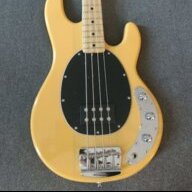
That's amazing. Do you leave the audio cable plugged in the bass?My Fender jazz deluxe V active uses 2 x 9v batteries, and it gets regular gig use, the batteries last at least 3 years.
I use alkaline Duracells or Energizers.

Enjoy the benefits of a premium membership!
Upgrade Account
-
TalkBass has been independent since 1998. Add your voice.
Create a free account to reply to discussions, view embedded media, and browse with fewer display ads.
Join free Log in
Want zero display ads or expanded classifieds tools? Compare plans.
You are using an out of date browser. It may not display this or other websites correctly.
You should upgrade or use an alternative browser.
You should upgrade or use an alternative browser.
Do I need new batteries on my active bass?
- Thread starter Mtoklitz22
- Start date
More options
Who Replied?
From sound check to the end of the gig, yes.That's amazing. Do you leave the audio cable plugged in the bass?
Then it is unplugged the rest of the time (in it's case).
Do you think inserting and removing the cable a lot of times will worn out the plug on the bass?From sound check to the end of the gig, yes.
Then it is unplugged the rest of the time (in it's case).

Do you think inserting and removing the cable a lot of times will worn out the plug on the bass?
Corrosion will eventually occur. It's more likely to happen if you leave a cable plugged in even into a passive bass. But it happens from regular usage too. I would be more worried about it happening with a cable that stays plugged in all the time rather than only when in use however.
I just had to scrap off some corrosion on the input jack of my P-bass. Got what I could with contact cleaner then my dad took a knife very lightly to it and scraped off the rest of the discoloration. Works like a charm now.
What happened in my case, was I would have to wiggle cable end a bit sometimes to get a signal from my bass..
Thankfully, they're not too difficult to clean and not to expensive to replace if you mess up somehow or just can't get the corrosion off.

The recording sounds more-or-less normal to my ears, but it does sound like you have the treble (and possibly the bass) boosted WAY up. Is this your first active bass? Active EQ works differently than a passive tone control. Try setting your EQ knobs to the "middle" position and see if that's better.
Under normal use (like you're doing), batteries should last for months.
Under normal use (like you're doing), batteries should last for months.
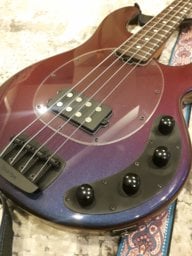
Use a MM to check continuity between the output jack 'ring' and your shielding or ground. If the ring has been sent to ground by accident with your new shielding install, it will complete the circuit and act as if a cable is plugged in, effectively draining your battery.
OK thanks, I just checked with a MM and it appears there is continuity between the ring of the output jack and the shielding. I currently have the conducting shielding paint soldered to the back of the volume know as I was under the impression the shielding was supposed to be grounded to a pot. How should I resolve this? Would it be recommended to just remove that ground from the paint to the volume pot? If so, would that render the shielding ineffective?

OK thanks, I just checked with a MM and it appears there is continuity between the ring of the output jack and the shielding. I currently have the conducting shielding paint soldered to the back of the volume know as I was under the impression the shielding was supposed to be grounded to a pot. How should I resolve this? Would it be recommended to just remove that ground from the paint to the volume pot? If so, would that render the shielding ineffective?
Well thats good news! Nah, leave your shielding grounded. It's necessary. It's just a matter of a little detective work now. You'll now have find out why the ring is grounded. Inspect, test...inspect ..test. The wire connected to the output 'ring' lug (or the battery ground wire from the battery) is somehow touching the guitars ground, or the new shielding (which is grounded). Find that lead/connection and make sure it is no longer in contact with ground. Test for continuity again and then get back to some music!
Well thats good news! Nah, leave your shielding grounded. It's necessary. It's just a matter of a little detective work now. You'll now have find out why the ring is grounded. Inspect, test...inspect ..test. The wire connected to the output 'ring' lug (or the battery ground wire from the battery) is somehow touching the guitars ground, or the new shielding (which is grounded). Find that lead/connection and make sure it is no longer in contact with ground. Test for continuity again and then get back to some music!
OK thanks again, I'll check it out and see if I can find the problem.

Wow, what is that tune you are playing?
Get a passive bass.....you won't need no stinkin' batteries!
There it is. The ever-helpful "passive" suggestion...
Took longer than usual, but I knew we wouldn't be disappointed...


When I started gigging active basses, it never even occurred to me *not* to have a spare battery with me. And I did need it once, in the middle of a set - see previous post about different circuits failing differently. I was used to a circuit that gradually descended into tone suckage as the battery drained. But some act pretty normal up to the point where they start self-oscillating.
Yup. I found out the same way. My first active bass was a Warwick Corvette $$ and that thing started to distort, at first gently, over several hours, before becoming unusable and squealing etc. I assumed they were all the same... then one died on me, at home. Since then, I just replace the batteries once a year and stop worrying, but I still carry spare batteries (and strings, and a strap, and cables, and...) just in case.
Once I broke my G string (stop sniggering at the back!
 ) on a slap-heavy song, so I limped through the song the best I could and went to change my string (I very rarely take spare basses for easy going bar gigs). It takes me... what, a couple of minutes between the end of the song and my being ready to play again? Meanwhile the band launched into a funky jam, with the singer making up lyrics joking about my G string... the audience loved it, and I laughed too... but boy, I was happy when it stopped

I've an active jazz bass that runs on two 9v batteries. I recently changed my batteries, that is on august 1st week 2020. I practice approx. 45 mins everyday. In that ime, I'll have the preamp on for 10-15 mins. My bass is sounding like this now. Should I change the batteries?
I handle and maintain my bass very carefully. Is everything alright with the electronic part of my bass?
Do let know guys. Thanks!
Edit: I DO NOT LEAVE MY BASS PLUGGED IN. I ALWAYS UNPLUG MY BASS AFTER USING.
The power depletion may depend on how much gain or EQ boost you are using. Just a guess.

Maybe, but I'd be surprised. Standby power should be pretty constant, regardless of gain settings, and if there's no input signal being amplified, the amplifier shouldn't be consuming any additional energy.The power depletion may depend on how much gain or EQ boost you are using. Just a guess.
The power depletion may depend on how much gain or EQ boost you are using. Just a guess.
Doesn't matter if you are flat,cut or boosted, consumption will remain very consistent at the preamp. I did speak to David Meadows (Audere) about this and the biggest battery / consumption - pull from the onboard pres will be from the amplifiers input and the impedance or load it needs to drive (As well as low end frequencies on the amps side if they are maxed). The 'extra' consumption from driving low impedance inputs is still too low to be significant, but it's there. [/QUOTE]


