• TalkBass has been independent since 1998. Add your voice.
    Create a free account to reply to discussions, view embedded media, and browse with fewer display ads.
    Join freeLog in
    Want zero display ads or expanded classifieds tools? Compare plans.

Does a backline bass rig cancel frequencies in the PA?

That's not how it works.

The cancellation increases as the phase angle between the two signals approaches 180 degrees. Likewise mutual summing increases as the phase angle approaches 0 degrees.

Cancellation and summing is reduced when the signal levels are not equal, but they do not stop completely.
It's math, and it's exactly how the basic principal works. That's why I said when frequency and amplitude are the same. Any frequency cannot cancel out another.
 
You can see what happens simply from having two identical-program subwoofers spaced apart in front of the stage, as shown in the "typical" plot (I don't know the exact frequency) below. In contrast, a well-considered subwoofer system will consist of an "array" of a cluster of units that is set up (via specific phase/delay adjustments) to produce, as a group, the most linear response possible.

This is why, when used in conjunction with a subwoofer array, an operating bass amp on stage will cause a similar effect to the separated subwoofers described above. The effect is mitigated if the volume of the bass rig is substantially lower than the FOH subs.

One of the primary goals should be to produce even low-end response everywhere in the room. A loud rig competing with FOH works against that.

PSW2014SubsFigure_2.jpg
 
Last edited:
  • Like
Reactions: Wasnex and SoCal80s
Yes, it does - to some extent. I have a degree in Acoustical Physics, this is not a debatable thing, it's simply established scientific fact. The bass amp is the absolute worst offender, as the wavelengths involved are pretty long.

A well setup PA (there is always some compromise) can give you good coverage in an audience, with everyone hearing pretty much the same thing. Every additional low frequency source (your bass amp) is an uncontrolled variable, which makes the situation worse. Maybe not a lot worse, but it's there.

If you are playing arenas or stadiums (stadia, technically), and the PA rig has gobs of subs, then you can probably get away with an amp. Of course, if you're playing behind a pop singer, they won't let you have one. So there may be a half dozen folks on here that fit this category, where a bass amp is fine. The rest of us, not so much.

If you're playing a small club (hundreds of people capacity, not thousands), your bass amp is almost certainly making things worse.

If you're playing really small places, and the bas amp is the ONLY source of low frequency sound, it can work, but that is a crapshoot as to the results. And there, you have to turn down if the sound person tells you to.

I play places from club sized (a few hundred capacity) to large theater sized (7000+ seats), and I play ampless all the time now. The folks at FOH love this, regardless of the size of the place.

There is a learning curve to IEM's - yes, it takes some work to figure out what to do with them. In the end, though, if you do the work, you hear everything (especially yourself) much better than you ever will with an amp and wedges.
 
Last edited:
In excessive stage volume + FOH situations where the acoustics are especially compromising, it is possible to experience some pitch movement in a room?

The acoustics of a room don't affect pitch. But there may be other explanations. The reverberations in a room from loud amps could cause clashing notes to ring out at the same time. Upper harmonics have many notes that are 1/2 steps or less apart, so if the room resonates certain high frequencies more you could be hearing them clashing more than normal. Motion affects pitch, so if there's a big mosh pit swirling around, that's possible (but not likely).
 
  • Like
Reactions: Wasnex
The acoustics of a room don't affect pitch. But there may be other explanations.

Pitch is strongly affected by the volume hitting your ears (this is Psychoacoustics 101 stuff) - you hear high notes as higher than they really are when things are loud. Sopranos in a choir (hearing their high pitched voices in their heads) tend to sing flat because of this, and if the rest of the choir follows them, an a cappella section can go very flat quickly. Singers in rock bands have the same situation, except that the band doesn't follow them. You want your singer to sing on pitch? Put them on in ears, and work on getting them a mix that isn't too loud.
 
I have an anecdote and a question for @Wasnex and anyone else with experience to answer.

There's a live music room in Denver that makes a great exhibit for this discussion. The place is called Herb's Bar; the room is deep and narrow like a lot of bars are in older buildings. This one may be narrower than most, I bet 20 feet wide.

The stage is in the back and it fires crossways across the narrow dimension, and the opposing wall has floor to ceiling mirrors. There is a house PA in there and the whole situation gets painfully loud. Miserable acoustics.

My anecdote is that I've played in that room in all sorts of situations, ranging from one with a guitarist who had a Vox tube amp and needed to crank it to ear-splitting levels to get "his tone" - all the way to an all-IEM, no stage volume approach.

For sure, the IEM approach is a revelation in that room. I leave the gigs without my head spinning and clearly it sounds better to the audience in there. In fact my comparison experience between IEM and stage volume in that particular room is what won me over to IEMs overall.

My question - several times when I've played that room with amps, I'm sure I've noticed a certain distortion of pitch in the room. There have been nights where I or one of the other guys have sounded just a little out of tune in there, despite objective proof to the contrary.

In excessive stage volume + FOH situations where the acoustics are especially compromising, it is possible to experience some pitch movement in a room?


AFAIK there is no actual pitch shift with indirect sound. There are possible explanations though.
1. Pitch perception actually changes a bit with SPL. In other words, although the pitch stays the same, the way you perceive it changes.
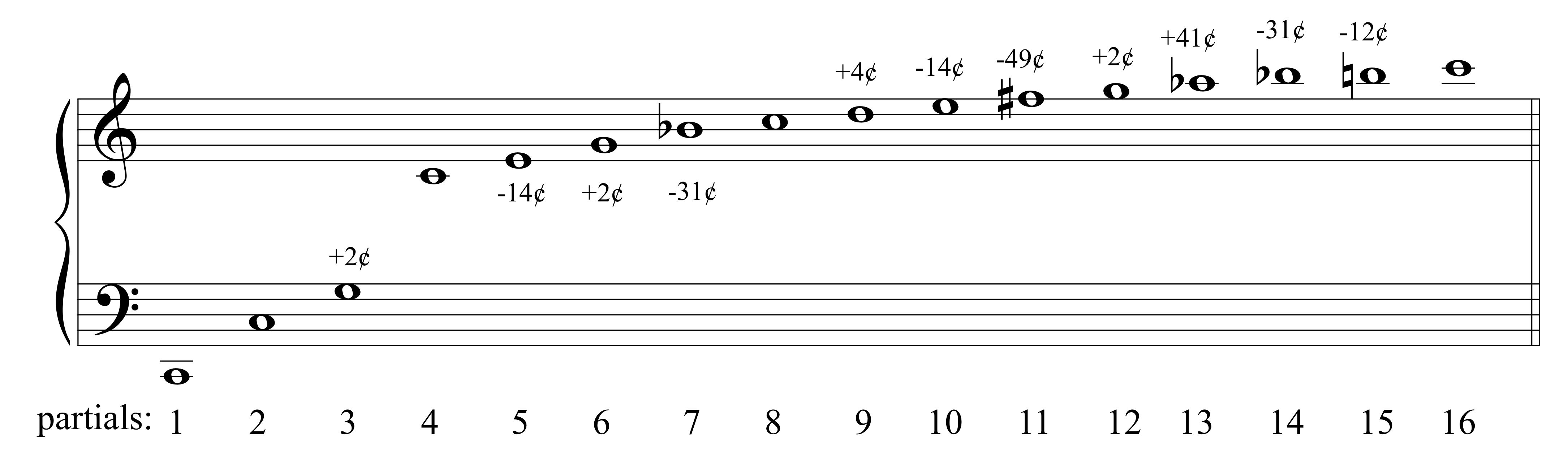
2. Different harmonics are sharp or flat to some degree. So if there is a build up of a harmonic that is significantly out of tune, it may clash with a chord tone that the guitar or keyboardist is playing. Or it may clash with a harmonic of a tone the guitar or keyboardist is playing.
basicovertoneseries.jpg


3. There may actually be significant variances in how instruments are tuned and tempered. Keyboards are probably fairly close to equal temperament but I don't think the tempering of fretted instruments like guitar or bass is super accurate, so they tend to be out of temper to some degree. Also the strings don't stay perfectly in tune while you play. Technique can pull a note out of tune or the string may go out tune over time. The reflected sound may just make the intonation problems easier to perceive. Chances are you will hear some tempering problems in a dry room as well.
4. The guitar are keyboard may be using an effect that shifts pitch. For example, chorus.
 
It's math, and it's exactly how the basic principal works. That's why I said when frequency and amplitude are the same. Any frequency cannot cancel out another.

I didn't say anything about different frequencies cancelling.

Comb filtering results from variation in the amount of cancellation and summation. It's not all or nothing (only) at 0 degrees and 180 degrees.

Wavelength varies with frequency, but the location and spacing between the sound sources remains constant. So the level at a given frequency varies incrementally across the dispersion pattern (depending upon the phase angle). Max summation occurs at 0 degrees, 360 degrees, 720 degree etc. Max cancellation occurs at 180 degrees, 540 degrees, 900 degrees, etc. Intermediate amounts of summation or cancellation occur at other phase angles. AFAIK at 120 and 240 degrees (+ multiples of 360), there is no summation or cancellation.
upload_2023-2-10_13-19-17.png

Ref: Invalid Link Removed

upload_2023-2-10_12-13-38.png

I don't believe this image accounts for the drop off of SPL that occurs with distance.

But, I believe this one does:
upload_2023-2-10_12-51-26.png

The spacing is 8m and the Lambda (wavelength) of 100hz is 3.43m. 8/3.43 = ~2.33.
The spacing to wavelength relationship for the top image is 5/2 Lamba = 2.5. Not exact...but relatively close.​

Same spacing VS wavelength relationship at 100hz (8m spacing and 3.42m Lambda 8/3.43 = ~2.33):
upload_2023-2-10_12-46-17.png
 
Last edited:
  • Like
Reactions: Thebiggestjerk
I posted recently regarding my sound guy not putting enough bass through the PA, based on what's been said in the posting above so far, is having a loud on-stage bass volume going to work if he isn't prepared to put more bass through the mix?

If the sound guy isn't putting enough bass through the front of house, then turning up your amp is only going to achieve three things:
a) pissing him off
b) making him turn you down further
c) messing up the FOH sound

Like when a guitarist is loud, so you turn up to match... so he turns up. He's balancing the sound the way he wants it, and if you don't like the way he does it, the only way to fix it is to have a conversation about it. Not by starting a war.

Trust your sound guy. Give him the signal he needs from you. Do your job. Let him do his. If you don't think he's doing the job properly, then find out if other stakeholders agree with you. If they do, then get him to fix it, and ultimately replace him. Otherwise chill out and play bass.
 
  • Like
Reactions: SoCal80s and Wasnex
But what's the prevailing wisdom for a small club (100-200) people where the crowd is pressed up against the stage, and the band is using IEMs?

If there are no amps, side fills, or monitors on the stage, what will the first 5 rows of people hear? Won't it all just be bass from the subs, or the sound of the PA bouncing off the back wall of the club?

Legit issue... but consider the alternative of big amps on stage. You've got exactly the same situation but reversed. The crowd in the PA dead spot still can't hear the PA, but they're getting the guitar amp straight at their head.

I've been to MANY small gigs where all I could hear was the guitar.
 
If the sound guy isn't putting enough bass through the front of house, then turning up your amp is only going to achieve three things:
a) pissing him off
b) making him turn you down further
c) messing up the FOH sound

Like when a guitarist is loud, so you turn up to match... so he turns up. He's balancing the sound the way he wants it, and if you don't like the way he does it, the only way to fix it is to have a conversation about it. Not by starting a war.

Trust your sound guy. Give him the signal he needs from you. Do your job. Let him do his. If you don't think he's doing the job properly, then find out if other stakeholders agree with you. If they do, then get him to fix it, and ultimately replace him. Otherwise chill out and play bass.

Thanks for your reply.

Yes, as you say it is all about trusting in that the sound guy will get your sound out there, however recently on 3 occasions people in the audience have said they can't hear the bass, and 1 guy went directly to the sound guy and told him.

I hear what you are saying about turning up my backline amp and possibly messing things up, but at least turning my amp (should) get my bass out there. Yes he may have to take the bass completely out of FOH but we don't play very big places so my on stage sound I'm sure would suffice.

We all use IEM's so I'm always going to hear my bass personally, but it defeats the object if no one in the audience can hear!
 
Thanks for your reply.

Yes, as you say it is all about trusting in that the sound guy will get your sound out there, however recently on 3 occasions people in the audience have said they can't hear the bass, and 1 guy went directly to the sound guy and told him.

I hear what you are saying about turning up my backline amp and possibly messing things up, but at least turning my amp (should) get my bass out there. Yes he may have to take the bass completely out of FOH but we don't play very big places so my on stage sound I'm sure would suffice.

We all use IEM's so I'm always going to hear my bass personally, but it defeats the object if no one in the audience can hear!

IMHO trust but verify. However, verify is not the same as taking the word of a few random audience members. Some audience members may think the bass is too soft, and some may think it is too loud as well. You can't make everyone happy.

The balance of a mix is entirely subjective. If you had everyone in your band create their idea of a perfect mix, most likely each mix would sound a bit different. My point is there may be no problem with the way your current audio tech mixes other than some people like more bass.

The other issue is there may be a reason why the audio tech runs the bass a bit low in that venue. IMHO the priority in a mix is generally vocals and melodic elements of the song. The bass is important, but it's not a top priority. In the event the bass is masking the melody and vocals, often the only things the audio tech can do is start pulling the bass out of the system or turn the rest of the mix up. If the bass player has his/her amp cranked too high, the only option for the audio tech is to make everything else louder, and often that is not desirable.

There are times when a loud mix is acceptable and even desirable, but I think most bands probably play louder than the both the audience and patron actually want.

In the event everyone in the band agrees the mix is lacking, have a conversation with the audio tech. There may be a valid reason or the audio tech may simply have a different artistic vision of what the band should sound like. If it's the latter, find a new audio tech who shares your artistic vision.

My Experience:​
I rarely took subs on tours because I could not mix loud enough for them to be beneficial. At the level I typically ran shows, putting the bass in the subs almost always made the sound worse. So no need for subs.

Most of my mixing time was running sound for concert bands and big bands.
Our audiences were mostly middle-aged or older, and they were not shy about complaining that the mix was too loud. They did not always wait till the end of the show.

At the end of sound check, I usually cranked the system up to make sure I had plenty of gain before feedback. What I found was that I could get a much tighter and more focused bass sound by running the system (with subs) about 6-10dB louder than I normally ran it.

In our case, it was not always the bass amp causing problems. We also ran the bass through the monitors, and the musicians wanted so much bass that it was problematic. I brought this to the attention of the group leaders, who almost always chose to prioritize the musicians needs. It wasn't really all that much of a problem, as people are used to hearing crappy bass live, but I wasn't real happy about it.

I guess I must have been doing something right as audience members regularly thanked me after the show and specifically expressed appreciation that I kept the volume at a reasonable level.
 
27224623[/URL], member: 113976"]I posted recently regarding my sound guy not putting enough bass through the PA, based on what's been said in the posting above so far, is having a loud on-stage bass volume going to work if he isn't prepared to put more bass through the mix?

That's a sure fire recipe for getting yourself turned off completely in the PA. Second guessing the person doing FOH and blasting away with your own rig is also a good way to never get called back.

Doing your part well and trusting FOH to do theirs well is the way to get yourself heard. If you're on stage, you have no way to judge if the mix is good in the audience - your ears are in the wrong place to make that judgement.
 
Last edited: