• TalkBass has been independent since 1998. Add your voice.
    Create a free account to reply to discussions, view embedded media, and browse with fewer display ads.
    Join freeLog in
    Want zero display ads or expanded classifieds tools? Compare plans.

Does a backline bass rig cancel frequencies in the PA?

Mine sure used to. (2x15 and 2x18):

18s-jpg.1700991
 
Our PA is RCF HD32a's with one RCF 8003as sub. The amp is the Markbass CMD112P. If this amp is used as a monitor on stage, will it cause frequency cancellations due phase/delay issues with the PA? I frequently hear about issues with multiple subs but never with a backline bass amp.

Thank you, Scott
Probably not, unless your PA is too small - which is a different issue.
One would probably only notice at the nodes anyway..
IOW- nobody but the most trained ear will be able to tell!
 
Yes. Every speaker adding sound will add some cancellations, to the extent that it is projecting into the audience. Lower volume will interfere less. However, you always have some frequencies cancelling in FOH due the FOH speakers themselves, the acoustics of the room, etc. The FOH engineer can and should try to compensate for the effect of the bass amp, but the lower you keep your amp volume the less he has to work to try to compensate.
 
Yes, the sound from your bass amp will interact with the sound from the PA. The result will be comb filtering. In some places the soundwaves will cancel and it other places the soundwaves will sum resulting in peaks.

The problem is mitigated if the PA is significantly louder out in the audience than your amp. So having your amp set back from the frontline can help mitigate problem. With a point source, SPL drops off by 6dB for each doubling of distance. Let's assume you amp is putting out 118dB at 1 meter. At 2 meters the SPL will have dropped off by 6dB (112dB). At 4 meters the SPL is down another 6dB to 106dB.

Ideally you run your amp at a reasonable volume so the PA can dominate the room. Frequently this does not occur, so either you get crappy sounding bass or the audio tech runs the mix hot enough so the PA dominates. This is a recipe for pushing very high SPL into the room. As an audio tech, I frequently accepted crappy bass rather than cranking the volume of the PA too high. If the bass amp is too loud, sometimes the best solution is to pull it completely out of the PA...and unfortunately this is not a great recipe for delivering great bass to the audience.

As a bass player, I usually elevate my speaker and aim it at my head. This allows me to monitor at the lowest possible volume, so my rig fights less with the PA. Unfortunately, if you like big pillowy lows, this approach will not satisfy you.
 
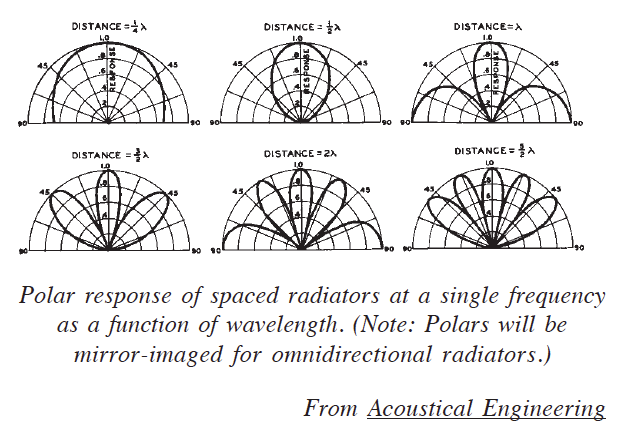
The dispersion pattern is a result of the ratio between center to center spacing of the drivers and the Lambda (wavelength).

Low_Directivity-polars1.png


Here are some examples at 50hz and 100hz...notice the spacing and the relationship to the wavelength (Lambda).
Lambda
50hz = 6.86m/22.507'
100hz = 3.43m/11.253'
Spacing = ~0.58 Lambda...........Spacing = ~ 1.17 Lambda........Spacing = ~2.33 Lamda
upload_2023-2-9_19-13-49.png


The first set of images is from: Low-Frequency Directivity and Arrays (prosoundtraining.com)

The second set of images if from: A_Practical_Guide_To_Bass_Arrays.pdf (sounddesignlive.com)
 
If the PA is loud enough to dominate in the room, then there will be lots of low backwash mud on the stage which will probably make you want to turn your amp up so you can clear. Suddenly the PA isn't that much louder than the bass amp.

I too, as a sound tech, have muted the bass in the FOH because the player on stage had their amp up enough that there was no room for the PA to work.

IEM is so much better for the audience.
 
Yes, the sound from your bass amp will interact with the sound from the PA. The result will be comb filtering. In some places the soundwaves will cancel and it other places the soundwaves will sum resulting in peaks.

The problem is mitigated if the PA is significantly louder out in the audience than your amp. So having your amp set back from the frontline can help mitigate problem. With a point source, SPL drops off by 6dB for each doubling of distance. Let's assume you amp is putting out 118dB at 1 meter. At 2 meters the SPL will have dropped off by 6dB (112dB). At 4 meters the SPL is down another 6dB to 106dB.

Ideally you run your amp at a reasonable volume so the PA can dominate the room. Frequently this does not occur, so either you get crappy sounding bass or the audio tech runs the mix hot enough so the PA dominates. This is a recipe for pushing very high SPL into the room. As an audio tech, I frequently accepted crappy bass rather than cranking the volume of the PA too high. If the bass amp is too loud, sometimes the best solution is to pull it completely out of the PA...and unfortunately this is not a great recipe for delivering great bass to the audience.

As a bass player, I usually elevate my speaker and aim it at my head. This allows me to monitor at the lowest possible volume, so my rig fights less with the PA. Unfortunately, if you like big pillowy lows, this approach will not satisfy you.

My test for this was to walk from my rig through the audience while playing.

By the time I was 6 or 8 feet into the audience, the only bass I heard was through the PA, otherwise, I needed to turn down my amp on stage.

I enjoyed playing wireless because I could hear how my bass sat in the mix from out in the audience, and because it was fun to start a song from the back of the audience and watch their reactions as I walked to the stage while playing. :)
 
  • Like
Reactions: DJ Bebop and Wasnex
IEM is so much better for the audience.

@darwin-bass I have a question about the audience's experience with IEMs:

Clearly, if it's a big room, and they're > 20 feet back from the stage, it must sound great.

But what's the prevailing wisdom for a small club (100-200) people where the crowd is pressed up against the stage, and the band is using IEMs?

If there are no amps, side fills, or monitors on the stage, what will the first 5 rows of people hear? Won't it all just be bass from the subs, or the sound of the PA bouncing off the back wall of the club?

I'm genuinely curious. I haven't been to a live show in years.
 
@darwin-bass I have a question about the audience's experience with IEMs:

Clearly, if it's a big room, and they're > 20 feet back from the stage, it must sound great.

But what's the prevailing wisdom for a small club (100-200) people where the crowd is pressed up against the stage, and the band is using IEMs?

If there are no amps, side fills, or monitors on the stage, what will the first 5 rows of people hear? Won't it all just be bass from the subs, or the sound of the PA bouncing off the back wall of the club?

I'm genuinely curious. I haven't been to a live show in years.

Relevant post and links to other threads: Is it the end of Amps and cabs? In Ears required for gigs now.....
 
  • Like
Reactions: fu22ba55
@darwin-bass I have a question about the audience's experience with IEMs:

Clearly, if it's a big room, and they're > 20 feet back from the stage, it must sound great.

But what's the prevailing wisdom for a small club (100-200) people where the crowd is pressed up against the stage, and the band is using IEMs?

If there are no amps, side fills, or monitors on the stage, what will the first 5 rows of people hear? Won't it all just be bass from the subs, or the sound of the PA bouncing off the back wall of the club?

I'm genuinely curious. I haven't been to a live show in years.

I have recently gained some experience gigging with a 4 piece band in small clubs with IEMs.

One guitar & I are dedicated ampless while the other guitar uses an amp. We have an acoustic kit, we hit that with a snare mic and a kick mic & one overhead mic.

Our PA consists of two rather small full range powered speakers posted about 4'- 5' above two reasonably sized Powered subwoofers. I think it actually works well in close quarters and could probably still handle some bigger venues with some limitations.

Everyone has wireless buds and control of their own mix. We all can hear what we want at a level that is safe for our ears.

We always get compliments from fans and fellow musicians alike.

It helps that we rehearse with this setup just to stay used to it.

I was unsure when making the commitment to this setup but it has been a pretty good experience for me.

Most of my fill in gigs or gigs with house sound do not offer IEMs, so I still get some time in on wedges and open air.... I have learned to like both just fine.

Point being, if you are worried about cancellation issues, IEMs are not something you should rule out.
 
Last edited:
Our PA is RCF HD32a's with one RCF 8003as sub. The amp is the Markbass CMD112P. If this amp is used as a monitor on stage, will it cause frequency cancellations due phase/delay issues with the PA? I frequently hear about issues with multiple subs but never with a backline bass amp.

Thank you, Scott
It won't be loud enough to matter
 
Every sound guy I have ever worked with has said “give me a low stage volume and I will make you guys sound great!”. Unfortunately musicians egos (especially guitar players) are a fragile thing and everyone worries they are not being heard. So what do they do? Turn up their amps of course and then it cascades from there. What makes matters worse is there is always a hearing damaged friend of the guitar player in the crowd signaling him to turn up.

My current band isn’t too bad and improving. We talk about this a lot in rehearsal. I think a big thing is to take the time to get it right in sound check. The inclination is to run through a song and make sure everything works and the vocalist can hear themself and it’s good enough. You have to go further and make sure you have a stage balance where everyone hears what they need to and the sound tech has the time to get things dialed in out front. If it’s not right, that’s the time to speak up, not wait to start playing and then turn up your amp.

Wow, I’m rambling. To answer the question, as others have said if you keep the stage volume low, no problems with FOH sound.