
Enjoy the benefits of a premium membership!
Upgrade Account
-
TalkBass has been independent since 1998. Add your voice.
Create a free account to reply to discussions, view embedded media, and browse with fewer display ads.
Join free Log in
Want zero display ads or expanded classifieds tools? Compare plans.
You are using an out of date browser. It may not display this or other websites correctly.
You should upgrade or use an alternative browser.
You should upgrade or use an alternative browser.
downfalls to p bass w/ added jazz pick up?
- Thread starter basschords420
- Start date
-
- Tags
- fender p bass p bass
More options
Who Replied?
The difference with a P-J while J is turned to zero is caused by the additional volume pot. If you use 250K pots and turn the J to zero, you still have an extra 250Kohm pot across the output from the P pickup. So that's why people hear a little difference. (it's about like having a P and rolling the volume pot down a little). Then there is a little magnetic pull on the strings from the J pickup. I think it's subtle and I certainly enjoy my vintage Yamaha BB basses that are P-J.
The main thing I notice with a P-J (as opposed to a P-P or J-J) is the tone quality when playing a slow, melodic line that crosses back and forth from A string to D string with both pickups on. The distance between the J and one half of the P is different from the distance to the other half -- and totally different if the P is reverse P (like my Yamaha BB2000) or standard P (like my BB3000). If you have a J-J or a P-P with both P's in the same orientation (some double P have them opposite each other) you don't hear as much of a shift in tone quality between A and D strings with both pickups on as you do with a P-J.
The main thing I notice with a P-J (as opposed to a P-P or J-J) is the tone quality when playing a slow, melodic line that crosses back and forth from A string to D string with both pickups on. The distance between the J and one half of the P is different from the distance to the other half -- and totally different if the P is reverse P (like my Yamaha BB2000) or standard P (like my BB3000). If you have a J-J or a P-P with both P's in the same orientation (some double P have them opposite each other) you don't hear as much of a shift in tone quality between A and D strings with both pickups on as you do with a P-J.

I have more than one bass in a P/J or derived configuration. All of the advantages, no disadvantages. I have heard people claim that with the loading of the additional J pickup circuitry that it can slightly alter the tone of the P-pickup from the additional loading to ground, even if the J-volume is rolled off completely. I can't hear any difference. I suppose if someone is that picky, you can install a DPDT push pull on the J-volume to isolate the P from the J.


Quick, somebody call this dude up and tell him all about how his tone sucks & why he's not Talkbass worthy - you know, what with his crappy PJ bass and all.


The P only is the most aggressive sounding. The P and J in series is still pretty gnarly but has more definition and clarity. Both in parallel is very clear, not aggressive. The J by its self I never use. This way the P is totally a P without any other wiring or load. The p/u magnet may have some effect. To my surprise, both pick ups in series is what I used most. It’s pretty aggressive but has some clarity to it. I can hear it best in a band mix. In parallel is a little too clean most of the time. I use parallel when I really want to be in the background on soft songs. Each switch position is a slightly different volume though. The P is the loudest, the series is a little quieter, and the parallel position as even quieter yet. It’s not perfect but it’s a good compromise for me.
I would like to try a MM pickup in bridge position.

A PJ is a good combination as long as you are expecting what it brings to the table.
It's not a Jazz, it's a P with extras.
I like them. I have 2.
It's not a Jazz, it's a P with extras.
I like them. I have 2.

Maybe, but when you're practicing alone at home those hum canceling J pickups lack lustre.In a live setting, all subtleness is lost in a loud mix.

You shouldn't own one if you don't need one.is there a reason why one shouldn't own one of these basses?


A PJ is a good combination as long as you are expecting what it brings to the table.
It's not a Jazz, it's a P with extras.
I like them. I have 2.
I dont think its a P with extras either: a PJ is its own thing with its own signature voicing (both PUs dimed), discovered in the 70s by Precision modders...... I think it can be referred to as a 'happy accident'

I don't think I could ever get the best of both worlds because I think of the best part of a Jazz to be the neck pickup... which I suppose could be mounted upside down, above the strings, facing the Precision split coil with a selector switch to go between the two... but that double magnetic field sandwich might do some funky things. Kinda kidding of course, but now I'm really curious how that might sound if BOTH pickups were selected 

Sometimes you want black leather

and sometimes you want your party dress

Damn, they're both PJ's
and sometimes you want your party dress
Damn, they're both PJ's

My primary bass is a P/J nordy 5 stringer. I use both pickups maybe 2% of the time. I use the bridge pickup solo'd 0%. Go for it but from my experience, a solo'd P just works better for virtually every style.
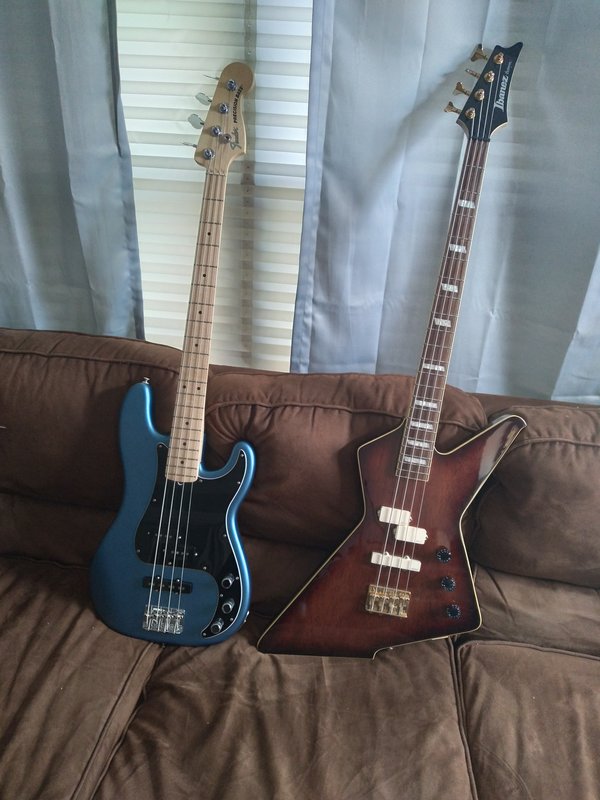
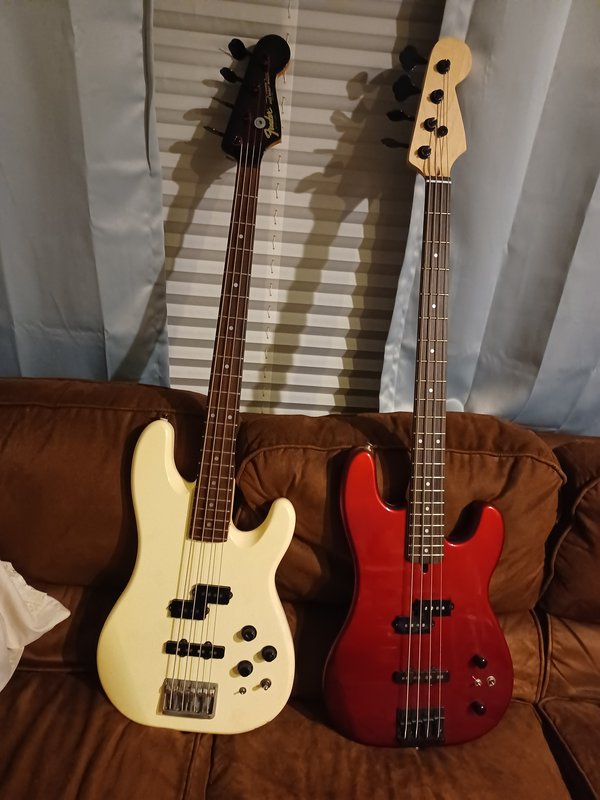
I forgot the porn.....Top Pic: My P/J basses..........Bottom Pic: My Reverse P/J Basses
It's a very useable combination with the right pickups in the right place, if the tones it supplies are useful to you.
I always recommend where possible to use a matched set which the smarter pickup makers offer, as sometimes the PBass humbucking pickup can overwhelm a poorly matched Jazz single coil it you just stick anything handy back there. I also prefer a stack or side x side humbucker for the Jazz pickup as it eliminates the single-coil noise and usually has more output, possibly at the expense of a little tone, which for me is more than made up for.
The real downside to it is this horse gets beaten to death regularly between guys who just think it's useless vs. guys that really like it, and this topic will get recycled over and over and over.
They rightly point out it doesn't sound just like a Precision Bass or a Jazz Bass either. It can be a great combination of both, a Jazz tone that can be thicker, or a Precision Bass with some added definition. That's the point.
Duuuuhhhhhhhhh . . . . . .
I always recommend where possible to use a matched set which the smarter pickup makers offer, as sometimes the PBass humbucking pickup can overwhelm a poorly matched Jazz single coil it you just stick anything handy back there. I also prefer a stack or side x side humbucker for the Jazz pickup as it eliminates the single-coil noise and usually has more output, possibly at the expense of a little tone, which for me is more than made up for.
The real downside to it is this horse gets beaten to death regularly between guys who just think it's useless vs. guys that really like it, and this topic will get recycled over and over and over.
They rightly point out it doesn't sound just like a Precision Bass or a Jazz Bass either. It can be a great combination of both, a Jazz tone that can be thicker, or a Precision Bass with some added definition. That's the point.
Duuuuhhhhhhhhh . . . . . .

On this board people will claim that the magnetic presence of the J pickup along with the complexity of the wiring inside to accommodate it sacrifices the pure tone of the P pickup alone. That might be true but if so it's probably only at an academic level and could only be knowable by running measurements of the output with the P soloed and then after removing the J pickup entirely and rewiring the exact same bass. Which I have not seen done and don't intend to do with mine. I think a PJ with the P pickup soloed sounds like a P bass.
Told you.The difference with a P-J while J is turned to zero is caused by the additional volume pot. If you use 250K pots and turn the J to zero, you still have an extra 250Kohm pot across the output from the P pickup. So that's why people hear a little difference. (it's about like having a P and rolling the volume pot down a little). Then there is a little magnetic pull on the strings from the J pickup.

I'm a grumpy curmudgeon, so if I don't like something, then no one else is allowed to.

Nothing I’d consider a downside.
About the only thing that was a surprise for me was how the JB pup really came across more as adding texture (to my ears at least) rather than tone. It seemed to work wonders for dialing in some additional edge or adding various degrees of definition to the PB vibe. But it didn’t significantly alter it or give me more tones. Possibly because a PB split will tend tend to outmuscle most Fender style single coils.
I have to disagree with those who feel the magnetic pull from the JB pickup is a significant factor in the differences in timbre. The alnico and ceramic magnets found in virtually all JB pups are going to have a negligible impact on something with the mass and tension of a bass string tuned to standard. String pull is more of a guitar thing than it is a bass thing.
It’s important to remember that a passive tonestack is a resonant circuit. So the presence of an additional component with its own resistance and capacitance does have the ability to alter the sound since it will change the impedance and therefore the overall tuning of the circuit. If you were to insert an additional small value resistor and/or capacitor into a PB’s tonestack the same thing would happen. The “treble bleed network” mod works that way. It’s just an appropriately sized capacitor and resistor wired in series and inserted between the hot and wiper lugs on a volume pot. The difference in sound is noticeable. (I don’t really care for it and think it’s probably better suited for a guitar than it is a bass. But maybe that’s just me.)
The overall sound of a PJ is different enough that I have no problem with owning a PB, JB, and PJ.
But this is me and my ears. So take the above as purely my personal opinion and nothing else.
About the only thing that was a surprise for me was how the JB pup really came across more as adding texture (to my ears at least) rather than tone. It seemed to work wonders for dialing in some additional edge or adding various degrees of definition to the PB vibe. But it didn’t significantly alter it or give me more tones. Possibly because a PB split will tend tend to outmuscle most Fender style single coils.
I have to disagree with those who feel the magnetic pull from the JB pickup is a significant factor in the differences in timbre. The alnico and ceramic magnets found in virtually all JB pups are going to have a negligible impact on something with the mass and tension of a bass string tuned to standard. String pull is more of a guitar thing than it is a bass thing.
It’s important to remember that a passive tonestack is a resonant circuit. So the presence of an additional component with its own resistance and capacitance does have the ability to alter the sound since it will change the impedance and therefore the overall tuning of the circuit. If you were to insert an additional small value resistor and/or capacitor into a PB’s tonestack the same thing would happen. The “treble bleed network” mod works that way. It’s just an appropriately sized capacitor and resistor wired in series and inserted between the hot and wiper lugs on a volume pot. The difference in sound is noticeable. (I don’t really care for it and think it’s probably better suited for a guitar than it is a bass. But maybe that’s just me.)
The overall sound of a PJ is different enough that I have no problem with owning a PB, JB, and PJ.
But this is me and my ears. So take the above as purely my personal opinion and nothing else.
Last edited:
To be fair whilst I understand what you are trying to say he is playing a Fodera, they could make a bass from a broomstick and it would sound goodQuick, somebody call this dude up and tell him all about how his tone sucks & why he's not Talkbass worthy - you know, what with his crappy PJ bass and all.
View attachment 4588632


