• TalkBass has been independent since 1998. Add your voice.
    Create a free account to reply to discussions, view embedded media, and browse with fewer display ads.
    Join freeLog in
    Want zero display ads or expanded classifieds tools? Compare plans.

Dual Precision Wiring mods

hi guys.

I'm installing in my oldie Squier Precision, a bridge P pickup.

The bass will look like this:
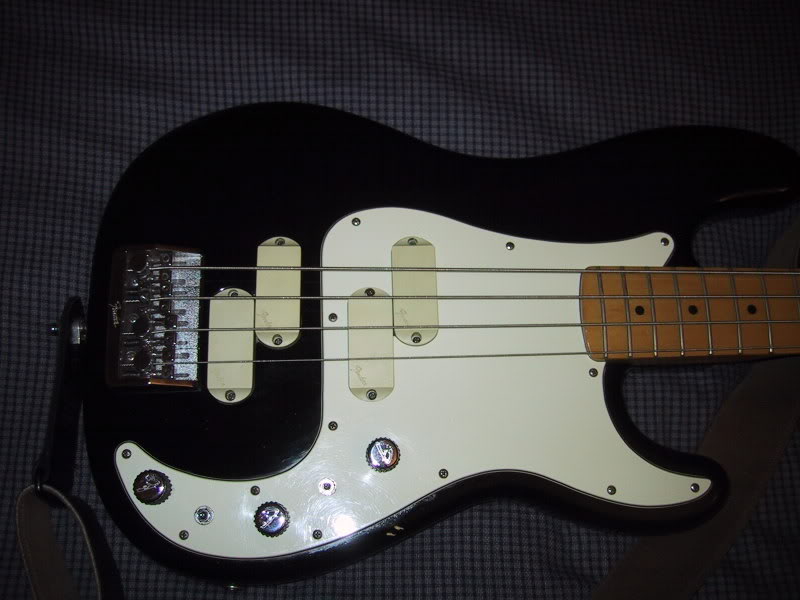
122-2275_IMG.jpg


The thing that I don't know what to do about the wiring...

Options are:

1) Classical Volume-Volume-Master Tone and a 3way switch selector.

2) Adding push pulls pots, so i can get a Series/Parallel from each pickup, like this:

series-parallel_switch.gif


3) Only one push pull, for wiring both pickups in series or parallel, like a Jazz Bass:

[Invalid or Expired Link Removed]


If you had experince about some of these mods, please tell me.

Thanks!
 
How about VVT and then series/parallel switches for each pickup, plus the master series/parallel switch?

mmmm... i don't know if i'll have the space for too much wire!


--------------------------------------------------------------------------------

EDIT: i have found this opinion about an user who did the nº2 with a PJ (J was a humbucker) and other who did the same in a PP...

I'm putting together a 2 P-bass pick-up bass V V & push pull
tone (series for bridge p-up)

I first wired the front pick-up following factory instructions
then I followed factory specs for series.
I spoke w/ a tech & he said to wire it like a jazz bass.

After a full day of wiring I put it down. After soundcheck today I'll re- attempt to fix .
As of last night, the front pick-up sounds fine but the bridge is week & thin ( even w/ just that pick-up at full ) the series function is working but the tone is reversed. I'm puzzled?

I actually just did this, mostly out of boredom. Specifically, two series/parallel switches for my PJ (the J is a DiMarzio Ultra Jazz humbucker). I wouldn't say "anemic", but you do lose quite a bit in volume and punch. It might be useful for recording, but I think it is just about useless when trying to cut through a live mix. I haven't had the time to record some samples, but when I do I will be starting a thread to share my experience.
 
mmmm... i don't know if i'll have the space for too much wire!


--------------------------------------------------------------------------------

EDIT: i have found this opinion about an user who did the nº2 with a PJ (J was a humbucker) and other who did the same in a PP...

I'm not going to lie, wiring stuff like this is an absolute PITA, however, it's definitely do able.
I'm assuming that you are going to have the pots on a pickguard, right? It's much easier to wire things on a removable pickguard than in a rear routed cavity.
There should be plenty of room for everything to fit in, it's just the matter of difficulty then soldering in tight places.

I have never actually tried wiring two P pickups in series, however, I would guess that the sound would be terrible.
Running through that much coil is going to give you an insanely hot output, and most of the high end and low end will be cut off.
It will probably just sound like very loud midrange.
 
yeah, series/parallel within a P-pickup is only useful on a guitar (I have a telecaster with a P-bass neck pickup that is pretty useful). On bass, the P-parallel tone is too weak and gives you an output in the 2-3.5k range depending on the pickup. This is why the S-1 switch for jazz bass was useful but the P-bass version was kinda useless except for very quiet acoustic songs where you could use the thin tone to match a quiet moment. It would be cool to have the middle position be something like the EA half from the bridge pickup and the DG half of the neck pickup...but that'd be a wiring nightmare
 
yeah, series/parallel within a P-pickup is only useful on a guitar (I have a telecaster with a P-bass neck pickup that is pretty useful). On bass, the P-parallel tone is too weak and gives you an output in the 2-3.5k range depending on the pickup. This is why the S-1 switch for jazz bass was useful but the P-bass version was kinda useless except for very quiet acoustic songs where you could use the thin tone to match a quiet moment. It would be cool to have the middle position be something like the EA half from the bridge pickup and the DG half of the neck pickup...but that'd be a wiring nightmare

You put a split-coil Precision bass pickup on a Telecaster?
I'd love to see some pictures of that.

Actually, if you wanted to do one coil from the neck pickup in series with one coil from the bridge pickup, that would be do able with a 4PDT mini toggle switch.
You would set up a Series/NC switch on for the neck pickup on pole 1, then a Series/SC switch for the bridge pickup one pole 2, then a master Series/Parallel switch on poles 3 and 4.
I can draw the diagrams for this setup if anyone is curious.

Of course, I would imagine a very unbalance string response though. Basically, two strings would sound like you are using the neck pickup, and two strings would sound like you are using the bridge pickup.
 
On bass, the P-parallel tone is too weak and gives you an output in the 2-3.5k range depending on the pickup.

Yes.
Since the coils of a split-coil P bass pickup are in series, they actually have a relatively low DC resistance.

Say you have a 12K split coil pickup...

The resistance of each coil is 6K, as 6K and 6K add up to 12K.
However, when you combine the coils in parallel, their resistance is split in half. Now your 12K pickup becomes 3K, as 6K in parallel with 6K is 3K.
 
Volume, blend, stacked bass/treble preamp tone pot. The series parrelllel switch thing for P's generally doesnt create two useful voices in my experience.

Hi,
Yes I agree with you but I don't really get why serie wouldn't work but blend would?
I tried the diagram above and different wiring last night and it always sounds the same.I am getting a bit nuts.

Do you have by any change a reference to a volume/blend/tone diagram?
 
I have never actually tried wiring two P pickups in series, however, I would guess that the sound would be terrible.
Running through that much coil is going to give you an insanely hot output, and most of the high end and low end will be cut off.
It will probably just sound like very loud midrange.

Back in the 70s I had a '74 P bass with two P pickups on it. At some point I replaced the Fender pickups with DiMarzios, which was the thing to do at the time.

I had a series/parallel switch for each pickup, and a series parallel for both pickups. I also had a phase switch.

Both pickups in series worked fine when you wanted a thick dark tone. Then by switching either or both pickups in parallel, you could change the overall thickness of the tone.
 
In the last couple of weeks, I finally finished a P/J from random parts...with series/parallel switches for both pups (Dimarzio Model P & Model J...seen here: http://www.talkbass.com/forum/f8/new-frankenbasses-day-796495/ ). It's strung with D'Addario Chromes. At least with this combination of strings and pickup, the switch for the P is useful. The flats going through a loud, darker pickup sounds great on its own, but is a bit unbalanced in a rock mix. So maybe whether it's worthwhile just depends on the instrument.
 
Got two amps?
Why not just stereo output it? Neck & Bridge separate. Build a Rick-O-Sound box Rick-o-sound: Moving in Stereo « Mikerophonography
Balance it at the amps. That will give you loads of control.
On the floor you could blend neck & bridge to have one amp 60:40 neck to bridge and the other amp 40:60 neck to bridge (or any ratio) with a dual ganged pot prior to the Rick-o-sound box or built in the same box.
I striped the pots out of my PJ and have it stereo. No knobs at all. I need to get a scratch plate w/o all those holes.