I have a Gallien Krueger 400RB head. The back says 4 Ohms 200 watts rms. There are two speaker outputs. I also have two bass cabinets. One of the cabinets says 8 Ohms 450 watts rms. The second cabinet says 8 Ohms 200 watts rms. Will I break something if I plug both of these cabinets in to my GK head. Will it actually sound worse. I have no idea what I’m doing. Please help!

Enjoy the benefits of a premium membership!
Upgrade Account
-
TalkBass has been independent since 1998. Add your voice.
Create a free account to reply to discussions, view embedded media, and browse with fewer display ads.
Join free Log in
Want zero display ads or expanded classifieds tools? Compare plans.
You are using an out of date browser. It may not display this or other websites correctly.
You should upgrade or use an alternative browser.
You should upgrade or use an alternative browser.
Dumb guy here. Will I blow up my speakers?
- Thread starter Ryan King
- Start date
More options
Who Replied?

- Feb 12, 2006
- 60,986
- 5
- 220,769
- Disclosures
- Development Engineer-Mesa Boogie, Development Engineer-Genzler (pedals), Product Support-Genz Benz
It will be fine as long as you use a tiny bit of common sense.

So this is what an audio engineer told me…
The 4 ohms 200 watts on the amp tells me two things. It will put out 200 watts into 4 ohms and the minimum impedance load is 4 ohms. It also tells me that the amp will put out a bit over 100 watts into 8 ohms (not as loud). Two 8 ohm cabinets in parallel (both plugged into that amp) will give you a 4 ohm load, allowing the amp to provide a maximum of 200 watts. That 200 watts will be split evenly between the two cabinets, giving each one 100 watts when the amp is providing full power, so you are not in danger of blowing up either cabinet. A solid state amp will put out more power as the load is lowered (100 watts at 8 ohms, 200 watts at 4 ohms) but it also runs hotter, therefore the minimum impedance rating to keep the amp from overheating. Whatever combination you use with that amp and those speakers, you should be fine. If one cabinet (100 watts) is loud enough, just use that as its easier on the amp (doesn't run as hot). There are formulas for all this if you're interested. Also, some of this does not apply to tube amps.
The 4 ohms 200 watts on the amp tells me two things. It will put out 200 watts into 4 ohms and the minimum impedance load is 4 ohms. It also tells me that the amp will put out a bit over 100 watts into 8 ohms (not as loud). Two 8 ohm cabinets in parallel (both plugged into that amp) will give you a 4 ohm load, allowing the amp to provide a maximum of 200 watts. That 200 watts will be split evenly between the two cabinets, giving each one 100 watts when the amp is providing full power, so you are not in danger of blowing up either cabinet. A solid state amp will put out more power as the load is lowered (100 watts at 8 ohms, 200 watts at 4 ohms) but it also runs hotter, therefore the minimum impedance rating to keep the amp from overheating. Whatever combination you use with that amp and those speakers, you should be fine. If one cabinet (100 watts) is loud enough, just use that as its easier on the amp (doesn't run as hot). There are formulas for all this if you're interested. Also, some of this does not apply to tube amps.
- Feb 12, 2006
- 60,986
- 5
- 220,769
- Disclosures
- Development Engineer-Mesa Boogie, Development Engineer-Genzler (pedals), Product Support-Genz Benz
That is good info, don’t worry about the amp heating as long as you respect the minimum impedance.

When you need to learn about your equipment, it’s good to start with the owners manual.
https://www.gallien-krueger.com/s/400RB-IV.pdf
Make sure to use speaker cables to connect the amp and speakers, not instrument cables.
https://www.gallien-krueger.com/s/400RB-IV.pdf
Make sure to use speaker cables to connect the amp and speakers, not instrument cables.
Your two cabs will give you a 4 ohm load , but don’t plug any more in. You’re fine just using one cab too.
Those RB 400 amps were legend. You’ve managed to snag a classic amp.
Congratulations!
Those RB 400 amps were legend. You’ve managed to snag a classic amp.
Congratulations!
(And my earlier comment was an attempt at humour.)
Yeah I love that GK head. The gain and boost knobs help to dial in a really nice growl.Your two cabs will give you a 4 ohm load , but don’t plug any more in. You’re fine just using one cab too.
Those RB 400 amps were legend. You’ve managed to snag a classic amp.
Congratulations!
I used an RB 400 for some years. It was bulletproof. And easy to dial in. I bought it just after they first appeared here. Back in the days of steam driven amplifiers …

There's nothing dumb about askingI have a Gallien Krueger 400RB head. The back says 4 Ohms 200 watts rms. There are two speaker outputs. I also have two bass cabinets. One of the cabinets says 8 Ohms 450 watts rms. The second cabinet says 8 Ohms 200 watts rms. Will I break something if I plug both of these cabinets in to my GK head. Will it actually sound worse. I have no idea what I’m doing. Please help!

I laughed! It worked.(And my earlier comment was an attempt at humour.)

One thing to remember is that the power output rating is into a certain load and usually measured at 1000 hertz. The lower in frequency you go (think of your low B string which is 31 hertz), the lower the load impedance gets and closer to a dead short you get (we're talking impedance here). This will of course cause the current through the power transistors to rise and create more and more heat. If the amp's power supply can't supply the current needed, you'll get distortion through clipping (simply speaking).
Last edited:

The RB 400 was the dividing line between the steam driven amps to something more modern: no known power source, magic or something.I used an RB 400 for some years. It was bulletproof. And easy to dial in. I bought it just after they first appeared here. Back in the days of steam driven amplifiers …

I have a Gallien Krueger 400RB head. The back says 4 Ohms 200 watts rms. There are two speaker outputs. I also have two bass cabinets. One of the cabinets says 8 Ohms 450 watts rms. The second cabinet says 8 Ohms 200 watts rms. Will I break something if I plug both of these cabinets in to my GK head. Will it actually sound worse. I have no idea what I’m doing. Please help!
When you need to learn about your equipment, it’s good to start with the owners manual.
https://www.gallien-krueger.com/s/400RB-IV.pdf
Make sure to use speaker cables to connect the amp and speakers, not instrument cables.
^This^
Maybe you knew that, perhaps you’re coming from having only used a combo and didn’t know, but it’s very important. A speaker cable is two separate wire lines of equal gage, while instrument cable is a core wire thread (“hot”)wrapped with a woven ground shield. Meant for line signal only, not heavy enough for what the amp puts out.
What brands/model/driver configurations are the individual cabs? Can’t say that your particular set-up wouldn’t work, and more drivers will assist in perceived loudness, but there’s the potential of phase interference when mixing different sizes/brands/models of drivers, even if they are in correct enclosures.
Last edited:
- Feb 12, 2006
- 60,986
- 5
- 220,769
- Disclosures
- Development Engineer-Mesa Boogie, Development Engineer-Genzler (pedals), Product Support-Genz Benz
Not really, on a ported cabinet the impedance falls as the frequency decreases except for where it rises. In practice for a reasonable speaker, it’s close enough to nominal from the amp’s perspective that it’s a non-issue.One thing to remember is that the power output rating is into a certain load and usually measured at 1000 hertz. The lower in frequency you go (think of your low B string which is 31 hertz), the lower the load impedance gets and closer to a dead short you get (we're talking impedance here). This will of course cause the current through the power transistors to rise and create more and more heat. If the amp's power supply can't supply the current needed, you'll get distortion through clipping (simply speaking).
Correct...in a ported cab, there is a resonant frequency in which the Z actually increases for a small band of frequencies before dropping again as one approaches 0 ohms Z (at least that's my understanding...)Not really, on a ported cabinet the impedance falls as the frequency decreases except for where it rises. In practice for a reasonable speaker, it’s close enough to nominal from the amp’s perspective that it’s a non-issue.
- Feb 12, 2006
- 60,986
- 5
- 220,769
- Disclosures
- Development Engineer-Mesa Boogie, Development Engineer-Genzler (pedals), Product Support-Genz Benz
In a ported cabinet the impedance dip occurs at the resonant frequency of the system. There are typically 2 peaks, one on each side of the resonant frequency of the system.
Right...it's been too many years after studying this stuff. 40 years me thinks.In a ported cabinet the impedance dip occurs at the resonant frequency of the system. There are typically 2 peaks, one on each side of the resonant frequency of the system.
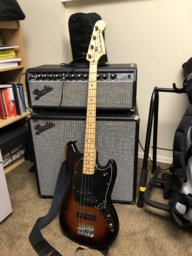
Lots of people ask the question, and it’s not super easy to understand when you don’t know how ohms and watts relate between amps and cabs. Even the manual can be unclear if you have two different cabs with different wattages, like in OPs case.
And you’re not the dumb guy. The dumb guy would’ve just plugged it in without checking anything.
And you’re not the dumb guy. The dumb guy would’ve just plugged it in without checking anything.


