• TalkBass has been independent since 1998. Add your voice.
    Create a free account to reply to discussions, view embedded media, and browse with fewer display ads.
    Join freeLog in
    Want zero display ads or expanded classifieds tools? Compare plans.

Dunlop DBFS 45/105 flatwound Strings - Uhm...

Shouldn't the comparison for similarity with TI flats be with the Dunlop 40-100 set?

I don't hear or feel a similarity between those 2 strings. The Thomastiks don't compare well with other strings for me because they are unique among flats.

I like the Dunlops because for me they are the closest to the now discontinued Sadowsky black label flats.
There were no DBFS 40-100 available for me to buy when I bought them.
However hex core strings will always be hex core strings .. better 2nd choice for me were LaBella LTF-4A
 
  • Like
Reactions: GwenOnBass
(Btw, for some reason Saitenmarkt have the Pyramid singles listed with the Pyramid Gold sets, not under "Single strings for bass").
Thanks for this! I'd noticed some singles missing from the relevant query and now found them by looking for corresponding sets. (The ones I was looking for have, uh, grown a lot dearer since last time I bought some there...)
 
You won't find a cheaper alternative to TI Jazz Flats IMO. Not an expensive one either. The TI flats may not be for everyone but they are unique. I've tried pretty much every flatwound set available today and nothing sound or feel even remotely like the TIs.

The TIs are a bit expensive but in my experience they last forever (provided that you take the necesseary precautions for installing round core strings!). When comparing the lifetime of TIs with certain "cheaper" brands the TIs aren't really that expensive after all IMO. And if you're in Europe the price gap between TIs and some US brands is also considerably smaller than in the US.

The only negative things I've got to say about TI flats is that I wish the A-string had SLIGHTLY heavier gauge and that it sounded less metallic out of the box. For some reason that A-string always takes considerably longer to mellow out than the rest of the set.

I also had a string go bad after loosening the tension all they way when tweaking the setup. It felt like the dreaded round core issue, with the windings loosening slighty from the core. The string made weird "ping" noises when bringing it back up to tension and had developed some weird, ugly overtones. I've never loosened the tension on TI flats all the way after that experience.

Apart from that I've used TIs on several basses for over a decade and never had to replace a set. In fact, they sound better than ever and they're one of my favourite strings. At least the long scale sets are. The short scale sets are almost unplayable to me due to the INSANE jump in tension between E and A. I really can't understand what they were thinking when they designed the short scale TI flats set???

Have you tried the Optima RB flats? If you're looking for flats with a loose, round core feel you might like them. They tone isn't remotely close to TIs though and the tension feels somewhat unbalanced across the strings. If I remember correctly the G felt rather stiff compared to a VERY bouncy D. I only used them briefly because they gave me buzzing issues on two separete basses with PERFECTLY levelled frets that worked great with other strings. The problem was that bouncy D-string. It vibrated with a HUGE amplitude that didn't work for my style of playing (I like to dig in a bit, close to the neck). I loved the tone though. I generally love the tone and feel of round core strings exactly because they tend to vibrate with a bigger amplitude than hex core strings. But with the Optima RBs is was just a bit too much for me. I never used them long enough for the strings to break in but as far as I can remember they were quite bright out of the box but also had a bit of "bounce" to them. A bit like the D+G strings on Pyramid Golds (out of the box) perhaps. Except that the Optimas RBs were far more balanced sounding out of the box. The Pyramids take a lot of time to mellow out before the tone is balanced across the strings. But like I said, I haven't used the RBs long enough to comment on their broken-in tone. I suspect I would have LOVED it but I couldn't live with the buzzing I got from the D-string.

The strange thing is that TIs are also very low tension but I've never had any buzzing issues with them, even on some rather problematic basses. I don't know how they do it. Maybe the silk inlays dampens them somehow? They really are exceptional if you can handle the low tension.
What are the precautions for installing round core strings? Avoiding twists?
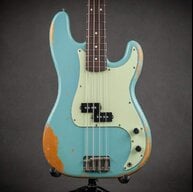
You also out me off these strings when you wrote that they go bad when you loosen them. My P bass has the truss rod nut at the heel so it's necessary to take the neck off when making adjustments.
 
What are the precautions for installing round core strings? Avoiding twists?
You also out me off these strings when you wrote that they go bad when you loosen them. My P bass has the truss rod nut at the heel so it's necessary to take the neck off when making adjustments.

With round core strings you need to make a 90 degree bend or crimp them before cutting. This will lock the windings to the core. The windings on round core strings don't lock onto the core like with hex core strings. If you don't bend or crimp the string the windings may unravel. Maybe not completely but it can still be enough to ruin the string. I discovered this the hard way with DR Hi-Beams back in the early 90s.

I must stress that the incident I described was a one-off. I had previously loosened TI flats on several occasions without any problems. Also, people sell TI flats used and if THAT works my problem was most likely a case of bad luck. Maybe I accidentally straightened the string to a position where the windings started slipping. Still, I won't risk doing it again so I won't be loosening my TI flats all the way ever again.

For what it's worth I've experienced something very similar with GHS Pure Nickels. All round core stings need the same precautions, not just TI flats.

It might also be worth mentioning that it's nearly always possible to adjust the truss rod on P-basses with access at the neck heel without removing the neck. I do it all the time at the workshop. There are several ways to do this, depending on the pickguard and the truss rod nut.

Scenario 1: Slotted truss rod nut and the pickguard has a cut out in front of the truss rod nut.

In this case can use a truss rod "cheater" tool but a small flat screwdriver often works fine too. Lots of people think you need a big philips screwdriver to adjust slotted truss rod nuts but the trick is to use a small flat screwdriver and insert it into one half of the slot. This will provide enough leverage (in most cases) and enough access without removing the neck.

Scenario 2: Hex truss rod nut and the pickguard has a cut out.

You can use a truss rod wrench with a ball end, like the ones from Fender (and come with all Fender USA instruments). You just angle it downwards into the nut. The only time I wouldn't use these is when the truss rod is extremely tight. In those cases you may need better access to fully insert the truss rod for a better grip.

Scenario 3: No cut out in the pickguard or if 1) or 2) for some reason won't work.

Loosen the neck screws just enough to be able to tilt the neck backwards. This will provide access for truss rod adjustment. It may be a good idea to loosen the strings a bit first but this will work fine without loosening the strings TOO much. I understand if this isn't something everyone may want to do, it can be a bit scary if you've never done it before (you really need to WHACK the neck to tilt it with the stings at tension) but I do it all the time and I've never experienced any problems. Another option would be to simply remove the pickguard screws and slide the pickguard a bit backwards to gain access. You will have lift the jack socket over the edge of the cavity and wiggle the pickguard over the pickups. It may seem like a lot of work but it really won't take much longer than loosening the strings and removing the neck. Just be careful not to scratch the pickguard under the strings.

All of these methods (except the neck tilt) will also give you the possibility to check your adjustments as you go. When you remove the neck completely there's a lot of guesswork and you may have to repeat the whole process if you don't get it right.

But whatever works for YOU of course! :thumbsup: Just a couple of hints that may (or may not) make your life easier.
 
Last edited:
With round core strings you need to make a 90 degree bend or crimp them before cutting. This will lock the windings to the core. The windings on round core strings don't lock onto the core like with hex core strings. If you don't bend or crimp the string the windings may unravel. Maybe not completely but it can still be enough to ruin the string. I discovered this the hard way with DR Hi-Beams back in the early 90s.

I must stress that the incident I described was a one-off. I had previously loosened TI flats on several occasions without any problems. Also, people sell TI flats used and if THAT works my problem was most likely a case of bad luck. Maybe I accidentally straightened the string to a position where the windings started slipping. Still, I won't risk doing it again so I won't be loosening my TI flats all the way ever again.

For what it's worth I've experienced something very similar with GHS Pure Nickels. All round core stings need the same precautions, not just TI flats.

It might also be worth mentioning that it's nearly always possible to adjust the truss rod on P-basses with access at the neck heel without removing the neck. I do it all the time at the workshop. There are several ways to do this, depending on the pickguard and the truss rod nut.

Scenario 1: Slotted truss rod nut and the pickguard has a cut out in front of the truss rod nut.

In this case can use a truss rod "cheater" tool but a small flat screwdriver often works fine too. Lots of people think you need a big philips screwdriver to adjust slotted truss rod nuts but the trick is to use a small flat screwdriver and insert it into one half of the slot. This will provide enough leverage (in most cases) and enough access without removing the neck.

Scenario 2: Hex truss rod nut and the pickguard has a cut out.

You can use a truss rod wrench with a ball end, like the ones from Fender (and come with all Fender USA instruments). You just angle it downwards into the nut. The only time I wouldn't use these is when the truss rod is extremely tight. In those cases you may need better access to fully insert the truss rod for a better grip.

Scenario 3: No cut out in the pickguard or if 1) or 2) for some reason won't work.

Loosen the neck screws just enough to be able to tilt the neck backwards. This will provide access for truss rod adjustment. It may be a good idea to loosen the strings a bit first but this will work fine without loosening the strings TOO much. I understand if this isn't something everyone may want to do, it can be a bit scary if you've never done it before (you really need to WHACK the neck to tilt it with the stings at tension) but I do it all the time and I've never experienced any problems. Another option would be to simply remove the pickguard screws and slide the pickguard a bit backwards to gain access. You will have lift the jack socket over the edge of the cavity and wiggle the pickguard over the pickups. It may seem like a lot of work but it really won't take much longer than loosening the strings and removing the neck. Just be careful not to scratch the pickguard under the strings.

All of these methods (except the neck tilt) will also give you the possibility to check your adjustments as you go. When you remove the neck completely there's a lot of guesswork and you may have to repeat the whole process if you don't get it right.

But whatever works for YOU of course! :thumbsup: Just a couple of hints that may (or may not) make your life easier.
Thanks for the tips. I was aware of the crimp and I've always used it even with hex core strings.
All my truss rods are hard to move and they require a big flathead screwdriver to turn. A tiny one would just strip the nut. I wish Fender made a channel in the body to properly access the truss rod without all of this work. I wonder why they stubbornly reproduce dated design features from the 50s, even the idiotic ones...