• TalkBass has been independent since 1998. Add your voice.
    Create a free account to reply to discussions, view embedded media, and browse with fewer display ads.
    Join freeLog in
    Want zero display ads or expanded classifieds tools? Compare plans.

Dye/Staining a fretless fingerboard

pb9717

Supporting Member
Aug 18, 2006
2,502
5,623
I have an MTD Kingston (v1) Z5 fretless arriving in a few days that I picked up used. The body is imaculate. I will be upgrading the electrics to the US models in an effort to recreate the new current V2. One of the steps i’ll be taking is to fine sand the current rough hewn Ebony board to a far smoother and glossier finish. As it is now, it appears pourus, and without what I would consider finish sanding. It also has fret lines which are comprised of a wood filler, as per MTD.

I’ve fine sanded and polish sanded fretless fingerboards before with excellent results. I also prefer unlined, unmarkered fretless fingerboards aesthetically.

Now to the point….

If i want to to reduce or eliminate the visibility of the existing fretlines on the face of the fingerboard, what method of stain or dye would be the most effective? I’ve read of black leather dye as one solution. I have also used minwax ebony wood stain on a poorly grained “Tiger stripe ebony” board. But for this project, I’m wondering if dyeing the existing fingerboard is prudent, and if so, what is the best method to achieve a beautiful, glossy, even colored plank of black.

Whether the fingerboard is dyed or not, it will be finish sanded to 7000 grit. But as stated, I sure would prefer it to be as close to a solid polished black ebony finish as possible.
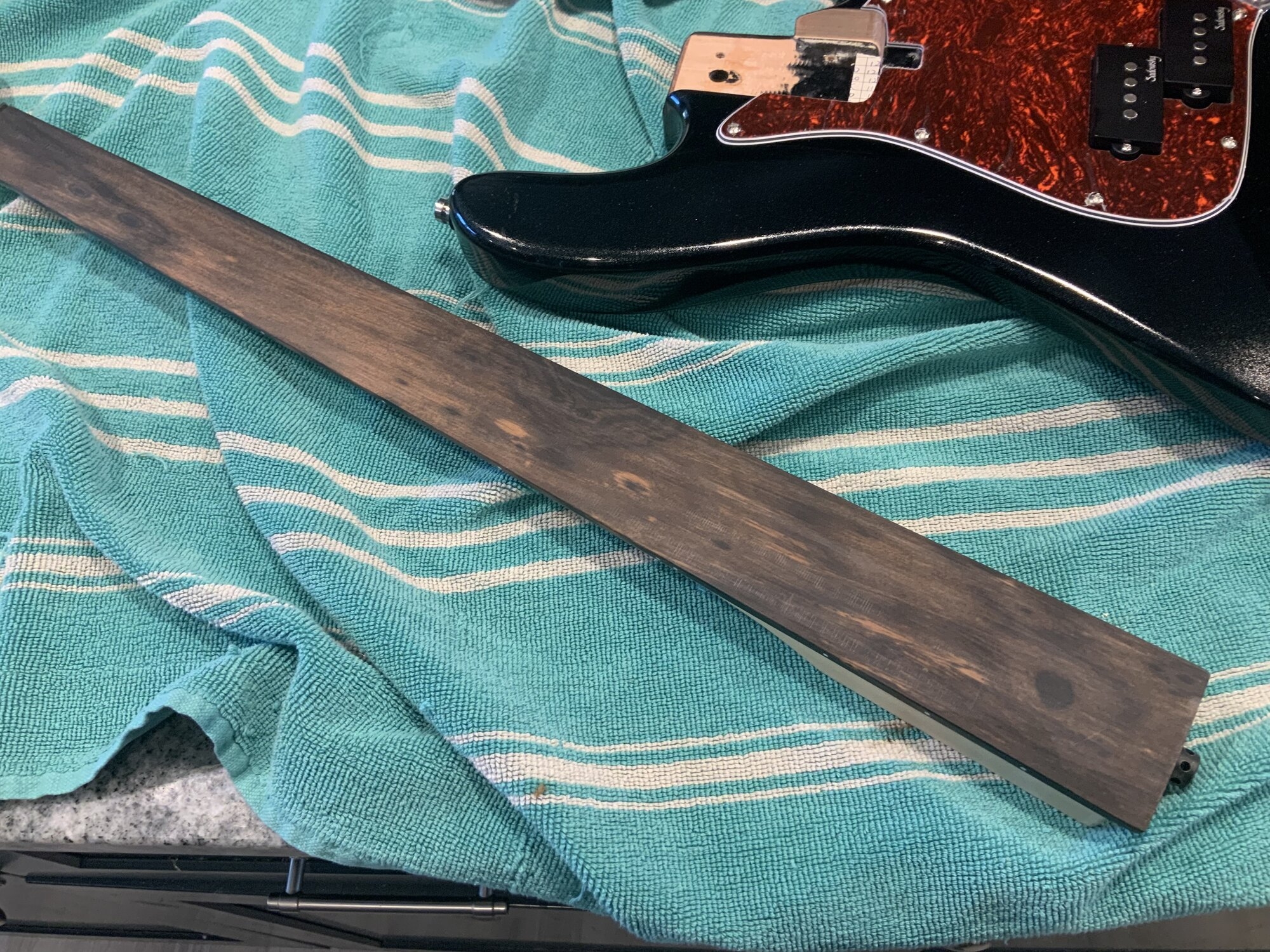
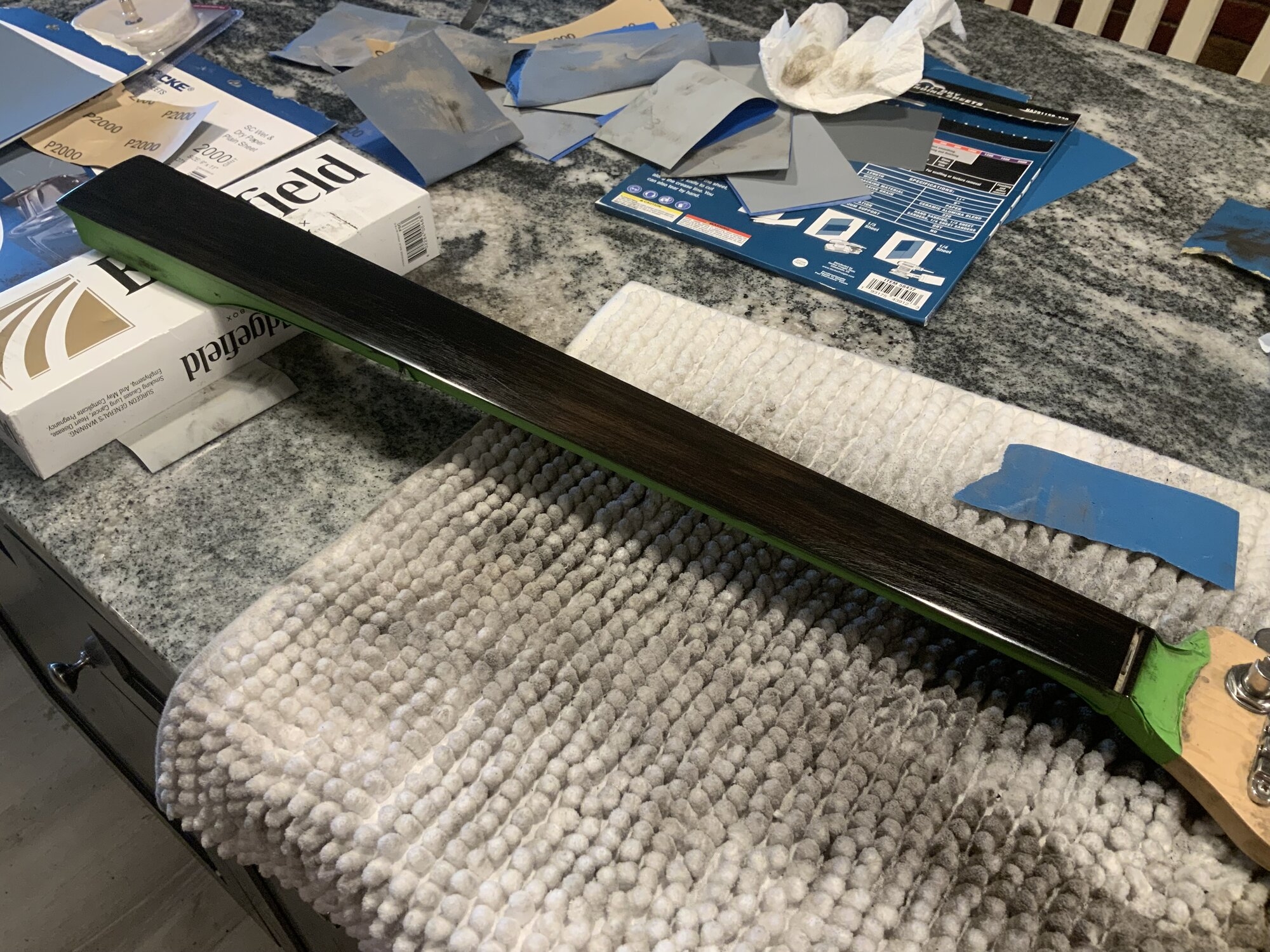
IMG_0520.jpeg

IMG_1321.jpeg

This is a before and after of a prior stained and sanded fingerboard. It was a good upgrade, but i’m looking for a more polished, OEM finished look.
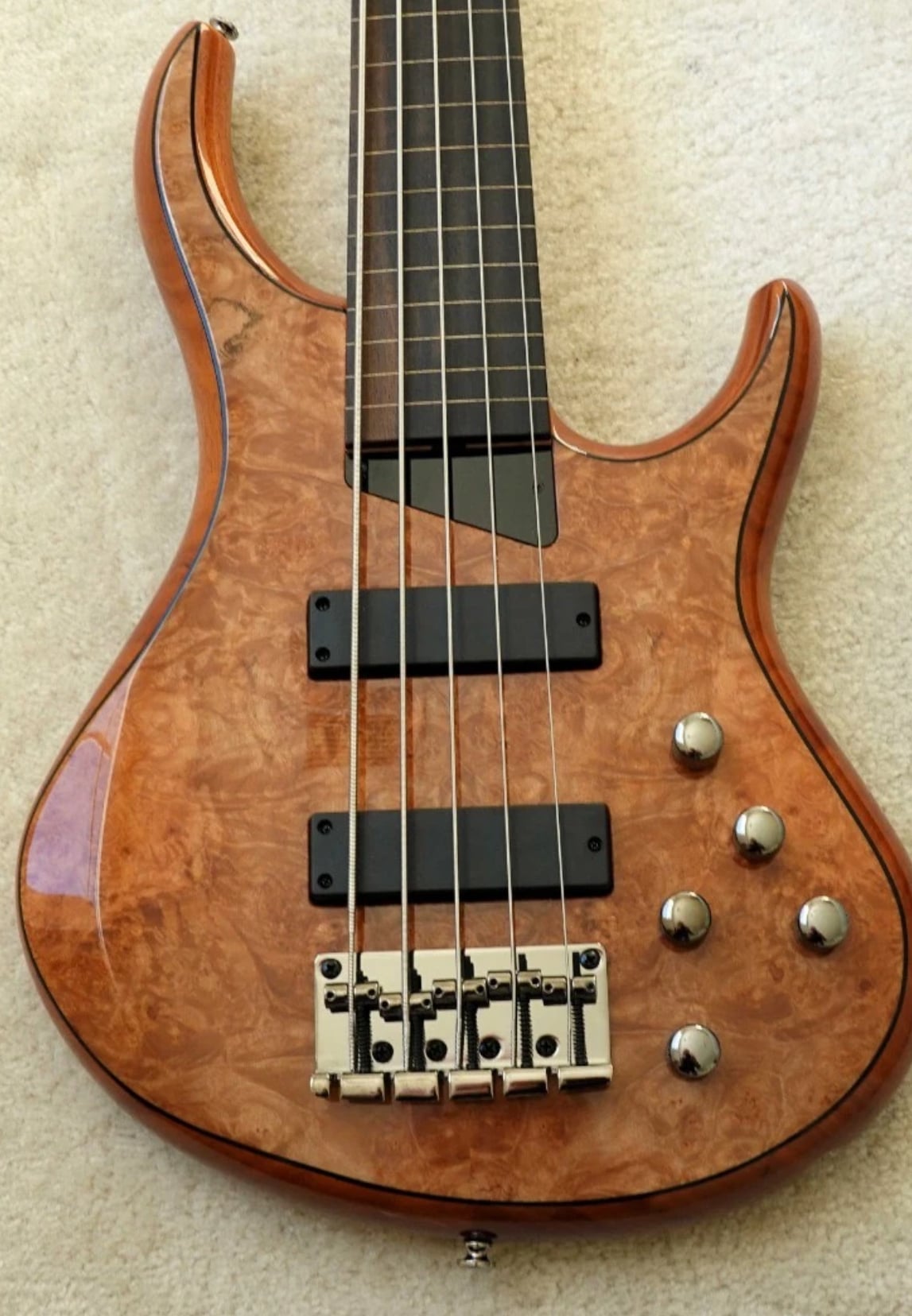
This is the MTD in question….
IMG_0130.jpeg

As you can see, the fingerboard appears dry, unpolished, and the fretlines aren't particularly crisp. I’m attempting to create a far more polished finish, and if prudent, dye the board to give it a more elegant look.

Any insights are appreciated on the most effective way to complete this.

NOTE: I only wish to dye the fingerboard face. I will be taping off the perimeter.

I look forward to any guidance you luthier guys can offer.
 
  • Like
Reactions: Hennob12

This stuff works pretty good. I used it on several fretboards.


This is a link from a thread on another similar product.
 
Replace the whole fingerboard if you want to do it right.

Another option may be dig out the maple veneer lines and use a darker veneer to fill the slots.

Depending on the thickness of the fingerboard and the depth of the fret slots, you might be able to plane the slots off the fingerboard.
I've never done that, but with a thicker fingerboard it should be possible. The only problem is if your fingerboard is radiused, it becomes a lot more challenging to pull off I would expect.

I'm skeptical that any dying is going to turn that white maple dark enough.
 
Replace the whole fingerboard if you want to do it right.

Another option may be dig out the maple veneer lines and use a darker veneer to fill the slots.

Depending on the thickness of the fingerboard and the depth of the fret slots, you might be able to plane the slots off the fingerboard.
I've never done that, but with a thicker fingerboard it should be possible. The only problem is if your fingerboard is radiused, it becomes a lot more challenging to pull off I would expect.

I'm skeptical that any dying is going to turn that white maple dark enough.
I don’t have the skillset to replace or put a saw to the board. I’m most interested in a stain/dye/polish sand approach. I know its likely the lines will still be visible after the board has been colored. Was hoping someone had experience with this type of project, and could speak to what dye they used, i.e. the leather dye I’d read of, or another coloring medium.
 
What kind of filler does MTD use in their fret slots? I googled a bit but could not find any references to their using fillers. That's seems odd to me, fillers are a bodge, not a fret-line solution, as fillers will typically not expand/contract the same as the wood in the slots. Most builders and manufacturers use wood lines or styrene, etc. Do you know for sure that they use filler, and if so, can you find out what kind is used? "Wood fillers" like those designed for the consumer market, typically can take some dye, but how much colour they take on varies.

Looking at colouring the board, I'd suggest dye rather than stain, as dye is thinner, penetrates deeper and delivers a more evenly coloured finish. That said, on a fretless, any colouring will wear off with use unless it's been coated. My preferred dye is aniline dye that I mix myself, but there are good commercially available dyes too, like Angelus, Fiebings, Transtint. They are just colorants though, so none are particularly durable under wear.

I imagine your best bet is just to try it and see how it goes. I'd suggest finish sanding your fingerboard to the sheen you want first, and then dying it. You may run into some challenges going up to such a high grit, as depending on circumstances, after around 1000 grit, you can start to burnish rather than sand. That can happen as low as 600 on some woods. Burnishing will close/seal the surface meaning that the dye does not penetrate as deeply.

If this were mine and I wanted it jet black and glossy, I'd dye the wood and do a CA coating on the board up to a high polish. That will certainly change the tone though, and it depends on what you like?

I don't have a nice solid suggestion for a workflow here though, mostly because the goal you're looking to achieve isn't usually arrived at through these methods. For a beautiful, solid, high-sheen ebony board, I'd personally replace the fingerboard. That would give the most professional OEM look.

One suggestion I will make though, is to post up your process here as you go through it. Give the hive mind an opportunity to weigh in with suggestions as to the next step as you go. There's a lot of good experience and willingness to help out here. I'd also advise checking into those who are weighing in before just assuming they know what they talk about - not everyone who posts in Luthier's Corner is a luthier. :smug:
 
  • Like
Reactions: 13ghosts
I’m reticent to use CA or other hard sealant. I’m familiar with, and embrace the burnished finish, I feel a very glossy highly polished board will provide the look/feel/sound I’m targeting. I may simply abandon the dye procedure as I do not want the color to have to be re-applied at a later time, and if you feel that would be the case, unless a sealant is applied, then I may just opt out.

I was told by MTD that the lines were comprised of wood filler, and expect they will sand in the same manner as the fingerboard itself.

I’ll be creating a post showing the process from start to finish, and welcome input. I will post the link to that post once the bass hits the bench, and the work is started.
 
I have used leather dye on wood (usually maple), sometimes with excellent results, other times less so. There are multiple types of "leather dye," include water, alcohol, and oil based. If you use the water type you should raise the grain with clean water and sand back before dying. I have not dyed ebony, because I liked the grain on my ebony board so I left it.

I don't think I would use a dye without a sealer after. That would invite the dye to rub off on fingers, strings, clothes, whatever. That also means confirming that the sealer is compatible with the dye.
 
  • Like
Reactions: Jazzdogg
If you search youtube for "ebonizing wood", the most common recommendations seem to be vinegaroon/iron acetate, india ink, and leather dye.

I've used vinegaroon+tea to darken a Pau Ferro fingerboard. It now looks more like dark rosewood than ebony, but I'm happy with it. I like that some grain is still visible and it still looks like wood. For pure black, I'd use India ink. In either case, oil will darken it further.
 
IMG_0140.jpeg

The fingerboard is much smoother than the ebay pix portrayed. I’m going to sand it further, then re-evaluate if i’m going to dye the wood. This thing is just pristine. I am shocked at the quality I’ve received for the price I've paid. Needed a setup badly. Would not play in tune with the intonation out to lunch , the action too high, and the nut cut for a fretted bass. Will start with some mechanical tweaks and the sand/polishing, and maybe some lighter wood knobs vs the metal OEM ones.Then we’ll decide what actions, if any are warranted. But yea, she’s very pretty.
 
  • Like
Reactions: MonetBass and TomB
Looks like a fairly thick fingerboard, a candidate to plane off the fret slots, perhaps?
I am very skeptical you're going to darken those veneers at all.
And if you do dye them, you need to protect it as well with at least an oil finish.
 
IMG_2345.jpeg

I am satisfied with the results if the burnish/Linseed oil work. Very pleased as a matter of fact. I am opting to not apply any color, and keep it just a burnish/polish sand job.
IMG_2347.jpeg

I have wood knobs arriving tomorrow. i found a set of Thomastik flats in the string box. And some straplock buttons and its gig ready.
IMG_2349.jpeg
 
If your goal is a "glossy, even colored plank of black", how about black dye, followed by black paint and a hard clearcoat? The dye will help if/when the finish starts to wear through.

@Experts - anything wrong with this?

Edit: It seems you've changed your mind about solid, glossy black, and I agree! I'd still like to hear from a pro or two about the paint option.
 
Last edited:
If your goal is a "glossy, even colored plank of black", how about black dye, followed by black paint and a hard clearcoat? The dye will help if/when the finish starts to wear through.

@Experts - anything wrong with this?

Edit: It seems you've changed your mind about solid, glossy black, and I agree! I'd still like to hear from a pro or two about the paint option.

I agree that pb9717 made the wise choice, to leave the color alone and polish it up. I think it looks great.

But if you really, really want high gloss opaque black, then you can paint the fingerboard with 2K polyurethane, in black.

The technique is to carefully sand the fingerboard to get it all perfectly trued up and level using that String Path stuff. I personally would saw the filler out of the slots and re-fill them with black-tinted epoxy. Sand the surface to 400 grit, no need to go crazy. Then mask it all up.

Make friends with a local auto body shop that has a good clean spray booth. Schedule it in when they are doing something in gloss black. Have them spray on maybe two thin coats of 2K poly, opaque black. Offer a tip if they can get it dead smooth with no dust or sags. Then you unmask it, feather the edges and do a light buffing.

That will be about as tough and wear-resistant as you can get with a coated fingerboard. And when it eventually does wear, level sand it again and take it back for a re-coat.

Far less work and hassle than coating with CA glue or epoxy.
 
If you search youtube for "ebonizing wood", the most common recommendations seem to be vinegaroon/iron acetate, india ink, and leather dye.

I've used vinegaroon+tea to darken a Pau Ferro fingerboard. It now looks more like dark rosewood than ebony, but I'm happy with it. I like that some grain is still visible and it still looks like wood. For pure black, I'd use India ink. In either case, oil will darken it further.
I’ve used vinegaroon / iron acetate to ebonize a walnut tailpiece. It looks very natural - black but with brown undertones, unlike say the black leather dye which has blue undertones. But it relies on a reaction with the tannins in the wood, so it only works on some woods.
 
IMG_0149.jpeg


Bass is completed and listed in the classifieds.

IMG_0162.jpeg


Thanks to all for the guidance. Erring on the side of caution was the right decision here. The OEM board was beautiful, and the bass, now sorted is ready to be enjoyed. The electrics are great as they Came, and now every other aspect to make this the best it can be has been completed.
 
I’ve used vinegaroon / iron acetate to ebonize a walnut tailpiece. It looks very natural - black but with brown undertones, unlike say the black leather dye which has blue undertones. But it relies on a reaction with the tannins in the wood, so it only works on some woods.
Right - vinegaroon has a stronger effect on woods with more tannin, like Walnut and Oak. You can also add tannin to wood to amplify the effect. I used tea. And we agree that it's a more natural look, if more subtle than other options.

To the OP: glad it worked out for you. Beautiful bass.