• TalkBass has been independent since 1998. Add your voice.
    Create a free account to reply to discussions, view embedded media, and browse with fewer display ads.
    Join freeLog in
    Want zero display ads or expanded classifieds tools? Compare plans.

Double Bass Ebony boards vs. Rosewood?

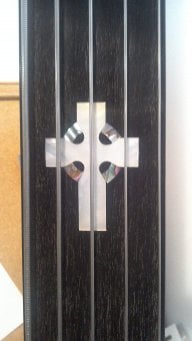
I am running out of fretboard at the end or another words it is getting to thin to replane again. I was thinking of getting a rosewood board and a rosewood tailpiece on my knilling 3/4 carved top. It has ebony now. What would be the big difference? I think it would look really good with the amber colored bass you know.

Thanks
 
supposedly rosewood is softer than ebony, and therefore doesn't make as good a fingerboard. But, I've played a couple of basses (both inexpensive) with them, and thought they played fairly well. I personally don't like the look of rosewood at all, it's just too brown. Also, nice polished ebony is smoother and imo, feels better. There are also other woods of various colors that are as hard and I believe even harder than ebony; might take a look into that.
 
Brazilian Rosewood has a very open and quick sound, whereas ebony damps out the highs. That's why they don't put ebony bridges on classical or flamenco guitars. There is probably a difference between pizz and arco, but a pizz bass has more punch and presence with rosewood fittings.

Jake
 
The general thinking in guitars and slab basses is that ebony is harder and denser, giving the instrument a more crisp, possibly sterile tone. Transfer that into DBs, and switching to rosewood should, if anything, give a more mellow, dull tone. It seems to me that for a fingerboard you want the densest, hardest material you can find. Traditionally, ebony fits that bill, and with its solid black appearance, is perfect for the application. These days, it seems to me that the graphite fingerboards are probably the ideal material, aside from the relative difficulty of working with them. Another option is stabilised and impregnated woods; in theory, you can take any wood you want and make it as hard or harder than the best ebony. I think that these "woods" along with graphite or other composites are going to be the future of DB fingerboards, particularly as ebony becomes more difficult to obtain and more expensive in top quality pieces.
 
I have a fingerboard ( no frets on a DB folks ;)) on one of my basses that is made of AAA grade gaboon ebony that has been impregnated and stabalized and it still wears, although very slowly. It has not been planed in the 2 years I've played it since I had it built. My Engle has a rosewood board and has been replained once in the last 1 1/2 years. Generally Ebony will give you a more crisp and focused sound, whereas rosewood is a little warmer and boomier, as it is a softer wood. As far as Electric basses go, composite fingerboards are not uncommon, and there is acompany now making "boards" from stone and getting good feedback on them, although they are susceptible to cracks if the bass is handled roughly.
 
I recently switched from rosewood to ebony on my East German bass. I don't feel that I can compare the sound because many other changes were made at the same time. What I can say is that the fingerboard takes some getting used to in terms of feel. The new ebony feels a bit like playing on a skating rink, very slick compared to the old rosewood. Since I am playing with very low action, I notice the difference with the fingers of both hands and sometimes it has actually required more of an adjustment with my plucking hand than with my stopping hand. Of course every piece of wood and everyone's playing style and skill is different so YMMV.

Peace,
S
 
My M1 Kay had an original rosewood board. It was replaced by a #2 grade ebony.Much better. The biggest difference is rose wood has a lot of oils and resins in it. My fingers wanted to stick to it. It is also less dense and absorbs more sound.I think the resin is why rosewood is a better board for fretted instuments.
 
Hey I know this is probably old news, I've been doing it for years on electrics but it works wonderfully on rosewood bass fingerboards as well.

Get some horn valve oil from the local music shop and spread it over the fingerboard loosely and on a level surface. It takes about 24 hours to soak in so you'll be out of commission during that period but it is well worth it if you want to "harden" the feel of a rosewood board. Depending how dry the board itself is, it may take a couple sessions of this. Be sure to put a real thick layer on, you'll be surprised how much the rosewood will soak up.

After oil stops soaking in, just wipe off the excess and let it dry. I can't speak to the origin of this advice but I've used it with a good degree of success. In the electric world, it makes the fretboard feel more like a hard maple board. For upright I've noticed it makes the board feel a little more uniform, like ebony, but with all the warmth you know and love from rosewood.
 

Latest posts