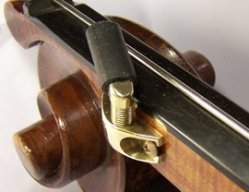
I'm not exactly sure what "wrong path" Bob is concerned about here, although I can guess. The study implicitly suggests -- but does not state outright -- that its findings might be generalizable to all basses. The author has no basis for such a claim, whether he intended to make it or not. His study doesn't examine variation across basses -- that's obvious and straightforward. So no generalizability for him -- Brown simply didn't design himself a platform from which to talk about "all adjusters, all basses".
But Brown wasn't completely wasting his time, and you won't waste yours either if you have an interest in the topic and an interest in science. I thought his measurement concepts and work were quite solid. Additionally, the study's design to control variation within that single bass were definitely adequate. Absolutely a passing grade, but marks deducted for appearing to go farther with conclusions than the design allowed.
Bob, I hope I'm not off-base summarizing your point as, "based on my experience, adjusters can make a tonal difference but the effects vary widely across basses and there is no predicting the effect of a given adjuster on a given bass." That seems completely reasonable and realistic. The idea that somebody might want to empirically test that wisdom -- or any finding or claim or experience having to do with the sound of our basses, not just stuff about adjusters -- also seems to me to be completely reasonable, valid and interesting. I'd read any further studies and so would a lot of folks on this board; there's definitely interest in the topic. Some people might say it's impossible to study this stuff empirically but my research background (social science and medical -- not acoustics or materials or anything directly relevant) tells me that isn't true at all. It's just a matter of effort and thus resources.
I posted the link for the purpose of general information. I guess my posting it gives the impression of authorizing everything (or anything) about it -- I hadn't considered that and it was a surprise to me. I reject completely, though, the idea that it might have been wrong or a waste of time to post the link. The study is relevant to the thread topic, that's all, especially to folks who are merely interested in the topic and not necessarily looking for or needing guidance from their luthier. The study is what it is; the followup conversation and peer review are what they are. We know more with both of those things than we did without them. But that's opinion number one again.